

 By
By Picture a word so small it fits in a text message, yet powerful enough to move stock markets, topple Supreme Court cases, and make your new washing machine cost like a small vacation. That word is tariff — a tax slapped on imported goods at the border, paid not by some faceless foreign government (sorry to disappoint) but by the domestic company that imports the product, which then usually passes the cost straight to you.
Is a tariff your economy’s loyal bodyguard, standing at the border turning away cheap foreign competition to protect your factories and your paycheck? Or is it a moody ex who shows up uninvited, breaks your grocery budget, and leaves you arguing with your neighbor (hi, Canada) about who started it? As of September 2026, after a year that included a Supreme Court smackdown, a tariff rewrite, and a retaliation tit-for-tat with Ottawa, the honest answer is: it depends who’s holding the invoice. Let’s dig in — with receipts, not vibes.
The 5-Second Takeaway
- A tariff is a tax on imports, and despite what politicians imply, the exporting country almost never pays it directly — importers and, eventually, consumers do.
- Tariffs can genuinely rebuild strategic industries and raise real government revenue, but the trade-offs show up in your grocery bill and GDP.
- History already ran this experiment in 1930 with the Smoot-Hawley Tariff Act, and the results were not a highlight reel.
- In 2026, the U.S. Supreme Court ruled that a huge chunk of tariff authority didn’t even legally exist — a plot twist nobody saw coming.
- The real answer to “friend or foe” isn’t a coin flip; it’s a matter of dosage, duration, and who’s sitting at the negotiating table.
1. What Exactly Is a Tariff, and Why Does Everyone Suddenly Have an Opinion About It?
Before 2025, a tariff was the kind of word that lived quietly in economics textbooks, bothering no one. Now it’s dinner-table conversation, dinner-table arguments, and occasionally the reason dinner costs more. Let’s actually define the thing properly before we let it ruin any more group chats.
A. The One-Sentence Definition on Tariff
A tariff is simply a tax a government charges on goods coming in from another country. That’s it. No secret sauce, no international conspiracy — just a customs fee collected the moment a shipping container crosses the border. Governments have used tariffs for centuries to raise money, protect local industries, or occasionally throw a geopolitical tantrum. The twist in 2025 and 2026 is less about the concept and more about the sheer scale, speed, and legal chaos with which tariffs have been deployed — turning a dusty policy tool into a genuine cultural moment.
B. A Tariff’s Family Tree: Older Than Your Grandparents’ Complaints About the Economy
Tariffs are basically the original tax — nations have leaned on import duties since before income tax existed, because taxing goods at a port is a lot easier than tracking every citizen’s paycheck. The most infamous chapter in American tariff history is the Smoot-Hawley Tariff Act of 1930, when Congress raised duties on over 20,000 imported goods, pushing average tariff rates toward the 50% range.
It was billed as a rescue plan for struggling farmers and factories during the early Great Depression. Instead, it triggered swift retaliation from roughly two dozen countries, and U.S. exports collapsed from about $7 billion in 1929 to $2.5 billion by 1932 — a fall of more than 60%. Most economists don’t blame Smoot-Hawley for causing the Great Depression, but nearly all agree it poured gasoline on a fire that was already burning. Consider it tariff policy’s original cautionary tale — the “don’t text your ex at 2 a.m.” of trade economics.
C. Who Actually Pays the Bill?
Here’s the plot twist that campaign speeches conveniently skip: when a tariff is announced on, say, Chinese steel or Canadian lumber, the check isn’t cut by the Chinese or Canadian government. It’s cut by the American company importing that steel or lumber — and that company almost always passes some or all of that cost down the chain until it lands, gift-wrapped, on your receipt.
Economic modeling from the Yale Budget Lab estimates that current U.S. tariff policy could raise the average household’s costs by roughly $760 to $940 a year if temporary measures expire on schedule — or as much as $1,200 to $1,500 annually if those tariffs become permanent. So next time someone says “the other country pays,” you can smile knowingly, the way you smile when a toddler insists the dog ate the last cookie.
And the pain isn’t spread evenly, either. Research from Equitable Growth found that retail importers have been paying meaningfully higher estimated tariff rates than domestic manufacturers, meaning the store shelf gets hit harder than the factory floor. Translation: your neighborhood retailer is quietly absorbing a bigger tariff bruise than the industrial giant a tariff was supposedly designed to protect — proof that even taxes have favorites.
Also Read – How Global Supply Chains Work: The Complete Guide
2. The Case for Tariffs as Your Economy’s Bodyguard: The “Friend” Argument
Every villain thinks they’re the hero of their own story, and tariffs are no different. There’s a genuinely serious case to be made that, used wisely, tariffs protect the things a nation can’t afford to lose.
A. National Security: Because Outsourcing Your Own Spine Is a Bad Look
Imagine relying on a rival country to manufacture the semiconductors that run your fighter jets, hospitals, and smartphones. Uncomfortable, right? That discomfort is exactly why tariffs on strategic sectors — semiconductors, pharmaceuticals, critical minerals, defense components — have bipartisan appeal even among people who otherwise can’t agree on pizza toppings.

Analysts note that tax incentives, tariffs, and direct government investment are jointly fueling a new wave of U.S. industrial investment in exactly these sectors, framed explicitly around supply-chain resilience and national security rather than pure economics. It’s less “we hate cheap imports” and more “we’d rather not have our life-support systems built by someone who might one day stop returning our calls.
B. Reshoring Jobs: The Promised Land That’s Taking Forever to Reach
The pitch is seductive: slap tariffs on foreign goods, and factories come roaring back to American soil, along with millions of good-paying jobs. And to be fair, there are real, chunky headline numbers — GlobalFoundries has committed roughly $16 billion to reshoring chip manufacturing, and Stellantis unveiled a multi-billion-dollar U.S. production expansion.
Investment announcements are up, trade deficits with some partners are shrinking, and executives everywhere are suddenly very fond of the word “resilience” in earnings calls. But — and this is the sarcastic-storyteller “but” — nearly 400,000 to 450,000 U.S. manufacturing jobs currently sit unfilled, and one industry forecast projects a shortfall of over two million manufacturing workers by 2030. Tariffs can summon the intention to reshore a factory; they cannot summon the trained welder to staff it.
In equipment manufacturing alone, more than 85,000 positions currently sit open, and industry surveys find that while a large majority of manufacturers say they’re actively reshoring or expanding domestic capacity, only a small fraction have actually finished the job. It’s less “the jobs are coming home” and more “the jobs bought a plane ticket home and got stuck at a layover called workforce shortage.”
C. Revenue Without a Vote: Uncle Sam’s Favorite Side Hustle
Whatever else you think of tariffs, they are unambiguously a moneymaker for the federal government — and one that doesn’t require the political theater of raising income tax. Tariff-related revenue is projected to bring in over $100 billion in a single year, and independent tax-policy estimates put the ten-year haul in the range of $1 trillion to $1.7 trillion, depending on how long current measures stay in place.
That’s not pocket change; that’s the kind of number that gets its own line in budget speeches. Of course, revenue collected from a tax that shrinks the broader economy is a bit like getting a big raise the same month your rent doubles — technically you have more money, but ask your accountant how thrilled to be about it. Independent modeling suggests the negative growth effects of tariffs can claw back hundreds of billions of dollars from that projected revenue haul over a decade, which is the fiscal equivalent of finding a great deal on a couch and then paying a fortune to have it delivered.
Also Read – The Silver Rush: Powering a Global Revolution
3. The Case for Tariffs as an Expensive Ex: The “Foe” Argument
Now for the other side of the breakup, because every relationship column needs balance, and tariffs have absolutely earned some receipts of their own.
A. The Smoot-Hawley Hangover: History Already Wrote the Warning Label
We already met Smoot-Hawley above, but it deserves a second visit here because history has a habit of rhyming when nobody’s paying attention. A wall of tariffs meant to shield American industry instead triggered global retaliation, gutted export markets, and became a textbook example of protectionism backfiring spectacularly. Modern economists are careful not to draw a straight line from 1930 to 2026 — the global economy today is a very different animal — but the core lesson holds up disturbingly well: when one country builds a tariff wall, trading partners tend to build one right back, and everybody ends up a little poorer for the construction costs.
B. Your Grocery Bill’s New Best Frenemy: Inflation
Tariffs function like a tax that arrives disguised as a price tag, and that disguise doesn’t fool your bank account. The IMF has estimated that a broad 10% increase in U.S. tariffs, combined with retaliation from major trading partners, could shave roughly 1% off U.S. GDP and about 0.5% off global GDP.
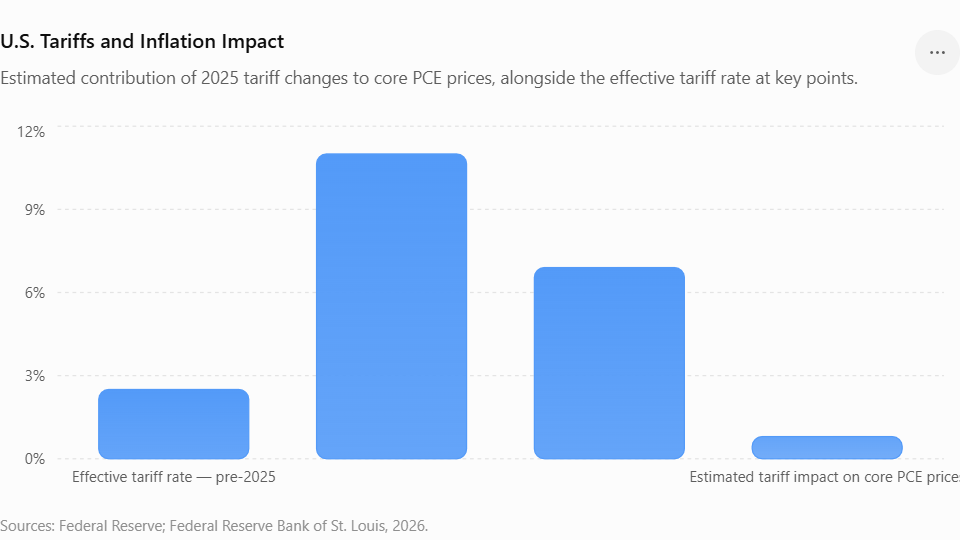
Separately, projections suggest current tariff policy could permanently shrink long-run U.S. GDP by around 0.1% to 0.4%, trim the capital stock, and cost hundreds of thousands of full-time-equivalent jobs. On a brighter note, the effective tariff rate paid on U.S. imports actually fell from a peak of about 11% in late 2025 to just below 7% by May 2026, as court rulings and new trade agreements chipped away at the broadest measures — proof that even a chaotic trade policy can occasionally sober up.
C. The Legal Rollercoaster: When the Supreme Court Says “Actually, No”
If 2025 was the year tariffs went viral, 2026 was the year the legal system asked to see their paperwork. On February 20, 2026, the U.S. Supreme Court ruled 6-3 in Learning Resources v. Trump that the International Emergency Economic Powers Act never actually authorized the president to impose sweeping tariffs in the first place — a foundational law the administration had leaned on for many of its most aggressive measures.
The ruling didn’t just end those specific tariffs; it opened the door to potentially $175 billion in refunds and forced a scramble to replace lost revenue through other legal channels, including Section 122 and Section 301 authorities, some of which now require congressional renewal every 150 days. Meanwhile, trading partners haven’t just watched from the sidelines: Canada announced dollar-for-dollar retaliatory tariffs on roughly $20 billion of U.S. goods, set to take effect September 8, 2026, covering everything from wood products to kitchen cabinets. Nothing says “complicated relationship” quite like a policy that can get legally annulled and diplomatically punched back within the same calendar year.
Also Read – U.S. National Debt: A Ticking Time Bomb
4. The Verdict: So, Is a Tariff Friend or Foe?
Honestly? A tariff is neither your best friend nor your sworn enemy — it’s more like caffeine. A little, used strategically, can sharpen focus, protect something genuinely important, and fund real priorities. Too much, applied indiscriminately, and you’re jittery, broke, and picking a fight with your neighbor over lumber prices.
The countries and companies that come out ahead in the tariff era aren’t the ones shouting the loudest about protectionism or free trade — they’re the ones reading the fine print, watching the courtrooms as closely as the trading floors, and building supply chains resilient enough to survive whichever direction the policy winds blow next.
For the average household, the practical takeaway is less ideological and more logistical: tariffs are now a semi-permanent variable in your budget, the way gas prices or interest rates are. You don’t have to pick a side in the friend-or-foe debate to notice that the price tag on a new car, a sofa, or a pair of sneakers now carries a little extra passenger riding along for the trip.
Businesses have responded the way humans do to any unpredictable relationship — some are diversifying their supplier lists like someone finally updating their group chat after a bad breakup, others are absorbing costs and hoping the policy mood swings back, and a few are betting big on U.S. factories and praying the workforce shows up in time. Whichever camp you fall into, one thing is certain: this particular economic frenemy isn’t leaving the group chat anytime soon, and it’s worth understanding the relationship before you get blindsided by the next price hike.
What is your opinion on this ? Comment Below…
5. Frequently Asked Questions
Does the exporting country pay the tariff?
Do tariffs actually bring manufacturing jobs back?
Are tariffs currently legal in the United States?
Do tariffs cause inflation?
Have tariffs like this happened before in U.S. history?
Who really decides whether a tariff stays or goes?
If you reached this “Congratulations” , You are the top 10% reader in Strategicworld360. I have a present for you . Please Subscribe to get the free gift.
