


 By
By Picture the scene the world sees. A U.S. carrier strike group cutting through open water. Wall Street lit up at 4 p.m., digesting another trillion-dollar trading day. Silicon Valley shipping the software that runs half the planet. The dollar sitting in nearly every central bank vault on earth, the default unit of global trade whether you’re buying oil in Riyadh or coffee in Bogotá. This is the version of America the world is shown, and it is not fake. It is real power, built over eighty years.
But walk past the cameras and into a quieter room, and you’ll find something less cinematic: a Treasury auction. Every week, without fanfare, the U.S. government asks investors around the world to lend it more money — and every week, they mostly say yes. That “yes” is the actual engine underneath everything else. Not gold, not oil, not aircraft carriers. Trust. The world keeps buying American debt because it believes America will keep paying it back, on time, in dollars that still mean something.
Here is the uncomfortable question nobody in Washington wants to sit with: what happens when that trust starts costing more than it used to? Because it already is. The U.S. isn’t broke. It isn’t close to broke. But it is borrowing on a scale and at a pace that raises a question every empire eventually has to answer — how long can the world’s largest economy keep spending more than it earns before the bill starts changing its behavior?
That’s what this article is really about. Not panic. Not doom. A hard look at the trajectory.
Five Things You’ll Understand By the End of This Article
- America’s debt doesn’t work like your debt. A country that borrows in its own currency, controls its own central bank, and prints the world’s reserve currency plays by different rules than a household with a credit card bill.
- Interest is the silent killer. Debt payments that once looked like background noise are now one of the largest line items in the federal budget — and they crowd out everything else.
- The dollar is America’s superpower. Extraordinary global demand for Treasury bonds is the only reason America can borrow this much this cheaply. That demand is a privilege, not a guarantee.
- Flexibility is what’s really at stake. The danger isn’t sudden collapse — it’s a slow loss of room to maneuver in the next war, recession, or emergency.
- Someone always pays the bill. Whether through higher taxes, thinner services, higher interest rates, or a weaker dollar, rising debt doesn’t disappear. It gets passed forward.
1. America’s Debt Isn’t Like Your Debt — And That’s Exactly the Problem
Let’s get the definition out of the way, because it matters. The U.S. national debt is the accumulated total of everything the federal government has borrowed and not yet repaid — the sum of every annual deficit stacked on top of the last, now sitting at roughly $39.9 trillion, with about $32 trillion of that held by outside investors and the rest owed internally between government accounts. That is the answer to “what is the U.S. national debt” in one sentence. Everything else in this article is about why that number keeps climbing and what it costs to let it.
A. Why America Can Borrow More Than Almost Anyone Else
Here’s a thing that annoys people when they first hear it: America’s debt is not evaluated the way a family’s debt is evaluated, and pretending otherwise makes you sound informed while actually missing the point entirely. A household borrows in a currency it doesn’t control, has a finite earning life, and eventually has to pay everything back or default. The U.S. government borrows in dollars it can issue, backs that borrowing with the largest economy on the planet, and gets to roll debt forward indefinitely as long as lenders keep showing up.
That’s not a loophole. It’s the actual architecture of reserve-currency borrowing power, and it’s why comparisons to your credit card statement are almost always lazy. But — and this is the part that gets left out — the fact that America can borrow more than anyone else doesn’t mean it should borrow without limit. Extraordinary capacity is not the same thing as infinite capacity. That distinction is where this entire debate actually lives.
B. The Debt Is Not the Problem — The Trajectory Is
You’ll hear people wave around the $39 trillion figure like it settles the argument. It doesn’t. A $39 trillion debt attached to a $30 trillion economy that’s shrinking the gap every year is a completely different story than the same number attached to an economy where the gap is widening. What matters isn’t the size of the number. It’s the direction.
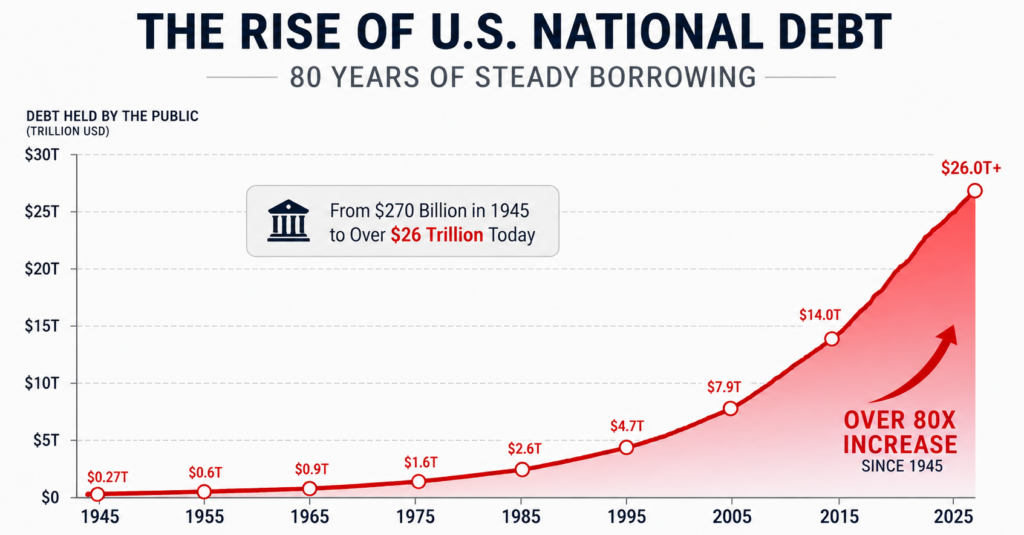
Sources: U.S. Department of the Treasury, Fiscal Data — Historical Debt Outstanding;
Federal Reserve Bank of St. Louis (FRED), Gross Federal Debt Held by the Public.
And the direction is not good. Debt held by the public has climbed from around 35% of GDP in the mid-2000s to roughly 100% of GDP today, and under current law the Congressional Budget Office projects it will keep climbing to about 120% of GDP within a decade — a level the country has never sustained outside the immediate aftermath of World War II. That’s the real headline. Not “debt is high.” Debt is high and accelerating, with no policy currently in place to slow it down.
C. When Borrowing Becomes a Permanent Habit
Somewhere in the last few decades, deficit spending stopped being an emergency tool and became a governing style. Recession? Borrow. Pandemic? Borrow. Tax cuts without matching spending cuts? Borrow. Spending increases without matching revenue? Borrow. War, peace, boom, bust — the deficit shows up every single year regardless of the weather.
This is the opinion at the center of this piece, and it’s worth stating plainly: America’s real debt problem isn’t that Washington borrows money. It’s that borrowing has become politically easier than confronting the structural gap between what the government promises its citizens and what it actually collects from them in taxes. Every Congress since the early 2000s has found it simpler to push that reckoning onto the next one. Eventually, “the next Congress” runs out of runway.
Also Read – Globalisation: Unlocking A More Connected World
2. The Hidden Danger Inside the National Debt
This is where the story stops being abstract and starts showing up in the federal budget itself.
A. The Interest Trap: When Debt Starts Paying for Debt
Here’s a sentence that should get more attention than it does: in fiscal year 2026, the U.S. government is on pace to spend more on interest payments — over $1 trillion — than it spends on national defense. Net interest costs have nearly tripled over the past five years as both the debt pile and interest rates have risen together, and CBO projects that bill will roughly double again, to about $2.1 trillion a year, within the next decade. Interest is now consuming somewhere around 14% of every dollar the government spends, on a path toward closer to 19% by the mid-2030s.
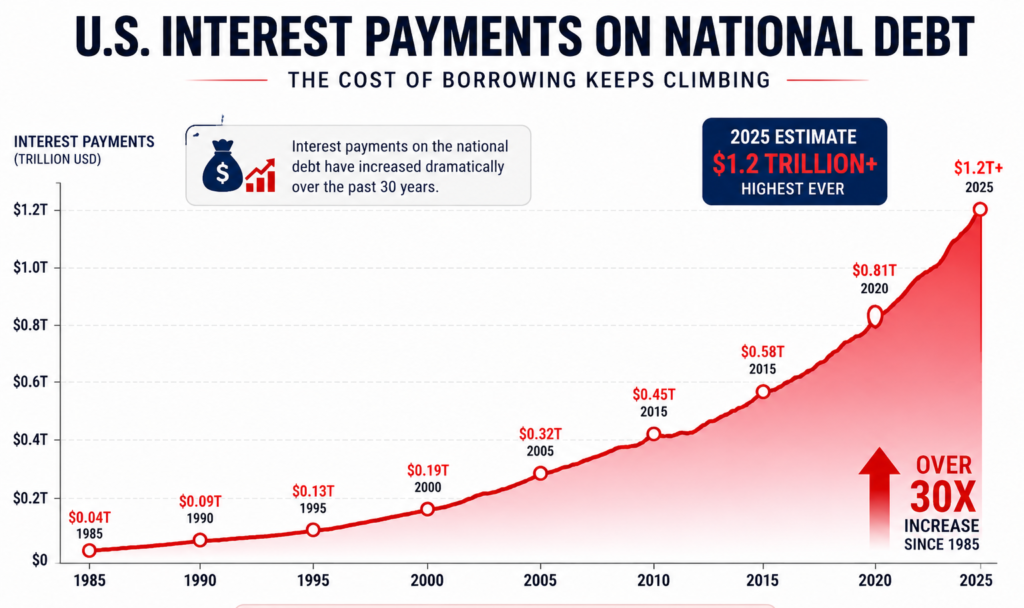
Sources – FRED — Federal Outlays: Interest (FYOINT)
That’s the interest trap, and it’s worth defining clearly because it’s one of the most misunderstood mechanics in the entire debate: the U.S. national debt becomes dangerous not simply when it becomes large, but when interest costs and persistent deficits begin consuming the government’s ability to respond to future economic crises. Once a growing share of the budget exists purely to service yesterday’s borrowing, that money can no longer fund anything else — not defense, not infrastructure, not the next recession’s stimulus package. Debt starts paying for debt, and the country pays the vig.
B. The Cost That Crowds Out America’s Future
Every dollar spent on interest is a dollar that isn’t spent building anything. It isn’t funding a bridge, training a workforce, or backstopping a bank run. It’s just… rent, paid on decisions made years ago. Economists call this “crowding out” — when government borrowing competes with private investment for the same pool of capital, pushing up the cost of capital for everyone else in the process.
Layer onto that the demographic wave already breaking: Social Security’s primary trust fund is projected to be exhausted by the early 2030s, and Medicare faces similar pressure as the baby boom generation ages fully into retirement. Mandatory spending on these programs, combined with interest, is on track to consume a rising share of the federal budget almost automatically — no vote required, no new legislation needed. That’s not a hypothetical future crisis. That’s the current law, doing exactly what it’s written to do.
C. Why the World’s Confidence Cannot Be Taken for Granted
Roughly a quarter of U.S. debt held by the public sits with foreign investors — Japan and the United Kingdom lead the list, with China’s holdings well below their 2013 peak as Beijing quietly diversifies away from Treasuries. The rest sits with the Federal Reserve, U.S. banks, pension funds, mutual funds, and everyday retirement accounts. That broad base of buyers is a genuine strength. It means no single country can hold America hostage by threatening to dump its Treasuries.
But broad demand is not the same as unconditional demand. Every Treasury auction is, in effect, a confidence vote. Foreign central banks and private investors buy U.S. debt because it’s the safest, most liquid asset on the planet — not because they’re obligated to. That confidence has never been seriously tested. It doesn’t have to collapse to matter; it only has to soften at the margins for borrowing costs to climb, and rising average interest rates on a $39 trillion debt pile turn small shifts in sentiment into very large dollar figures very quickly.
Also Read – Global Stock Markets: Trends, Risks & Opportunities 2026
3. What Happens If the Debt Bomb Keeps Ticking
This is the part worth sitting with, because the honest answer is less dramatic than the headlines and more serious than the reassurances.
A. What Happens If America Keeps Borrowing?
Let’s be precise about the distinction that gets blurred constantly in this conversation. “America is going bankrupt” is not a serious prediction — a country that borrows in its own currency and controls its own printing press does not default the way a corporation does. “America is gradually losing fiscal room to maneuver” is a far more realistic description of where this trajectory leads, and it’s the one that deserves your attention.
Losing fiscal room means this: the next time a real crisis hits — a war, a pandemic, a financial panic — the government’s ability to respond with the kind of aggressive borrowing that stabilized the economy in 2008 and 2020 will be more constrained, not less. Rates will already be higher. The debt base will already be bigger. The political tolerance for “just borrow more” will already be thinner. That’s not collapse. It’s something closer to arriving at the next emergency with less ammunition than last time.
B. The Dollar, Inflation and America’s Global Power
The dollar’s dominance and America’s debt are tied together more tightly than most people realize. The willingness of the world to hold dollars and dollar-denominated Treasuries is precisely what lets America run deficits that would sink almost any other country. If that willingness ever erodes meaningfully — not overnight, but over years, as alternatives slowly gain credibility — the cost shows up as higher borrowing rates, a weaker currency, and imported inflation, all landing on ordinary households through pricier imports and a higher cost of financing everything from mortgages to small-business loans.
Geopolitically, debt is leverage in reverse. A country that needs the world’s continued confidence to fund its own government has less room to project unilateral power than one that doesn’t. Every dollar of debt is, in a small way, a dollar of independence quietly traded away.
C. The Debt Bill Will Eventually Reach Someone
It always does. Historically, governments close fiscal gaps through some combination of higher taxes, reduced spending, faster growth, or — the option nobody says out loud — inflation, which erodes the real value of debt at the expense of savers and fixed-income retirees. None of these are painless. All of them are political poison, which is exactly why none has been seriously attempted at the scale the math requires.
Younger generations are the default recipients of whichever option gets chosen last, by default, when the choice can no longer be postponed. That’s the quiet injustice sitting underneath this entire debate: the spending happens now, the borrowing happens now, the political credit gets claimed now — and the bill gets mailed to people who weren’t in the room when the decisions were made.
4. The Solutions…
A. Cut the Structural Deficit Without Breaking America
America doesn’t need to erase its debt overnight. Nobody serious is asking for that, and anyone who tells you otherwise is selling a fantasy. What it needs is far more achievable and far less discussed: stop the debt from growing faster than the economy that has to carry it, indefinitely, on autopilot.
I. Reform Entitlement Spending
There’s no honest version of this conversation that skips Social Security and Medicare. They’re not the villains of the story — they’re the largest and fastest-growing drivers of future debt, and pretending otherwise is how Washington has avoided this fight for thirty years. Gradual, telegraphed changes — means-testing benefits for higher-income retirees, adjusting retirement-age rules for future workers rather than current ones, shoring up payroll-tax revenue, and wringing waste out of federal healthcare spending — could bend the curve without breaking promises to anyone already depending on the system. The longer reform waits, the more brutal the eventual math gets.
II. Stop Wasteful and Unproductive Spending
Fiscal discipline shouldn’t start with defense, infrastructure, or programs that actually build American capacity — it should start with spending that survives purely because no politician wants the headline for cutting it. The real work is separating investment from inertia: money that grows the economy versus money that just keeps flowing because challenging it is politically inconvenient.
B. Increase Revenue and Make the Economy Grow Faster
Spending cuts alone can’t close a gap this size, and pretending they can is its own kind of dishonesty.
I. Close Tax Loopholes and Strengthen Revenue
Tightening inefficient tax preferences and improving enforcement can raise real money without punishing the investment and entrepreneurship that actually grow the tax base. The objective should not be to tax America into prosperity; it should be to build a tax system capable of supporting the government Americans have actually chosen to build.
II. Make Economic Growth a Debt Strategy
A faster-growing economy shrinks debt as a share of GDP even without touching the debt itself. Investment in technology, energy production, infrastructure, manufacturing, and workforce skills is one of America’s most powerful weapons against debt — but growth is a force multiplier, not a substitute, for fiscal discipline.
C. Stop Treating Borrowing as a Permanent Solution
I. Create a Long-Term Fiscal Rule
Washington needs a credible 10-to-20-year debt strategy, not another short-term patch job. Every major tax cut or spending increase should come with a real financing plan attached. The country isn’t short on economic tools to fix this — it’s short on the political will to use them.
II. Protect the Dollar’s Global Advantage
The dollar’s global role is what makes America’s entire borrowing model possible. That advantage should be treated as something to protect through credible institutions and sustainable policy — not as a blank check to borrow forever.
America does not need to become debt-free. It needs to become debt-disciplined. The ticking clock can still be stopped — but only if Washington chooses difficult decisions today instead of leaving an even larger bill for tomorrow.
4. Frequently Asked Questions
What is the U.S. national debt?
The U.S. national debt is the total amount the federal government owes from years of spending more than it collects in tax revenue. It currently stands at roughly $39.9 trillion, split between debt held by outside investors (around $32 trillion) and debt owed between government accounts. Each year’s federal budget deficit adds directly to this running total, which is why the number has grown steadily for decades.
Why is the U.S. national debt so high?
Decades of deficit spending — tax cuts without matching spending cuts, wars, recessions, a pandemic, and rising entitlement costs — have compounded year after year. Revenue has consistently fallen short of spending, and rather than closing that gap through politically painful tax or spending decisions, Congress has repeatedly chosen to borrow instead, letting the debt absorb the difference.
Who owns U.S. national debt?
Most U.S. debt is owned domestically — by the Federal Reserve, banks, pension funds, mutual funds, and everyday retirement accounts. Foreign investors hold roughly a quarter of debt held by the public, led by Japan and the United Kingdom, with China’s share well below its 2013 peak. No single foreign holder controls enough to dictate U.S. policy.
What happens if U.S. debt keeps increasing?
Interest costs consume a growing share of the federal budget, crowding out spending on defense, infrastructure, and future emergencies. Borrowing costs can rise, the dollar can weaken, and the government’s flexibility to respond to the next recession or crisis shrinks. It’s not sudden collapse — it’s a gradual erosion of fiscal room to maneuver.
Can the United States ever pay off its national debt?
Realistically, no — and it doesn’t need to. Countries manage debt relative to the size of their economy rather than paying it off entirely. The meaningful goal isn’t zero debt; it’s stabilizing debt as a share of GDP through higher growth, spending discipline, or revenue changes, so the trajectory stops climbing faster than the economy that has to support it.
Is America’s Debt Really a Ticking Time Bomb?
Here’s the nuanced, still-strongly-held answer: no, and yes.
No, America is not on the verge of collapse. Its economy is too large, its financial markets too deep, and the dollar too entrenched for any sudden implosion scenario to be taken seriously. Anyone predicting imminent default or currency collapse is selling fear, not analysis.
But yes, in the sense that matters most: the trajectory is unsustainable, the interest bill is compounding, and every year of inaction narrows the country’s options for the next real crisis. That’s the “ticking” part. Not a countdown to a single explosive moment, but a slow tightening of the space America has to maneuver — fiscally, economically, and geopolitically — while the people currently in charge keep betting that the reckoning lands on someone else’s watch.
It will land eventually. The only open question is who’s holding the country’s finances when it does — and how much room they’ll have left to respond. The generation inheriting that answer isn’t in the room where these decisions get made. It should be.
What do you think? Comment below …
