

 By
By Picture a general in any era, staring at a map of North America, ordered to plan an invasion — not a raid, not a missile strike, but the kind that ends with an occupying army telling farmers in Kansas who is now in charge.
The first problem isn’t finding an army large enough. It’s crossing three thousand miles of open Atlantic, or six thousand miles of open Pacific, without the fleet being spotted, tracked, and destroyed before it ever reaches the beach. Nazi Germany actually tried to solve this problem for real: the Amerikabomber program spent years attempting to design a long-range bomber capable of reaching New York and returning, and it never advanced past prototypes before the war ended, without a single attack reaching the American mainland.
That failure wasn’t a failure of German engineering. It was a failure of geography. Every serious planner who has run the numbers on invading the continental United States has hit the same wall: the ocean has to be crossed before anything else can happen, and no one has ever crossed it in force. That is the real foundation of American power. Not the aircraft carriers. Not the nuclear arsenal. The land and water it happens to occupy. Military power is what America built. Geography is a large part of why it could build it undisturbed.
Key Takeaways…
- Two oceans and weak neighbors gave the U.S. a level of geographic isolation historically rare enough that no adversary has ever completed a serious invasion of the mainland.
- Continental depth means an invader would need to control a landmass drained by the Mississippi-Missouri river system alone, which touches 31 states — a logistics problem no army has solved.
- Farmland, freshwater, and domestic energy reserves turned geography into food security and industrial capacity before the military ever benefited from any of it.
- Geography is why America could build overwhelming force, not the source of the force itself — the Pentagon sits downstream of the map, not upstream.
- Missiles and cyberweapons have compressed the protective value of distance, but occupying territory still requires crossing it, and that part hasn’t changed.
1. America’s Geography: The Strategic Advantage Hidden in Plain Sight
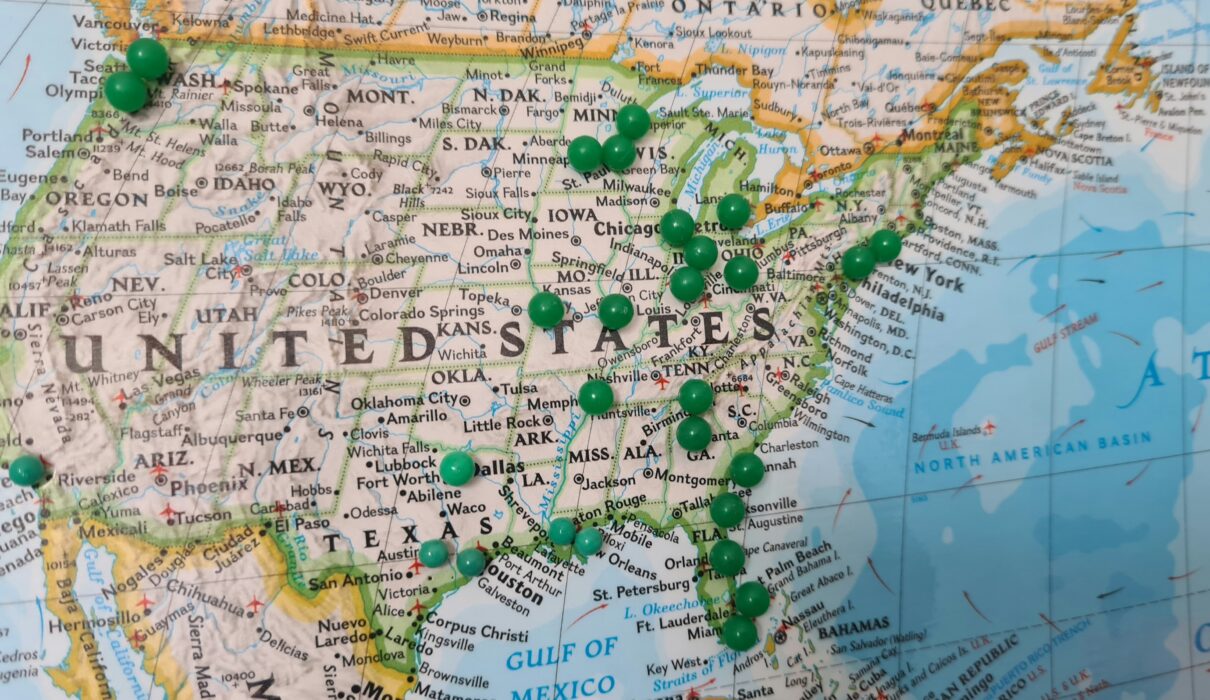
The conventional case for American power starts with hardware — carriers, satellites, the defense budget. That gets the causation backwards. Start instead with the fact that the United States sits between two oceans, and ask what that actually does for a country, rather than treating it as a postcard detail.
Poland offers the clean contrast. Sitting on the North European Plain with no mountain range, river barrier, or ocean to hide behind, Poland was invaded and partitioned repeatedly across the eighteenth, nineteenth, and twentieth centuries — not because Polish soldiers or strategists were inferior, but because the terrain gave every neighbor a highway.
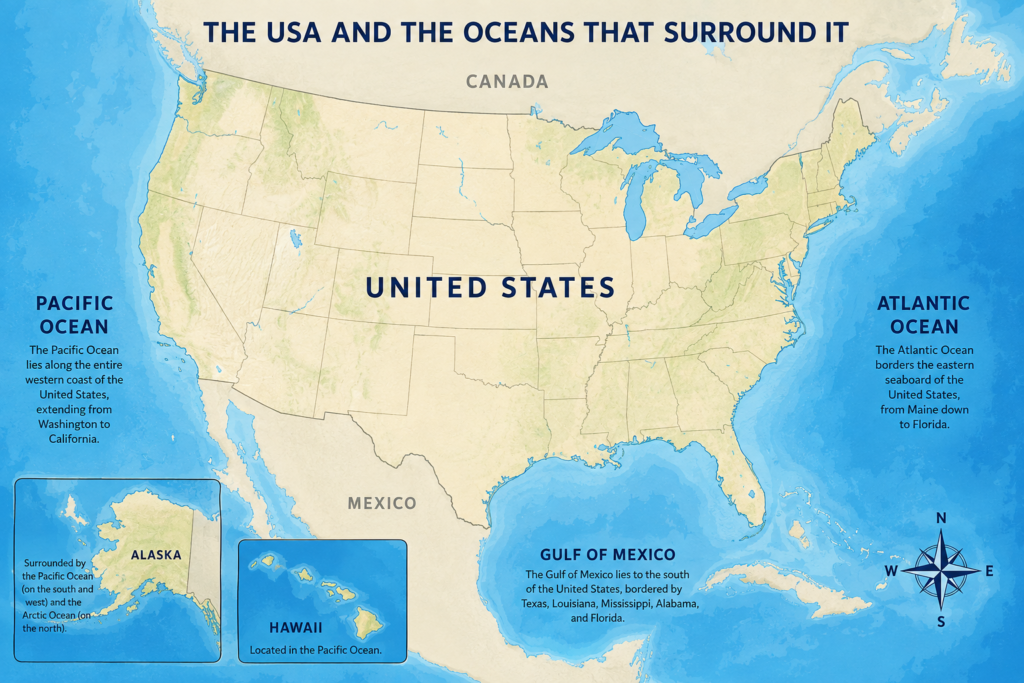
America inherited the opposite problem, in reverse: an ocean instead of a highway, on both sides. Any adversary’s plan against the U.S. homeland has to solve a naval and logistical problem before it can become a military one at all. Most great powers never face that requirement in the first place.
Also Read – How US Trade Policy Shapes Global Prosperity…
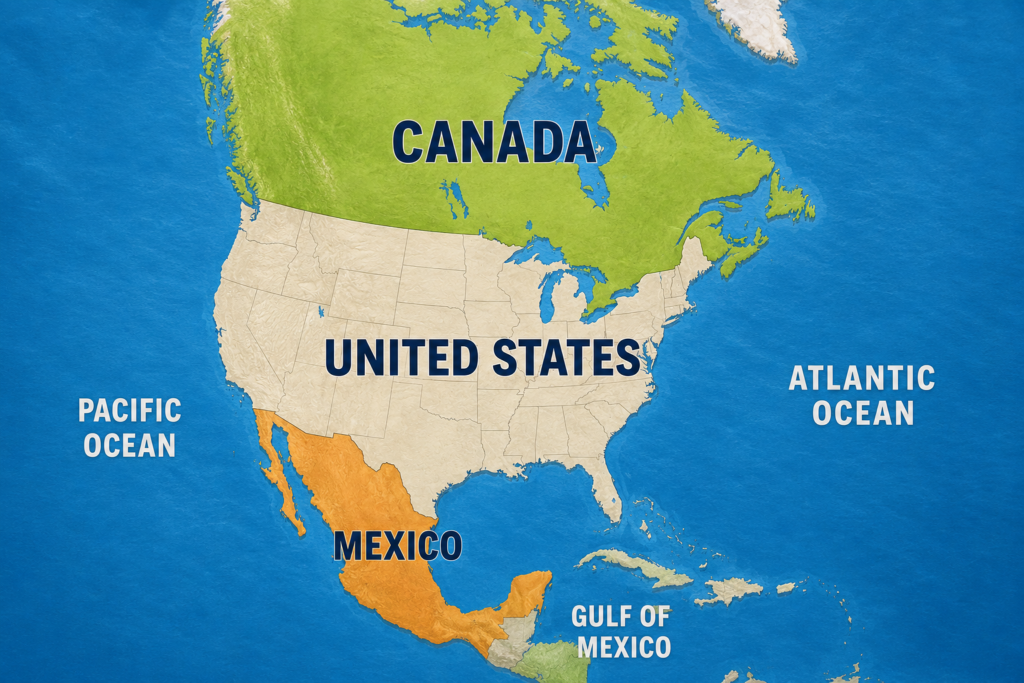
The neighbors reinforce it. Canada and Mexico have not been credible military threats to Washington in over a century, which frees American strategic planning from a burden almost no other great power escapes. Germany has spent centuries boxed in by rivals on a crowded plain. China negotiates borders with more than a dozen countries. Russia’s western frontier has essentially no natural defense at all. The United States simply doesn’t have that problem to manage.
Depth compounds it. Even a breached coastline leaves an invader facing a continent, not a country — a landmass with no single capital whose capture ends the resistance. That depth is fed, quite literally, by geography doing double duty as infrastructure: the Mississippi-Missouri river system drains all or part of 31 states and connects the agricultural interior directly to Gulf ports, moving grain and coal by barge for a fraction of overland cost.
The Great Lakes hold something like a fifth of the world’s surface fresh water and sit beside a belt of industrial cities that grew up specifically because the water was there. Add farmland across the Great Plains and Midwest among the most productive on Earth, deep reserves of coal, oil, and natural gas, and deepwater ports on both coasts feeding both the Atlantic and Pacific trade networks without routing through a rival’s waters — and the ocean, the rivers, and the resources stop being separate advantages. They function as one system. Very few nations in history have owned the whole thing at once.
2. America Has Been Attacked Before. But Defeating America Is Another Matter.
None of this means the United States has been untouchable.
In 1814, British troops landed, marched inland, and burned the Capitol and the White House — a real humiliation that proved the coastline could be breached. The campaign still ended in stalemate and a treaty that changed no borders, because landing troops and holding a continent turned out to be entirely different problems.
The Civil War makes the same point from the inside, and more painfully. Union forces already occupied the same continent as the Confederacy, spoke the same language, and used the same rail lines, and still needed four years and hundreds of thousands of casualties to subdue a determined adversary across a fraction of the country’s total landmass.
Compare that to Napoleon in 1812 or Hitler in 1941: both faced continental depth in Russia, with no ocean at all in the way, and both were still broken by the sheer scale of the terrain they had to cross and hold. If depth alone can wreck an invasion that starts on the same landmass, depth behind an ocean is a different order of problem entirely — and that’s the one America has.
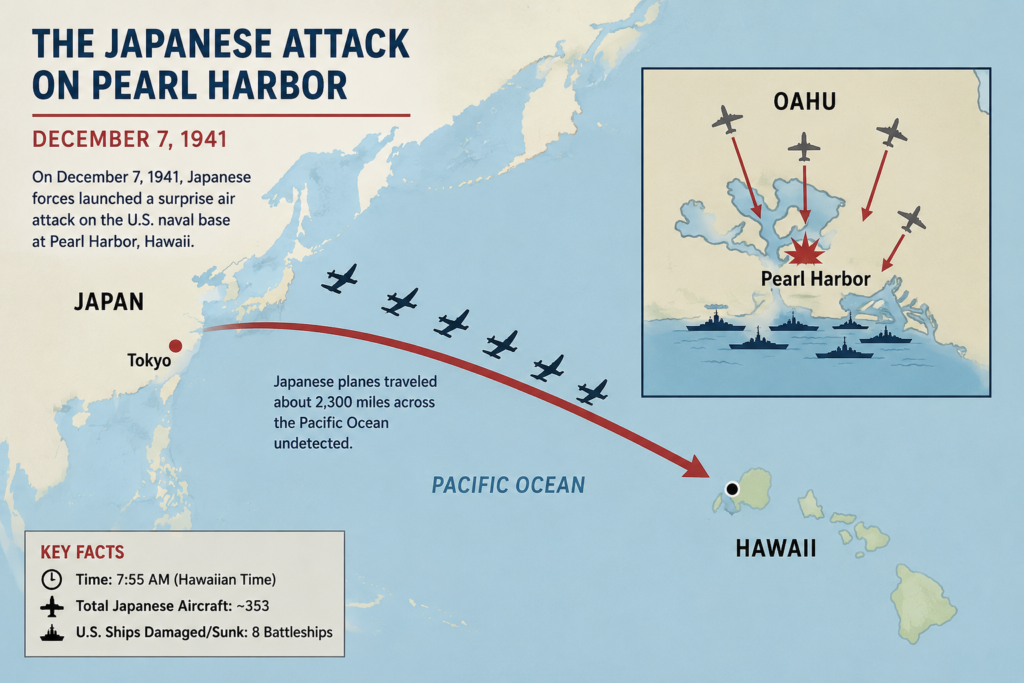
Pearl Harbor, in December 1941, proved a determined naval power could reach across the Pacific and land a devastating blow; Japan briefly held two remote Aleutian islands the following year before losing them back. But Japan’s plan was never a mainland invasion — it was aimed at the Pacific Fleet, because Japanese planners understood that occupying the continental United States wasn’t on the table. The rest of World War II reinforced the pattern from the other direction: the fighting devastated Europe and much of Asia, but American industrial capacity, protected by distance, never took a bomb, which is a large part of why the U.S. emerged from 1945 as the only major power with its factories still standing.
September 11, 2001, showed that distance offers no protection against a small group willing to exploit an open society rather than cross an ocean by force — still the deadliest attack on American soil in modern history, and still, unmistakably, an attack rather than the opening move of an occupation. Even during the Cold War, a rival with thousands of nuclear weapons never produced a serious plan for a ground invasion of North America, for the same reason nobody else has: the ocean has to be solved first, and nobody has solved it. Attacking America has happened repeatedly. Defeating it has never gotten past the first step.
3. Geography Built the Economic Power Behind America’s Military
Here is the argument in its plainest form: military power is what America built.
Geography is why it could build it. The Pentagon didn’t create America’s oceans, rivers, or farmland — it was funded by the wealth those things generated first. Nineteenth-century westward expansion opened farmland and mineral wealth that railroads and the river system then stitched into a single national market, the largest free-trade zone on Earth at the time, built on internal geography rather than colonies.
By the early twentieth century, that had already made the U.S. the largest industrial economy in the world, before it had built a military to match. When World War II arrived, the same geography protected what it had built: American factories, fed by domestic resources and safe from bombing, out-produced the rest of the world combined and became the decisive factor in the Allied victory. The soldiers won the battles. The map is why there was an arsenal behind them at all.
Does any of that still hold in an age of missiles, drones, cyberweapons, and artificial intelligence? Distance has clearly lost some of its old magic — an intercontinental missile can reach American soil in roughly half an hour, a cyberattack ignores oceans entirely, and long-range precision weapons extend an adversary’s reach further than any battleship ever could.
But compression is not elimination. Occupying and holding territory, the actual endpoint of “defeating” a country, still requires ships, troops, and supply lines crossing real physical space, and that’s exactly where American geography remains hardest to overcome.
The shale boom turned the U.S. into a net petroleum exporter in recent years, converting what was once a geographic accident into a deliberate strategic asset again.
The Panama Canal — built, not natural, but built specifically to exploit America’s two-coast geography — still lets a fleet move between oceans without circling South America. Climate change is opening new Arctic shipping lanes, turning America’s northern geography into a live arena of competition rather than an afterthought. Geography didn’t retire in the missile age. It just started sharing the stage.
Read – The geography of American power
FAQs
Why is America’s geography so advantageous?
How does geography protect the United States?
Why is the United States difficult to invade?
Does America’s geography make it a superpower?
How do two oceans benefit the United States?
Why are the Mississippi River and U.S. waterways important to the economy?
Does geography still matter in modern warfare?
Could another country defeat the United States?
Final Verdict
America’s geography never made the country invincible, and it never guaranteed superpower status by itself. What it gave the United States was an unusually forgiving foundation — two oceans instead of hostile borders, a continent instead of a crowded plain, and enough farmland, fresh water, and raw material to build an economy without depending on anyone else’s shipping lanes.
Everything stacked on top — the factories, the fleets, the satellites — is the product of choices and effort. Geography opened the door. People walked through it. Military power is what America built; geography is still why it could build it largely undisturbed.
The next chapter will test how much that still counts. China’s rise, hypersonic weapons, and cyber warfare are compressing the distance that once protected America almost by default. The Arctic is thawing into new competition, and energy independence is becoming a deliberate asset again rather than an accident. None of that erases geography. It just raises the price of ignoring it.
Technology will keep shrinking the map. It won’t flatten it. The ocean is still there, and someone still has to cross it.
What do you think ? Comment Below …..
