

 By
By Why the world’s most important trade referee stopped blowing the whistle — and what that silence is really telling us.
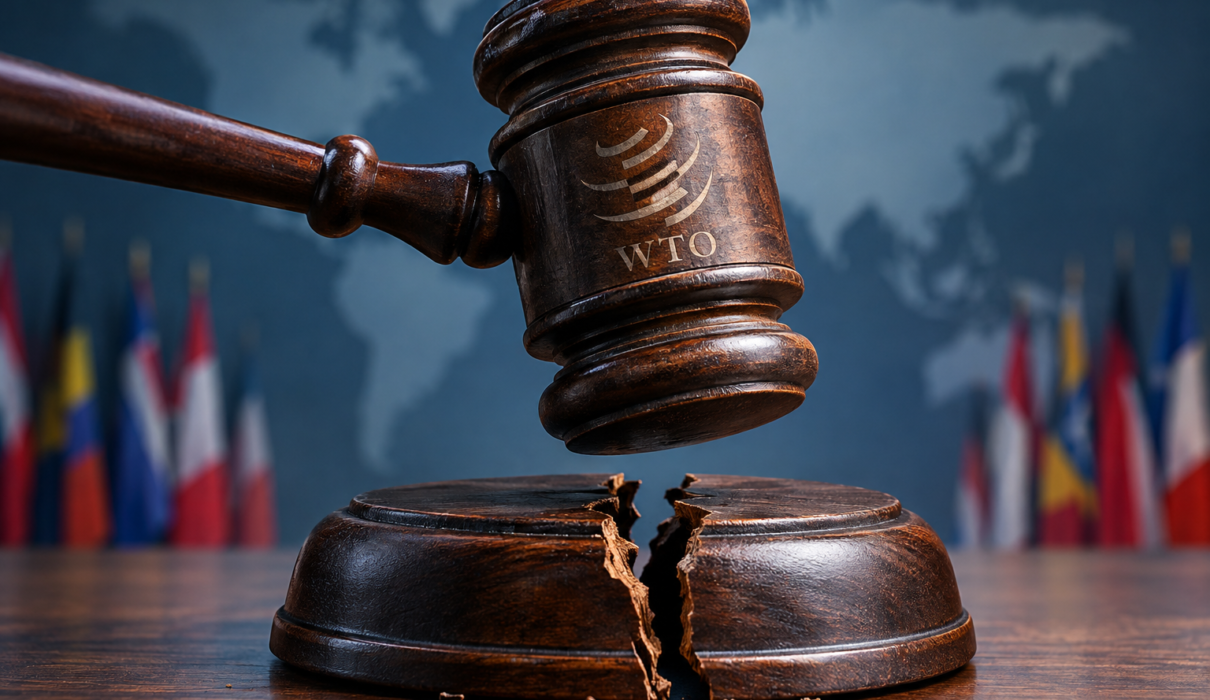
The WTO’s authority collapsed because its two most powerful members — the US and China — stopped treating trade as a shared rulebook and started treating it as a battlefield for strategic advantage. The Appellate Body has been unable to hear new appeals since 2019, the 2026 Yaoundé Ministerial ended without a reform deal, and what’s replacing formal WTO consensus is a patchwork of smaller, plurilateral coalitions — power, not rules, increasingly decides outcomes.
Key Takeaways…
- The WTO’s Appellate Body has been non-functional since December 2019, after the US blocked judge appointments starting in 2017 — collapsing appeals from 169 (1995–2019) to just 26 (2020–2026).
- The WTO’s March 2026 Ministerial Conference in Yaoundé ended without a reform deal or final declaration, widely read as confirmation of the institution’s deeper crisis.
- The root cause isn’t procedural — it’s geopolitical. US-China rivalry has expanded from trade disputes into full strategic competition, and both sides are actively reducing economic interdependence.
- The WTO isn’t simply dying — it’s fragmenting into smaller, plurilateral coalitions, exemplified by a binding e-commerce agreement signed outside the formal WTO rulebook.
- Crisis-response coordination still works even when reform doesn’t — the WTO, IMF, World Bank, and IEA formed a joint response group for the Middle East war’s trade and energy impacts in 2026.
- The bigger story is the shift from rules to power: enforcement is increasingly optional for major economies and effectively mandatory for smaller ones.
There’s a particular kind of quiet that falls over a room when everyone already knows the outcome and is just waiting for someone to say it out loud. That was Yaoundé, Cameroon, in March 2026. Trade ministers from around the world flew in for the WTO’s 14th Ministerial Conference, sat through the usual parade of opening statements about “shared prosperity” and “rules-based cooperation,” and then went home without a final declaration. No agreement on reform. No communiqué. Nothing.
In diplomacy, silence is rarely neutral. It’s usually a verdict.
And the verdict on the World Trade Organization — the institution that was supposed to be the referee of global commerce, the place where a dispute between a soybean farmer in Iowa and a steel plant in Jiangsu got settled with lawyers instead of tariffs — is looking grim. Not dead, exactly. But increasingly irrelevant to the two players who matter most.
This is the story of how the WTO went from umpire to bystander, and why pretending it’s just “institutional dysfunction” misses the real culprit sitting in plain sight: the United States and China stopped playing the same game.
1. What Is the WTO, and Why Should You Care?
Quick refresher, because it’s easy to lose the plot when an institution has been quietly falling apart for years: the WTO exists to do three things. Negotiate trade rules. Monitor whether countries follow them. And, crucially, settle disputes when they don’t — through a court-like system with panels and an Appellate Body that issues binding rulings.
That third function is the one that made the WTO actually matter. Rules without enforcement are just suggestions with better branding. And that’s precisely the function that’s now sitting in a coma.
Also Read – The UN Was Built for 1945. Is It Still Fit for 2026?
2. A Brief History: What the WTO Was Actually Built to Prevent
It’s worth remembering what problem the WTO was solving in the first place, because the contrast with today is almost embarrassing.
Before 1994, global trade disputes were settled the old-fashioned way: tariffs, retaliation, and whoever had the bigger navy or the bigger market got the better deal. The WTO — and the GATT system it grew out of — was a genuine attempt to replace that with something closer to a legal order. Smaller economies got a seat at the table. Rulings applied regardless of how big your GDP was. For a while, it more or less worked. Trade volumes exploded. Disputes got resolved through panels and appeals instead of gunboats and embargoes.
Nobody expected the system to be perfect. But the basic bet was that predictable rules would beat the chaos of raw power, and for two decades, that bet mostly paid off. The WTO wasn’t just a bureaucracy — it was a wager that the 21st century’s economic disagreements could be smaller, quieter, and less destructive than the 20th century’s. That’s the wager currently unraveling in real time, one blocked appointment and one failed ministerial at a time.
3. The Court That Stopped Hearing Cases
Here’s the part of the story most people missed because it happened slowly, then all at once.
Since 2017, the United States has been blocking the appointment of new judges to the WTO’s Appellate Body — the seven-member panel that hears appeals on trade disputes. Blocking judicial appointments to strangle a court’s authority isn’t a new tactic; it’s a page ripped straight out of domestic politics and applied to the global stage. By December 2019, the Appellate Body lost its quorum. It couldn’t hear new appeals anymore. It still technically exists, the way a decommissioned ship still technically floats.
The numbers tell the story better than any op-ed could. Between 1995 and 2019, WTO members filed 169 appeals through the system. Between 2020 and 2026 — after the Appellate Body went dark — that number collapsed to just 26. Countries didn’t stop having trade disputes. They just stopped expecting anyone to resolve them.
What happens to a case that gets appealed now? It goes “into the void.” A country loses at the panel stage, appeals anyway, and the appeal simply… sits there. Forever, or close to it. Nobody wins, nobody loses, nobody has to comply with anything. It’s less a legal process and more a filing cabinet for grievances.
A handful of WTO members tried to patch the hole themselves, setting up an alternative appeals mechanism called the Multi-Party Interim Appeal Arbitration Arrangement. Nice acronym, weaker impact — because the United States isn’t part of it, and neither are several other major economies. It’s a life raft built for people who agreed to get in it, while the ship keeps sinking around them.
Also Read – USA–China Relations: The Rivalry That Could Shape the 21st Century
4. Yaoundé: When the Patient Stopped Pretending to Be Fine
If the Appellate Body’s paralysis was the slow leak, MC14 in Yaoundé was the moment everyone finally admitted the tire was flat.
Reform was supposed to be the headline achievement of the conference. Instead, ministers left without a deal and without even a joint statement papering over the disagreement — which, in the diplomatic world, is the equivalent of a couple leaving a couples’ therapy session in separate cars. There was no shared taxi ride of “we’ll figure it out together.” There was just silence, and everyone quietly heading their own way.
To be fair to the WTO’s negotiators, they didn’t have much to work with. The organization was founded in 1994, built for a world of relatively cooperative globalization. It was not built for a world where the two largest economies on the planet increasingly see trade policy as a subset of national security policy.
Which brings us to the actual disease, not just its symptoms.
5. The Real Story Isn’t the WTO. It’s Washington and Beijing.
Every explainer about “WTO reform” that treats this as a procedural or bureaucratic problem — committee structures, voting thresholds, dispute timelines — is missing the point on purpose or by accident. The WTO isn’t broken because its rulebook is outdated. It’s broken because its two most powerful members no longer want the same thing from it.
What started as a trade dispute between the US and China — tariffs, subsidies, intellectual property complaints — has metastasized into full-blown geopolitical rivalry. Both sides are now actively trying to reduce their dependence on each other, reshaping supply chains, restricting technology flows, and treating economic interdependence less as a source of stability and more as a vulnerability to be managed. That’s not a trade dispute anymore. That’s strategic decoupling with a trade-policy costume on.
And here’s the uncomfortable truth for anyone still hoping for a tidy institutional fix: any future WTO reform will have to accept that economic security concerns are going to limit how far rules-based trade discipline can actually go. You cannot out-negotiate geopolitics with a better dispute-resolution timeline. The WTO was designed to referee a game where everyone agreed on the rulebook. It was never designed to referee two heavyweights who’ve decided the rulebook itself is the enemy.
This is the shift the headline promises: from rules to power. Not because anyone announced it. Because when the referee’s whistle stops meaning anything, the only thing left on the field is leverage.
6. But Wait — Is the WTO Actually Dying, or Just Evolving?
Here’s where the story gets more interesting than a simple obituary, and where a lot of commentary gets lazy.
Because even in its weakened state, the WTO didn’t just roll over in Yaoundé. Out of that failed ministerial came something unexpected: a plurilateral e-commerce agreement, open for signature among the countries actually willing to commit to it, and — this part matters — legally binding, even though it technically sits outside the WTO’s formal rulebook.
Translate that out of trade-policy jargon: a coalition of the willing just quietly built a side door because the front door was locked. That’s not collapse. That’s adaptation, and it’s arguably a more honest reflection of how international cooperation actually works in 2026 than the old consensus-or-nothing model ever was.
There’s a second data point worth sitting with. In April 2026, the heads of the IEA, the IMF, the World Bank, and the WTO formed a joint coordination group to manage the trade and energy fallout from the war in the Middle East, and by July they were meeting to assess the damage together — vulnerable economies, energy supply disruptions, food security, the works. Say what you want about the WTO’s paralysis on reform; when the world actually needed multilateral coordination in a crisis, the institution showed up to the meeting.
So which is it? Is the WTO a zombie institution stumbling toward irrelevance, or a bruised survivor learning to operate through side channels because the main channel is blocked by its own most powerful members?
Honestly — both. That’s not a cop-out; it’s the actual state of play. The WTO’s formal, consensus-based machinery is functionally dead. Its informal, coalition-based machinery is very much alive. The organization didn’t die. It mutated into something smaller, faster, and considerably less democratic — because plurilateral deals, by definition, only include the countries that show up.
7. What’s Actually at Stake Here
It would be easy to file this under “boring trade bureaucracy” and move on. Don’t.
What’s dying in slow motion isn’t a filing system for tariff complaints. It’s the idea — genuinely radical when it was built in the aftermath of the 20th century’s worst conflicts — that economic disputes between nations could be settled by law instead of by leverage. That a mid-sized economy could win a case against a superpower and expect the ruling to actually mean something.
That idea is now on life support, kept alive mostly by countries too small to have any other option. The big players — the US, China, and increasingly the EU when it suits them — are quietly reverting to something older and less pleasant: bilateral deals, unilateral tariffs, and “rules” that apply exactly as far as your negotiating leverage extends.
If you’re a smaller trading economy watching this unfold, the message is not subtle. The rulebook you were promised is optional for the powerful and mandatory for everyone else.
Picture a country that isn’t the US, isn’t China, and isn’t in the EU — a mid-sized exporter that spent two decades restructuring its economy around WTO commitments, trusting that predictable rules would protect it from being steamrolled by bigger trading partners. That country now faces a choice nobody sold them at the outset: keep playing by rules the biggest players increasingly ignore, or scramble into whichever plurilateral coalition will still have them. There is no third option where the old system simply gets restored by committee vote. That option quietly left the building in Yaoundé.
8. Frequently Asked Questions…
What caused the WTO’s dispute settlement crisis?
Did the WTO’s 2026 Ministerial Conference in Yaoundé succeed?
Is the WTO completely irrelevant now?
Why can’t the US and China just fix the WTO together?
What comes after the WTO if it keeps declining?
9. So, Is the WTO Worth Saving?
That’s the question worth sitting with after you close this page. Not “can the WTO be reformed” — the honest answer to that, for now, is probably not, not while its two most powerful members treat trade as a security issue instead of a shared marketplace. The better question is whether the plurilateral, coalition-based version quietly emerging from the wreckage is a worthy successor, or just a smaller, more exclusive club wearing the old institution’s name tag.
Either way, the age of trade governed primarily by consensus and courts appears to be closing. What replaces it — power, coalitions, or something nobody’s invented yet — is arguably the defining economic story of the decade. The WTO didn’t fall apart in a single dramatic moment. It just quietly stopped being the place where the world’s biggest economic arguments got settled. And nobody with real power seemed all that eager to fix it.
What do you think about this ? Comment Below….
Have thoughts on where global trade governance goes from here? StrategicWorld360 will keep tracking the WTO’s next moves — because if the rules stop mattering, the power dynamics behind them are the only story left to tell.
