

 By
Picture a spice trader in Kochi on an ordinary Tuesday morning. He is selling cardamom to a buyer in Dubai. Neither man is American. The shipment will never touch American soil. Yet the invoice is written in dollars, the bank guarantee clears in dollars, and the loan that financed the harvest was priced off a decision made by a handful of officials in Washington the evening before.
He does not think of this as an empire. He thinks of it as Tuesday.
That quiet, invisible habit is the most powerful instrument of American influence ever built. The dollar is not just money. It is plumbing, language, insurance policy and, when Washington chooses, a weapon. It lets the United States borrow cheaply, punish rivals without firing a shot, and shape the economic weather far beyond its borders.
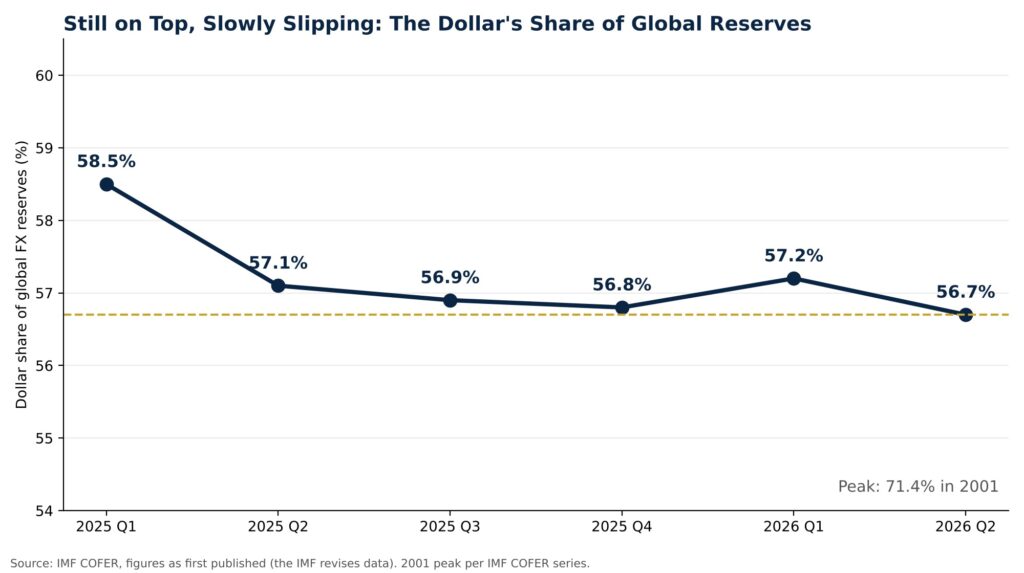
But empires built on trust can also be tested by it. Today the dollar holds about 56.7% of global foreign exchange reserves, down from a peak of 71.4% in 2001, and rival powers are busy building workarounds. So how did one currency come to rule the world, how does it exercise power, and can it keep that power? Let’s follow the money.
The Birth of the Dollar Empire: How America Built Financial Supremacy
Most empires arrive with armies. This one arrived with a ledger. By 1944, Europe was rubble, Britain was nearly bankrupt, and the United States held most of the world’s monetary gold and produced around half of its manufactured goods. The dollar did not win a competition so much as inherit an empty field.
What turned that moment into lasting dominance was a rare combination of four things: the size of the American economy, military security that reassured investors, the deepest financial markets on earth, and a legal system that foreigners trusted with their money. Each pillar supports the others. Pull one out and the structure wobbles, which is exactly why the story of the dollar is a story of both power and vulnerability. The eight chapters below show how the dollar empire was built, how it is used, and where it is starting to crack.
1. The Bretton Woods Agreement: The Foundation of Dollar Dominance
In July 1944, delegates from 44 countries gathered at a hotel in Bretton Woods, New Hampshire, to design the post-war economy. The bargain was simple. The dollar would be convertible into gold at $35 an ounce, and every other major currency would be pegged to the dollar. The International Monetary Fund and the World Bank were born in the same negotiation.

Overnight, the dollar became the anchor of global finance. Countries needed dollars to trade, to defend their own exchange rates and to rebuild. To get them, they had to sell goods to America or borrow from it. That fed American demand and strengthened American influence at the same time.
The system carried a built-in flaw, known as the Triffin dilemma. To supply the world with enough dollars, America had to run deficits, yet those deficits steadily eroded confidence that each dollar was really worth its gold. In August 1971, President Richard Nixon suspended gold convertibility, and the fixed-rate order collapsed.
A weaker currency would have collapsed with it. The dollar did not. It had become so embedded in trade, debt and habit that it kept its throne after losing its gold crown. That is the first lesson of the dollar empire: once a currency becomes a network, it can outlive the promise that created it.
Also Read – Tariff: A Friend or Foe ? The Power to Reshape the Global Economy
2. The Petrodollar System: How Oil Strengthened America’s Financial Power
After 1971 the dollar needed a new reason to exist, and oil supplied it. Following the 1973 oil shock, Washington reached an understanding with Saudi Arabia in the mid-1970s. Oil would be priced and sold in dollars, Riyadh would invest its surplus revenue in US government debt, and America would provide security. Other producers largely followed.
The effect was elegant. Every oil importer on earth, from India to Japan, now needed dollars to buy the world’s most important commodity. Demand for the dollar became structural rather than optional. Meanwhile, oil exporters recycled their earnings into Treasury bonds, which helped finance American deficits at lower cost.
Historians still debate how formal the arrangement really was, and today’s picture is more complicated. America is now a major oil producer itself. China buys enormous volumes of Gulf crude, and some exporters are experimenting with the yuan and other currencies for part of their sales.
Even so, commodities remain heavily dollar-priced. In SWIFT’s July 2026 trade finance data, the dollar accounted for almost 80% of value, far ahead of any rival. Energy and the dollar remain close companions, which is why any serious attempt to dethrone the dollar must eventually solve the oil problem.
3. The Dollar as a Global Reserve Currency: Why the World Holds American Money
Central banks hold reserves as financial armour against crises. According to IMF data for the second quarter of 2026, about 56.7% of the world’s disclosed foreign exchange reserves, roughly $7.49 trillion of $13.22 trillion, sit in dollars. The euro is a distant second at around 20.6%, and the Chinese yuan remains below 2%.
Why do governments choose the dollar? Four reasons stand out:
- Depth. The US Treasury market is the largest and most liquid government bond market in the world. A central bank can move hundreds of billions without wrecking the price.
- Trust in law. Contracts are enforced, property rights are respected and capital can flow in and out freely.
- Network effects. According to the Bank for International Settlements, the dollar was on one side of about 89% of foreign exchange trades in April 2025. Everyone uses it because everyone uses it.
- No true substitute. The eurozone lacks a single unified government bond market, and the yuan is not freely convertible.
For America this is the famous “exorbitant privilege”, a phrase attributed to French finance minister Valéry Giscard d’Estaing in the 1960s. Constant global demand for dollar assets keeps American borrowing costs lower than they would otherwise be, allowing deficits that other countries could never sustain.
Also Read – The Silver Rush: Powering a Global Revolution
4. SWIFT and Financial Sanctions: Washington’s Invisible Economic Weapon
SWIFT is a Belgium-based messaging network that banks use to talk to each other. It does not move money, and it is not an American institution. Yet the dollar made up about 51% of global payment value on SWIFT in July 2026, rising to nearly 60% once payments inside the eurozone are stripped out.
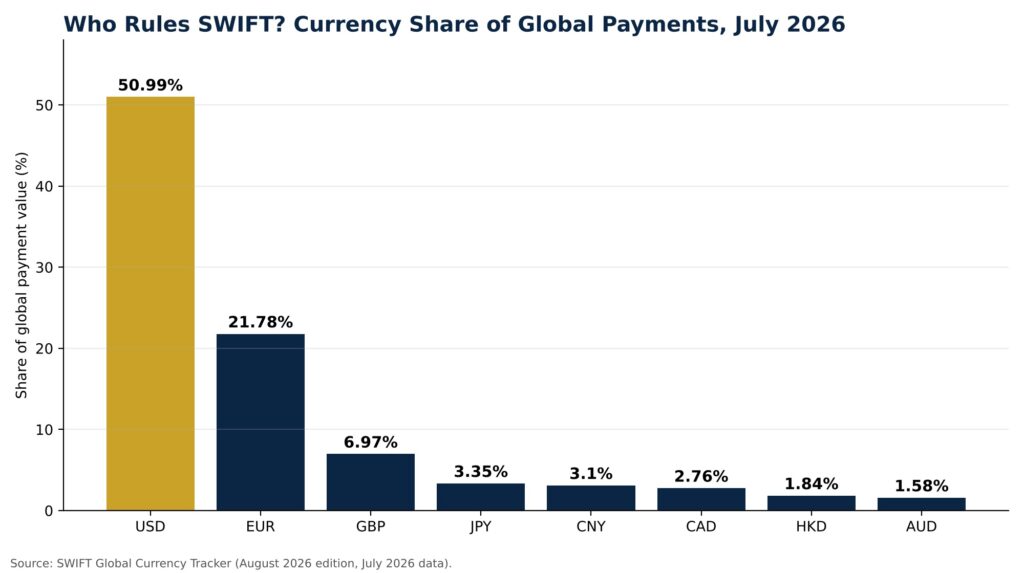
Here is the catch. Almost every dollar payment ultimately clears through the American banking system, which puts it within reach of American law, no matter where the sender sits. A bank that wants to keep its dollar access must respect US sanctions or risk losing it. That is the weapon, and it requires no missiles.
Iran learned this lesson in the early 2010s when it was cut off from much of the global financial system. In 2022, after Russia invaded Ukraine, Western governments froze hundreds of billions of dollars in Russian central bank assets held abroad and disconnected several Russian banks from SWIFT. The impact was immediate.
Sanctions are cheap, legalistic and politically convenient. But every use carries a hidden cost: it teaches other governments to build alternatives. A weapon used too often creates its own antibodies, and that brings us to the heart of the modern challenge.
5. The Federal Reserve’s Global Influence: How US Interest Rates Move the World
The Federal Reserve sets interest rates for one country, but dollar debt belongs to the entire planet. When the Fed raises rates, dollars become more expensive to borrow and more attractive to hold. Capital flows from emerging markets back to America, local currencies weaken, and foreign borrowers with dollar loans face heavier repayments. The 2013 “taper tantrum” and the aggressive 2022-23 tightening cycle both showed how a decision in Washington can rattle markets from Mumbai to Jakarta.
The reverse also holds. When the Fed cuts rates, cheaper dollars flood into emerging economies, lifting asset prices and currencies. That is why central bankers from Brazil to India watch Fed meetings as closely as their own.
In a crisis, the Fed even acts as the world’s lender of last resort. It opened dollar swap lines with major foreign central banks during the 2008 financial crisis and again in 2020, ensuring that the world did not run out of dollars in a panic. This is power of a subtler kind. Access to dollars in an emergency is a privilege granted by Washington, not a right guaranteed by any treaty.
The outcome is a quiet loss of monetary independence for everyone else. Foreign central banks must either follow the Fed or accept sharp currency swings. Nobody votes for this arrangement, yet almost everyone lives with it, and growing numbers of governments are asking how long they should.
6. The Rise of De-Dollarization: BRICS and the Challenge to American Financial Power
De-dollarization means reducing dependence on the dollar in trade, finance and reserves. The BRICS group has become its loudest champion. At the 2026 New Delhi summit, members endorsed expanding trade and investment settlement in local currencies. China has signed local-currency settlement arrangements with partners such as Brazil and Iraq, and trade between China and Russia is reportedly settled almost entirely in rubles and yuan. Intra-BRICS trade, estimated at around $500 billion, offers room for such experiments to grow.
Central banks are also hedging with gold. The IMF noted that in 2025 gold overtook US Treasuries as a share of official reserves, although most of that jump came from rising gold prices rather than a flight from the dollar.
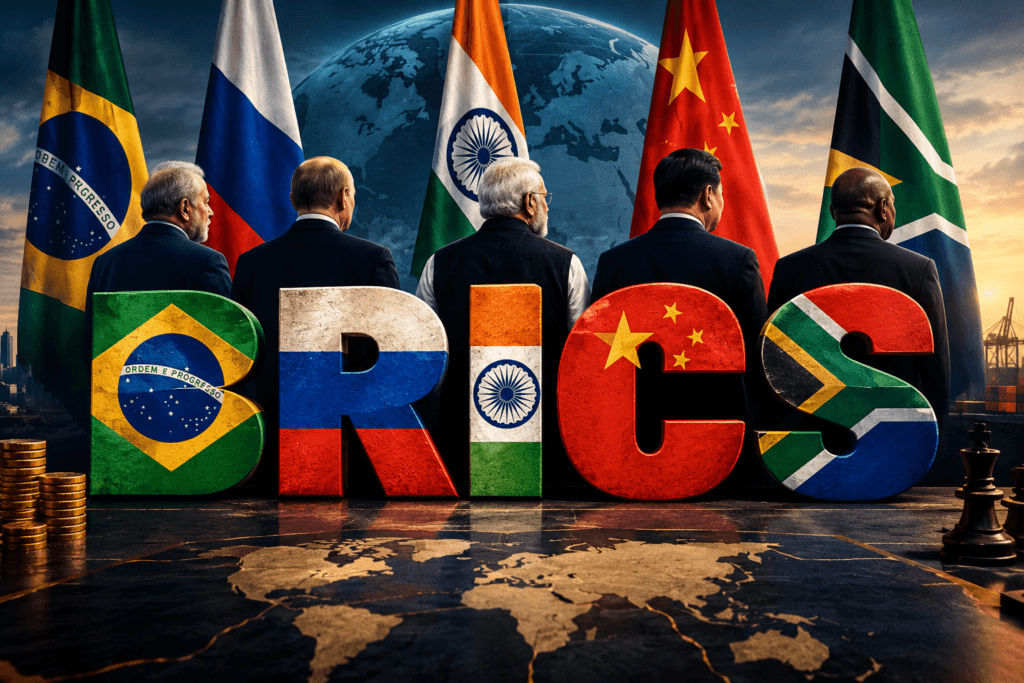
Now the reality check. No BRICS common currency is on the table. Indian officials have said there is no proposal for a fixed bloc currency, and Brazil’s President Lula has described the shift as gradual. Members have conflicting interests, and India has no appetite for replacing dollar dependence with yuan dependence. The yuan still makes up under 2% of global reserves and about 3% of SWIFT payments.
The sober summary is this: de-dollarization today means skipping the dollar in individual deals, not replacing it globally. Roughly 54% of global trade invoicing is still dollar-denominated. The challenge is real, but it is a slow leak, not a burst pipe.
7. The Limits of Dollar Dominance: Debt, Rivalry and Growing Global Resistance
Three pressures are testing the dollar empire from the inside and the outside.
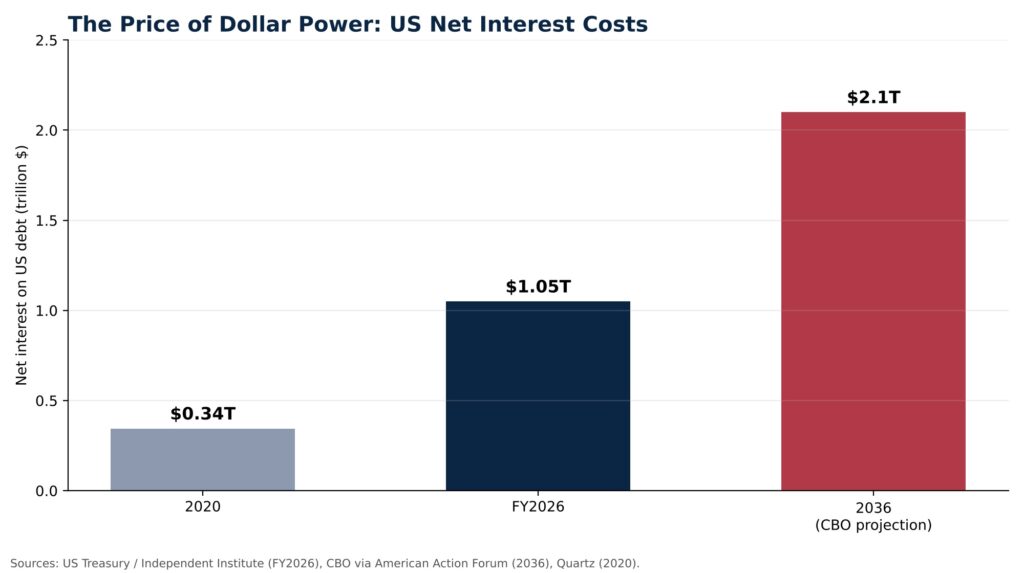
Debt. US national debt passed $40 trillion in 2026. Net interest costs crossed $1 trillion in fiscal 2026 for the first time, reaching roughly $1.05 trillion, and the Congressional Budget Office projects about $2.1 trillion by 2036. Interest now rivals what America spends on national defence. A currency’s strength ultimately rests on the credibility of the government standing behind it, and mounting interest bills raise uncomfortable questions.
Rivalry. The euro holds about a fifth of global reserves, and China is building its own payment infrastructure, including the CIPS system and a digital yuan. None of these is a complete replacement, but together they form a menu of options that did not exist twenty years ago.
Resistance. Sanctions fatigue and trade-policy uncertainty are pushing governments to diversify. Analysts have linked recent reserve diversification partly to policy unpredictability in Washington. When the issuer of the world’s money becomes unpredictable, everyone else hedges. Hedging is not abandonment, but it is the first step toward it.
8. The Future of the Dollar Empire: A Changing Global Financial Order
Nobody can predict this with certainty, but three scenarios deserve attention.
- Slow erosion (the most likely). The dollar’s share drifts gradually lower as the euro, gold and smaller currencies gain ground. The dollar remains number one for decades, just with less dominance.
- A fragmented, multipolar system. Regional payment networks and local-currency trade expand, but the dollar stays the centre for commodities, deep capital markets and crisis safety.
- A dollar renewal. American fiscal restraint, stable policy and the spread of dollar-backed digital assets such as stablecoins extend the dollar’s reach into the digital economy.
Notice what is absent: a sudden collapse. The dollar’s share has never fallen below 50% in the IMF’s data, and it has lost share without losing its central role. Analysts sometimes put it neatly: the dollar is losing share, not power.
To see which way the story bends, watch four signals: the IMF’s quarterly reserve data, SWIFT’s monthly currency tracker, foreign demand at Treasury auctions, and central bank gold purchases. The empire will not end with a headline. It will change in the footnotes.
Frequently Asked Questions
What is the dollar empire?
Why is the US dollar the world’s reserve currency?
Is the dollar losing its dominance?
Can BRICS replace the dollar?
Conclusion: The Dollar Is Power, but Trust Is the Real Currency
Go back to the spice trader in Kochi. He did not choose the dollar out of loyalty to Washington. He chose it because it was the easiest thing to trust: his buyer accepts it, his bank understands it, and his insurer prices against it. Behind every grand theory of empire is a person making an ordinary, practical choice.
That is the real secret of the dollar empire. It was never held up by gold, oil or sanctions alone. It was held up by billions of small decisions made by people who believed the dollar would be there tomorrow and be worth roughly what it was today. Such trust takes decades to earn and can erode much faster than it was built.
The next chapter will be written less in treaty rooms than in markets and kitchens: in what governments borrow, how fairly they use their financial power, and whether people elsewhere decide they would like options. The dollar’s future is not only about America. It concerns every trader, saver and family whose lives run on someone else’s money. The question worth asking is whether the world’s most powerful currency can remain worthy of the world’s trust.
