

 By
The Saturday Drive That Stopped Feeling Normal
Picture a man we will call Daniel. He lives in Windsor, Ontario, and for thirty years his Saturdays have looked the same: coffee, a drive across the border to Detroit, a hockey game or a hardware run, a burger on the way home. He never thought of it as “trusting the United States.” It was simply what neighbours do.
Then, one Saturday in 2026, Daniel caught himself doing arithmetic he had never done before. Would the tariffs reach this checkout line too? Would his daughter, who studies in Michigan, still feel welcome? Was the country next door a friend, a landlord, or a weather system?
Daniel is invented. His doubts are not. In 2022, 83% of Canadians told Pew Research Center that the United States was a reliable partner. By 2026, that figure had collapsed to 35%.
That is the human cost of the Trump era in foreign policy, and it will never appear in a trade statistic. Trust is not a line item. It is the quiet assumption that lets a farmer in Ontario, a student in Seoul and a finance minister in Berlin plan their lives around what America says it will do. Across much of the world, that assumption is now broken.
So the question haunting every capital is simple: after Trump, can America rebuild what it has lost? My answer is yes, but only if Washington stops treating trust as a mood and starts treating it as infrastructure.
1. The Short Answer for Readers in a Hurry
Can the United States rebuild global trust after Trump?
Yes, but slowly, and not automatically. Surveys show that many people still like America more than they trust Trump, which suggests the damage is partly reversible. But allies have learned that American commitments can flip every four years. Only consistent behaviour across more than one administration can repair that.
2. How Far Has America’s Trust Fallen?
Opinions are cheap. Data is not. So let us start with what the world’s largest surveys actually found.
A. Gallup: A Record-Low Verdict on American Leadership
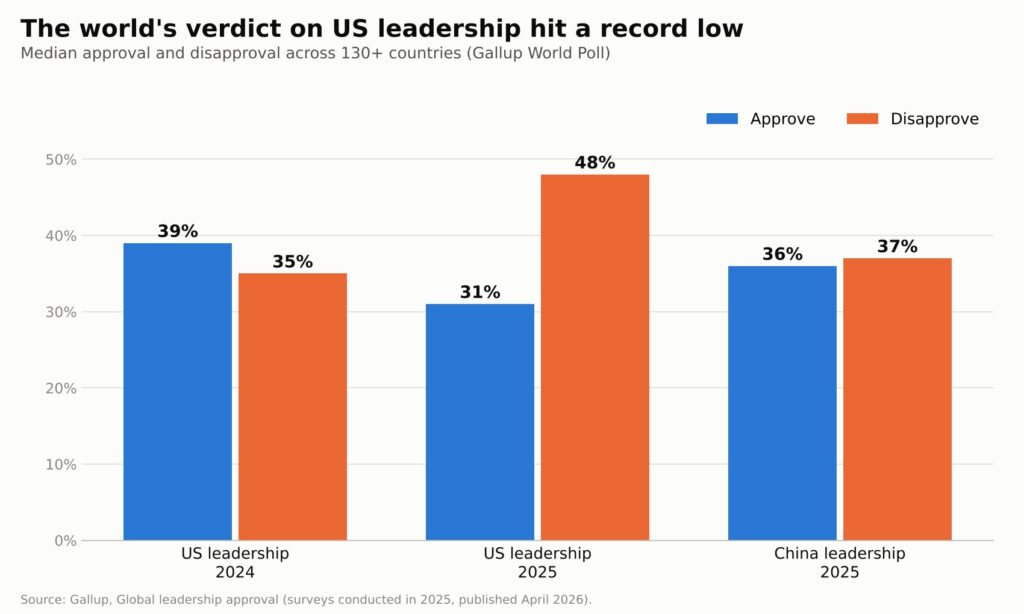
Gallup’s World Poll, covering more than 130 countries, found that median approval of US leadership fell from 39% in 2024 to 31% in 2025, the first year of Trump’s second term. Disapproval jumped to 48%, the highest Gallup has ever recorded. China’s leadership, by contrast, drew 36% approval and 37% disapproval.
Median net approval of US leadership was minus 15, the lowest in the poll’s history. China’s was minus 1. For the third time since Gallup began tracking, Beijing out-polled Washington. The earlier two came under George W. Bush, a hint of how closely the world links America’s image to its president.
One more detail matters. Gallup noted that these surveys predate the US withdrawal from 66 international organisations in January 2026 and the war with Iran in late February, so the picture may have worsened since.
B. Pew: Thirty-Six Countries, One Uncomfortable Pattern
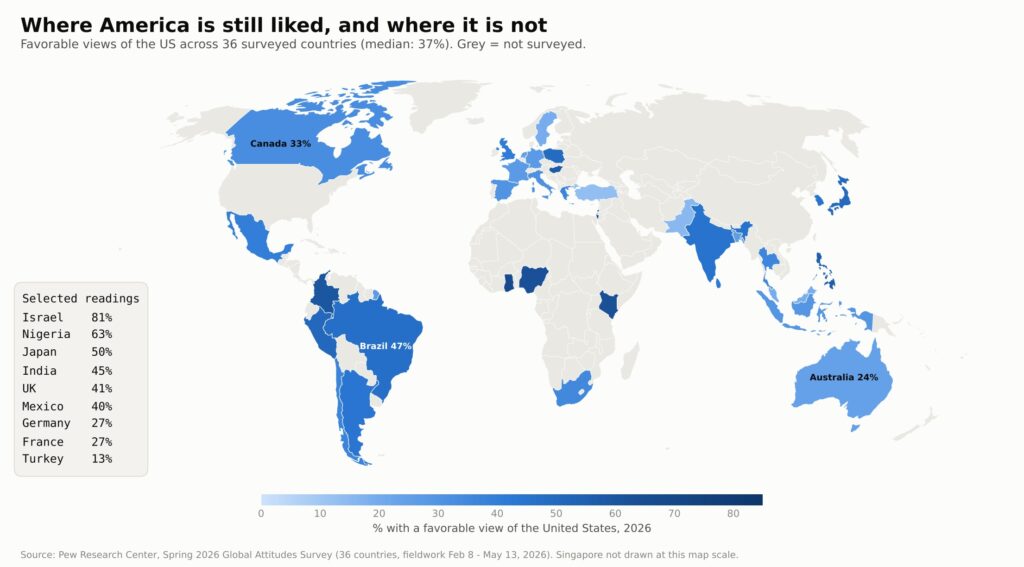
Pew Research Center’s spring 2026 survey spoke to more than 42,000 adults in 36 countries between February and May. The headline is blunt: a median of just 37% hold a favourable view of the United States, and only 23% have confidence in Trump to do the right thing in world affairs.
Favourable views of the US fell significantly in 15 of the 24 countries where Pew has trend data. Not one country showed a significant improvement in confidence in Trump. Majorities in most countries disapproved of how he handles each major foreign policy issue Pew asked about. In many nations, positive ratings for America are at or near the lowest Pew has recorded since it began its surveys in 2002.
C. Allies Feel the Fall Hardest
Here is the part Washington should lose sleep over. The steepest drops are among friends.
Across 31 NATO members, Gallup found median approval of US leadership fell 14 points to 21%. Germany saw the sharpest single-country drop in the world, 39 points, followed by Portugal at 38. In Pew’s survey, the share of Germans who say America takes other nations’ interests into account fell from 60% in 2023 to 23% in 2026. Canada’s reliability score, as we saw, fell by nearly fifty points in four years.
And then came the reversal nobody in Washington wanted to read about. In July, Pew reported that people in many countries now view China more positively than the United States, the first time in almost two decades that has been true. Canada, Australia, France and Germany, all treaty allies or close partners of America, are among the countries where the favourability gap has flipped.
Also Read – Freefall: Trump’s State-by-State Approval Numbers Reveal a Presidency Losing Its Grip
3. Why Trump Is Not the Whole Story
It would be comforting to blame everything on one man. It would also be lazy.
A. Trust Now Rises and Falls With the President
Pew found something striking in 2026: in all 36 countries, views of the United States are more positive among people who trust Trump and more negative among those who do not. The link between how people see the country and how they see its president has grown tighter. Pew notes the same strong link existed during the Bush years.
That is the real diagnosis. America’s reputation has become a personality contest. For a superpower whose entire system of alliances was built on predictability, this is a design flaw.
B. The Whiplash Problem
Imagine you are a defence planner in Warsaw. You sign a deal with Washington. Four years later, a new administration tears it up or ignores it. You sign again. Four years later, the pendulum swings back. After two or three cycles, you stop asking what America promises. You start asking how long the promise lasts.
Trump did not invent that doubt, but he has amplified it, accelerated it and made a brand of it. Tariffs on allies, open pressure on partners, sudden withdrawals from international bodies: his supporters may defend each in isolation. Together they teach the world one lesson, which is that American commitments come with an expiry date.
Gallup’s long data series shows approval of US leadership hitting a previous low of 30% back in 2017, during Trump’s first term. It then recovered, and now it has fallen again. A reputation that bounces like that is not a reputation. It is a mood.
4. The Hidden Asset: People Still Like America
If this were a eulogy, I would stop here. It is not, because buried inside the numbers is a surprising reason for hope.
A. The Gap Between a Country and Its President
Look at Pew’s country-by-country results. In nearly every place surveyed, the share of people with a favourable view of America is higher than the share who trust Trump. In Mexico, 40% view the US favourably but only 11% trust the president. In Japan the numbers are 50% and 25%. In South Korea, 45% and 22%. In Poland, 49% and 29%.
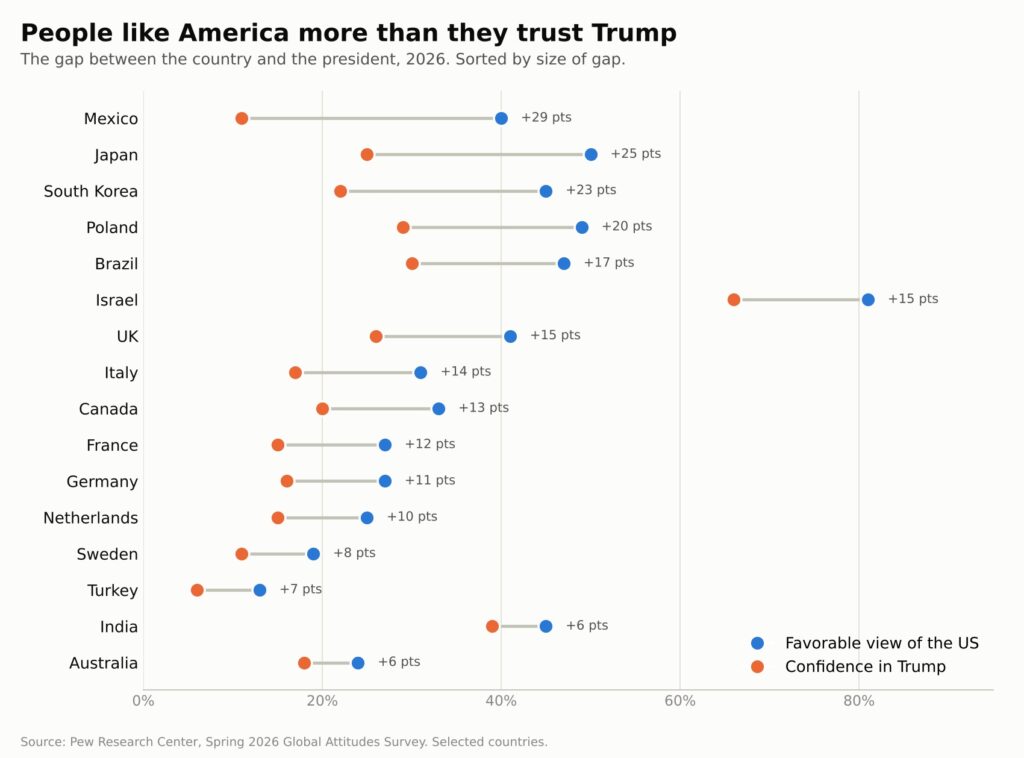
There are exceptions worth noting honestly. In the Philippines and Nigeria, confidence in Trump is actually higher than the favourable view of the country. Trust is never uniform.
But the pattern is clear enough to matter. Millions of people still admire American universities, American music, American scientists and American neighbours. What they distrust is the way the government is behaving. That distinction is the foundation of any recovery.
B. Soft Power: Still Number One, but Barely
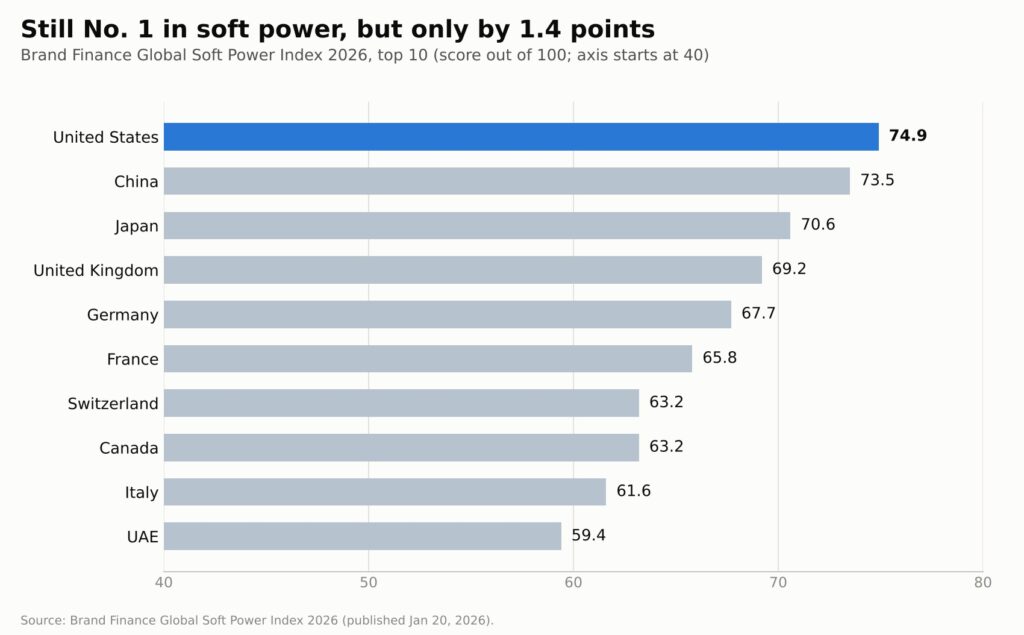
The Brand Finance Global Soft Power Index for 2026 tells the same story in different language. The United States still ranks first overall with 74.9 points out of 100, but only 1.4 points ahead of China. It also recorded the steepest decline of any of the 193 nations ranked. Its reputation score fell 11 places to 26th, while China’s reputation rose to 18th, overtaking America for the first time.
Why is America still first? Because of familiarity and influence. Everyone knows America. Everyone watches its films, uses its apps and follows its elections. But familiarity without trust is just a loud neighbour.
5. What Rebuilding Trust Would Actually Require
Trust is not rebuilt with a speech. It is rebuilt with receipts. Here is what the receipts must look like.
A. Make Promises That Outlive Elections
The single most valuable thing the next American government can do is make commitments that survive the next American government. That means treaties ratified, not merely announced. It means bipartisan agreements that allies can read as national policy rather than presidential preference. Predictability is not boring. It is the currency of alliances.
B. Show Up in the Rooms Again
Withdrawing from 66 international organisations did not make America more powerful. It made America absent. And absence creates vacancies, which others fill. A serious rebuilding plan starts by asking which of those seats matter most, and returning to them with a clear agenda rather than an apology.
C. Treat Allies’ Interests as Real
When only 23% of Germans believe America considers other nations’ interests, no amount of clever messaging will fix that. Allies must see their concerns shape outcomes. That does not mean surrendering American interests. It means recognising that a partner who is consulted stays a partner, while a partner who is lectured starts building alternatives.
D. Live the Values You Export
Pew found that the share of people who say America respects personal liberty has dropped to its lowest recorded level in several countries, including Australia, Canada and Greece. Think about what that means. The country that made liberty its global brand is now doubted on liberty by its closest friends. Foreign policy credibility cannot be separated from how a country treats its own people, its courts, its press and its immigrants.
E. Invest in People, Not Just Pacts
Treaties are signed by officials, but trust is built by people. A South Korean engineer deciding between a job in California and one in Munich is making a trust decision. So is a Nigerian nurse choosing where to train, or a Brazilian student picking a university. Student visas, scientific exchange, humanitarian aid and fair treatment at the border are not charity. They are the cheapest reputation insurance a superpower can buy.
Also Read – Can America Rebuild International Trust?
6. But Doesn’t Power Matter More Than Popularity?
Sceptics will say none of this matters. Great powers are feared, not loved, and America has the world’s strongest military and largest financial system. That argument is half right and dangerously incomplete.
A. Hard Power Needs Partners
American military power projects globally because allies host bases, share intelligence and buy equipment. American financial power depends on others trusting its currency and its rules. Hard power does not run on its own electricity. It runs on cooperation, and cooperation is trust with a budget.
B. China’s Gain Is Conditional
Before anyone in Beijing celebrates, note what the data actually says. Gallup concluded that the recent shift is driven more by falling support for the United States than by rising support for China. Pew likewise describes the reversal as a mix of improving views of China and worsening views of America. China is winning partly because America is losing, not because Beijing has suddenly become beloved. Its own limits are visible: Gallup recorded 37% disapproval of Chinese leadership.
That cuts both ways. It means China’s lead is soft. And it means America can win the comparison back, simply by making itself worth trusting again.
7. What “After Trump” Really Means
Here is where I will be most direct. “After Trump” is not a date on a calendar. It is a decision.
One version of the future is a swing back. A new president arrives, apologises, signs a few documents and promises that the adults are in the room again. Allies would smile politely, and then hedge, because they have learned that the pendulum swings both ways. In that world, trust becomes a four-year lease.
The other version is a rebuild. A new generation of American leaders, in both parties, concludes that predictability is a strategic asset and designs policy to survive transitions. They explain commitments to their own voters first, because a promise the home audience will not defend is not a promise. They accept that credibility takes years, and they stop expecting the world to applaud on day one.
The first version is easy. The second is the only one that works.
Meanwhile, the world will not wait politely. Allies will keep diversifying their trade, their suppliers and their friendships, which is rational for countries that cannot bet their futures on a single election. The longer Washington delays, the more those habits harden into structure.
8. Frequently Asked Questions
Can America regain global trust after Trump?
How low is global trust in the United States right now?
Why do America’s allies trust it less?
Is China now more trusted than the United States?
How long would it take to rebuild trust?
9. Conclusion: The Bridge Is Still There
Go back to Daniel in Windsor. The bridge to Detroit is still standing. Most Saturdays, he still drives across. But he looks at the road differently now, the way you look at an old friend after a bad argument: grateful the friendship exists, uncertain how much weight it will bear.
That is where America stands with much of the world. Not abandoned, but doubted. Not hated, but watched. The choice before the next generation of American leaders is whether to treat that doubt as an insult or as a bill.
It is a bill that can be paid. People still want to believe in America, even while they question its government. The gap between those two feelings is the opening, and a country that keeps its word across administrations, listens to its friends and lives by the rules it preaches could walk back through it.
Trump may be the reason the world’s trust fell. He does not have to be the reason it never returns. Trust is the one superpower that cannot be drafted, taxed or sanctioned into existence. It can only be earned, one kept promise at a time.
Which promise should America keep first? Share your answer below, and subscribe to StrategicWorld360 for more geopolitical analysis that treats readers like grown-ups.
