

 By
On a Tuesday in October, a Panama-flagged tanker was crossing the Strait of Hormuz when an unidentified projectile struck it. Twelve crew members were injured, India’s Ministry of External Affairs said. The ship carried on. The Oil market flinched, then moved on too.
Picture the people at the far end of that voyage. A delivery rider who checks the pump price before every shift. A farmer waiting for urea made from Gulf gas. A shopkeeper in Colombo who has queued for cooking gas. None of them will ever see the Strait of Hormuz. All of them are living inside it.
Eight months into what the International Energy Agency calls the largest oil supply disruption in history, that is the real shape of the crisis. On 8 October, nearly 20.8 million barrels crossed the strait. On 11 October, only 2.9 million did, according to the tracking firm Kpler. No field had run dry. No demand had vanished. A route had simply become dangerous.
That swing is the argument of this article. For fifty years we asked who owns the Oil. The question that decides power now is who controls the passage, the stockpile, the refinery and the substitute. Most governments are still fighting the old contest.
Key Takeaways…
- Oil is scarce at particular places: a strait, a port, a refinery, a diesel pipeline. It is no longer scarce on paper.
- Flows through the Strait of Hormuz fell 77% between late 2025 and mid-2026, and nothing has fully replaced them.
- Emergency stocks, pipelines and electric cars have softened the blow. None has removed the danger.
- The next chokepoints are mineral refineries and gas terminals, so security means managing several dependencies at once.
1. What does energy security mean in 2026?
Energy security is a country’s ability to get the fuel and power it needs, at a price it can survive, without relying on one route, seller or technology that a rival can switch off. In the twentieth century that meant securing Oil fields. Today it means securing four things: the supply, the passage, the stockpile and the substitute.
The strangest fact of the year is how recently the problem was supposed to be too much Oil. In January the IEA said supply was still outrunning demand, and Brent traded near $60 a barrel. Within six weeks of that report the war began. A glut on paper offered no protection against a shortage at the pump, because the barrels were in the wrong place and the ships could not reach them.
2. How did the Strait of Hormuz turn Oil into a weapon?
Because roughly 21 million barrels a day, about a quarter of all seaborne Oil and a fifth of world consumption, passed through one waterway between Iran and Oman, and neither navies nor pipelines could replace it quickly.
The US Energy Information Administration estimates that flows of crude and petroleum liquids fell from 21.6 million barrels a day in the fourth quarter of 2025 to 14.9 million in the first quarter of 2026, then to 4.9 million in the second. That is a 77% collapse in two quarters. IEA chief Fatih Birol called the crisis worse than the two oil shocks of the 1970s and the gas shock after Russia’s invasion of Ukraine put together.
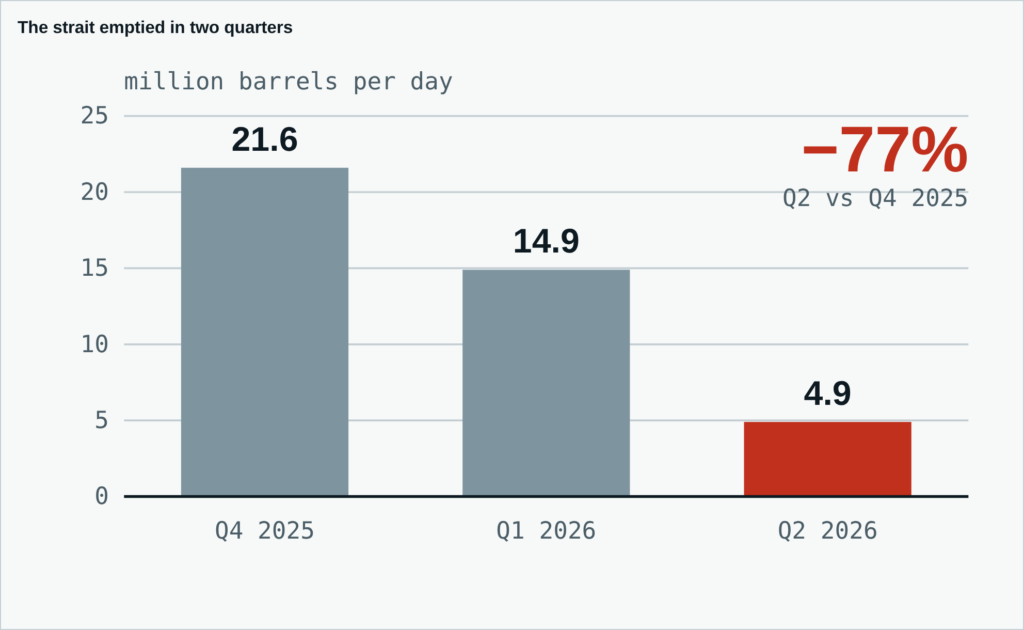
Source: US EIA via Rigzone and S&P Global, August 2026.
The EIA says ship-tracking data in the strait is unreliable and estimates are often revised.
Notice what the weapon was. Iran did not need to sink a fleet. It needed insurers, ship owners and crews to decide the risk was too high. Closure by fear is cheaper than closure by force, and it lasts exactly as long as the fear does.
October showed how this works. More commercial ships came under attack than at any earlier point in the war, yet Kpler still counted crude exports through Hormuz averaging about 11.1 million barrels a day, only 2% below September. Tankers kept moving under US Navy protection. Then, in the last week of the month, flows slid to 7.3 million barrels a day, more than 40% below the pre-war baseline. Uncertainty did what a blockade could not.
3. Where is the new battlefield?
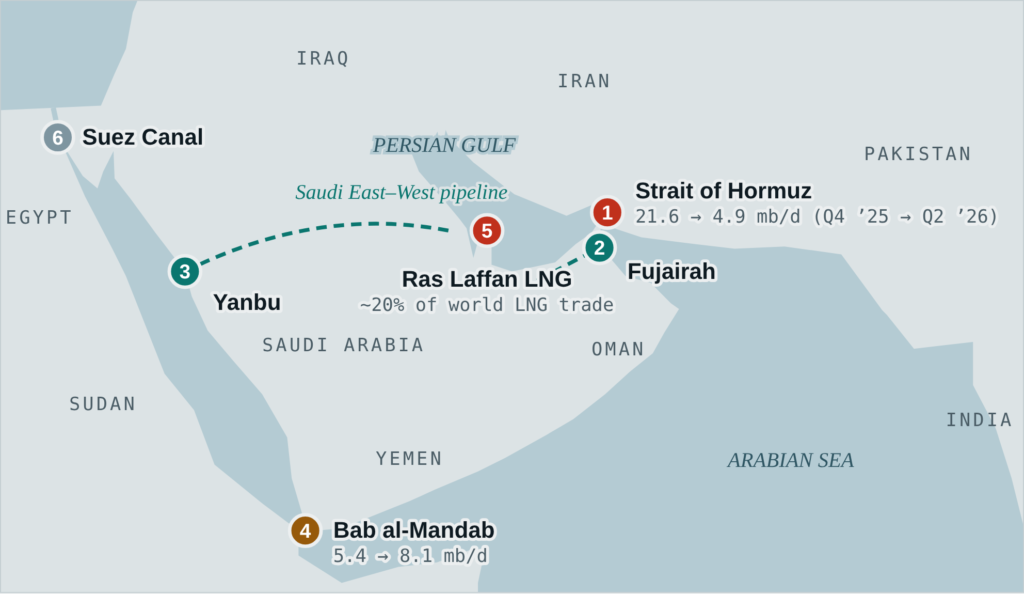
Draw it and it looks less like a front line and more like a plumbing diagram. Every marker on this map is a place where one bad week can move prices on another continent.
- Strait of Hormuz. The main artery. It carried 21.6 million barrels a day in late 2025 and 4.9 million in the second quarter of 2026.
- Fujairah. A terminal on the Gulf of Oman side, reached by pipeline, which lets some Emirati crude skip the strait.
- Yanbu. The Red Sea end of Saudi Arabia’s East–West pipeline, now carrying crude that once left through Hormuz.
- Bab al-Mandab. The southern gate of the Red Sea. Flows rose from 5.4 to 8.1 million barrels a day as Saudi crude rerouted.
- Ras Laffan. Qatar’s LNG hub, about a fifth of global LNG trade, struck by Iranian missiles in March.
- Suez Canal. The northern exit of the Red Sea route towards Europe.
4. Why is the Oil price the wrong number to watch?
Because price tells you how nervous traders are, while inventories tell you how long a country can last.
Brent opened 2026 at $60.75. It closed at $118.35 on 31 March, fell 15% to $92.77 on 8 April when a ceasefire was announced, averaged $83.40 in July, returned to about $118 in October and settled at $103.60 on 3 November, a four-week low. Up roughly 70% in ten months, and still the least revealing number in the market.
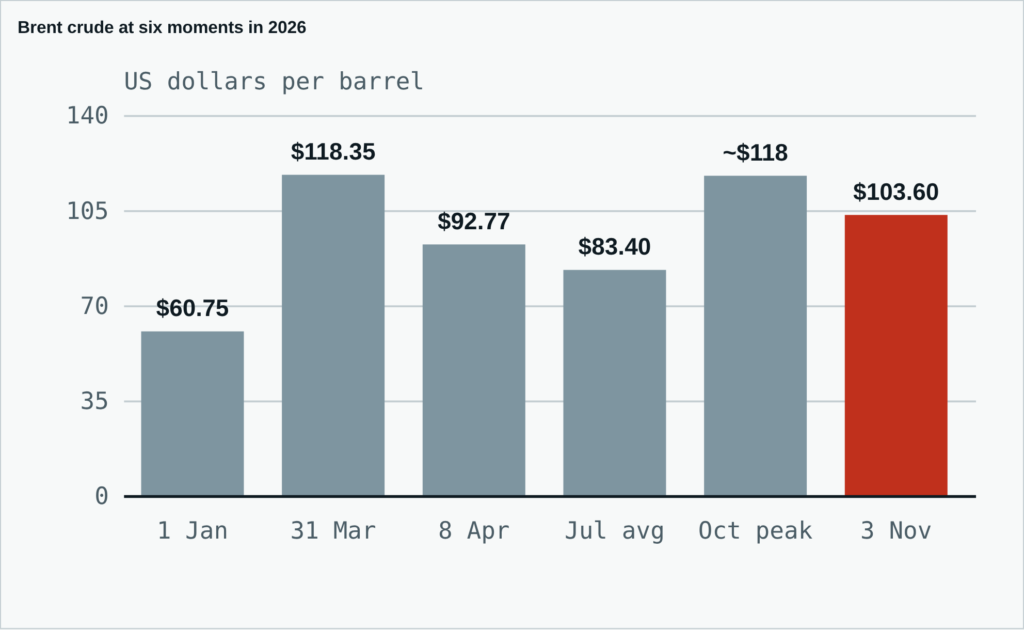
Source: World Oil Monitor (closes), Hargreaves Lansdown, World Bank (July), Oil & Gas Middle East, 3 November 2026.
October peak is approximate.
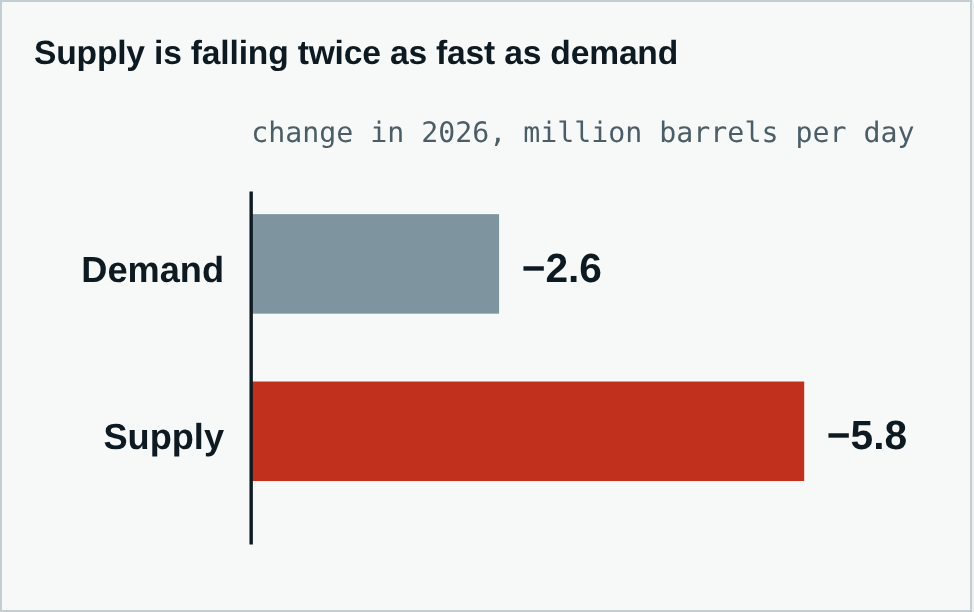
The slower story sits underneath. The IEA now expects world oil demand to fall 2.6 million barrels a day in 2026, to 102.4 million. It expects supply to fall 5.8 million, to 100.7 million. Supply is dropping more than twice as fast as demand, and stockpiles are filling the gap.
The release was historic. IEA members agreed on 11 March to put 400 million barrels on the market, more than double the 182 million of 2022. By the end of September about 331 million had been delivered. Birol was blunt about the limits, saying a release would not be “the solution”. A stockpile is a bridge. Every barrel spent this year is a barrel missing from the next emergency.
The crude also came back faster than the fuel. Kpler recorded refined products crossing Hormuz at 677,000 barrels a day in late September, against 3.6 million before the war. Diesel accounts for about a quarter of the 2026 demand decline, and Goldman Sachs has called the diesel crunch the biggest threat in the oil market. Trucks, tractors and trains run on the product the strait still struggles to deliver.
5. Who is most exposed, and who gains?
Exposure comes down to three questions. How much does a country import? How much of that crosses a chokepoint? How many days of stock does it hold? On those measures the shock was never shared equally.
| Economy | Exposure | What the shock revealed |
|---|---|---|
| India | Imports about 88% of its crude, 51% of its gas and 60% of its LPG | Only 9 to 10 days of strategic reserve cover. Current account deficit estimate widened from about $95bn to $120bn. |
| Japan | Between 75% and 90% of crude from the Gulf, depending on source and year | Gasoline subsidies at home and a $10bn pledge to help Southeast Asian partners diversify. |
| Pakistan | Import-dependent fuel market | Needed a $1.2bn IMF loan and $3bn of Saudi aid. |
| Sri Lanka | Import-dependent island economy | Severe fuel rationing and cooking gas shortages. |
| Iraq | Exported about 3.5 mb/d before the war, mostly through Hormuz | About $60bn of lost oil export revenue, by Baghdad’s own account. |
| Qatar | About 20% of global LNG trade from one hub | LNG output halted on 2 March, then Ras Laffan struck by missiles on 18 and 19 March. |
| Europe | Gas prices tied to the LNG market | TTF jumped more than 30% to €72 per MWh on 19 March. Diesel futures touched $190 a barrel. |
| United States | Net producer, yet priced off the world market | Commercial crude stocks forecast below their five-year low through year end. |
Dependency figures vary by year and source.
Who felt the Oil shock, and how
India’s numbers show the trap. A decade of buying from many sellers, Russia among them, kept crude arriving. Diversification worked. Reserves were the weak link, with roughly nine to ten days of cover and an import bill that stretched the budget. The Indian government cut excise tax on petrol to shield drivers, and analysts expect the fiscal deficit to rise to about 4.8% of GDP as a result.
A subsidy is a decision to pay for the crisis later, with interest.
The winners are quieter. Exporters with routes that skip the Gulf hold leverage they did not have a year ago. So do sellers of American LNG. Importers with no say over the price and little stock simply wait for someone else’s ceasefire.
6. Can more drilling and more pipelines fix this?
No. More supply helps only if it can reach the buyer, and every workaround so far has found a new chokepoint to lean on.
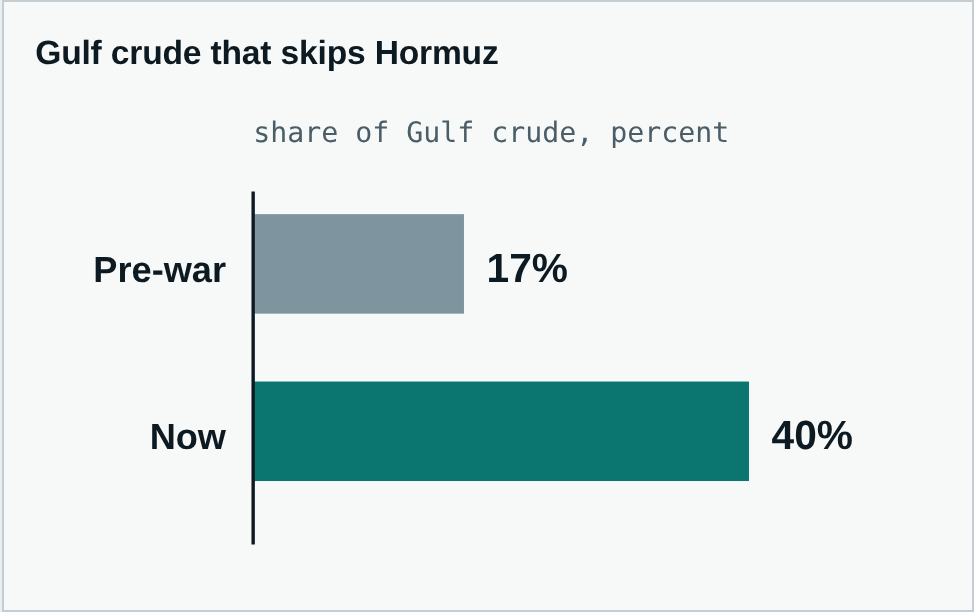
The pipelines did real work. About 40% of Gulf crude now bypasses Hormuz, against 17% before the war. Saudi Arabia pushed crude west along its East–West pipeline to Yanbu. In late September, crude crossing Hormuz briefly matched its pre-war baseline of 13.5 million barrels a day, helped by US escorts and those pipelines. Yet the workaround moved the risk instead of removing it.
Traffic through Bab al-Mandab climbed from 5.4 to 8.1 million barrels a day. A system with two doors is safer than one door, and still fragile if both open onto the same street.
The strait has also become a bargaining chip. Iran says it will reopen within days if Washington lifts its naval blockade, eases oil sanctions and releases frozen assets, which one account puts at no less than $12 billion. Whatever one thinks of those terms, the structure is the lesson. A waterway now carries the weight of a treaty.
7. Does the electric transition solve energy security, or only move the risk?
It solves part of it. Electric vehicles cut demand for imported Oil, but batteries and magnets depend on minerals that China processes at a scale nobody else matches.
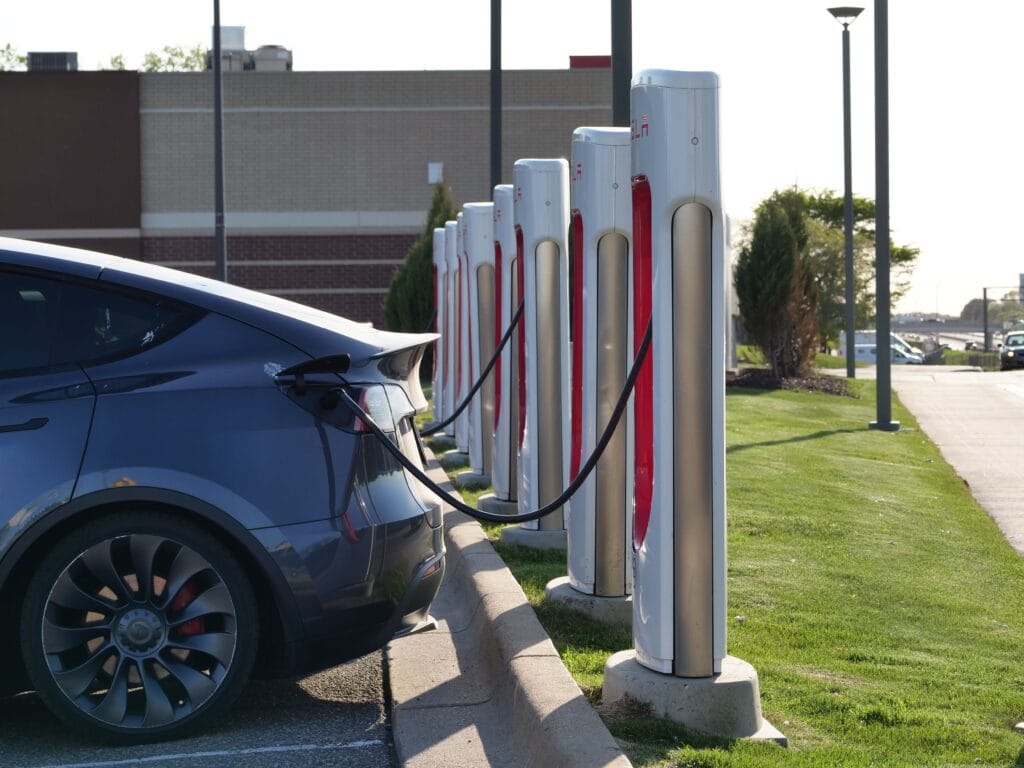
The demand response is real. The IEA expects about 23 million electric car sales in 2026, close to 29% of the global market. In the second quarter, sales hit records in 50 countries while total vehicle sales fell. That happened even as EV purchases declined in both China and the United States after policy changes. Birol said the rise of EVs was “providing some relief now amid the largest oil supply shock in history.” More than a dozen governments have announced new support since the shock began.
Then look at the other side of the ledger. China mined about 270 of the 390 thousand tonnes of rare earth oxide produced worldwide in 2025, roughly 69%, and handles up to 90% of the processing. The IEA tracks 20 strategic minerals, and China leads processing in 19 of them. Controls on seven medium and heavy rare earths, introduced in April 2025, remain in force. A pause on the wider October 2025 controls is due to lapse this month.
My argument is that Oil dependence is visible, insurable and stockpiled. Mineral dependence is quieter, concentrated in refining rather than mining, and has nothing like the IEA’s coordinated emergency system behind it. Swapping a barrel for a battery moves the vulnerability from a strait to a processing plant. It remains an improvement, because a magnet supply chain can be rebuilt over years while a closed strait empties the tank within weeks.
8. What does this cost ordinary people?
Energy security sounds like a matter for admirals and ministers. It is a household budget. The Food and Agriculture Organization has pointed out that Gulf natural gas is a feedstock for fertiliser, so a fuel shock becomes a food shock a season later. Rationing in Sri Lanka, subsidies in Japan and rescue loans in Pakistan are three versions of one story.
Poorer households spend the largest share of income on fuel and cooking energy, and have the fewest ways to switch. Governments that answer with subsidies are spreading the pain across future budgets. Governments that answer with stockpiles, efficiency and electrified transport are buying protection that outlasts the headline.
9. What are five rules for a world beyond Oil dependence?
- Treat stockpiles as strategy. IEA members entered the crisis holding more than 1.2 billion barrels of public emergency stocks. India held days of cover. Raise reserves, and plan the refill before the next shock arrives.
- Diversify routes and sellers together. A second pipeline to the same port is a second dependency. Resilience needs different geography, not just different contracts.
- Protect refined products, not only crude. Diesel is what the economy actually burns. Hold product stocks and keep refineries flexible about what they can process.
- Electrify demand and finance the minerals behind it. Mines, refineries and recycling in more than one country. Every kilometre driven on electricity is a barrel the strait cannot withhold.
- Plan for gas separately. LNG has no equivalent of the IEA’s emergency stocks. Ras Laffan showed that one terminal can remove a fifth of the traded market in a week.
10. What happens to Oil next?
Three paths are visible. In the first, talks succeed and the strait reopens. Brent fell 7.6% on 2 November on exactly that hope. In the second, the standoff grinds on. Goldman Sachs lifted its December Brent forecast to $105 from $90 on 1 November, and one analyst quoted by Bloomberg warns Oil could stay near $100 through 2027. In the third, escalation returns. At least four tankers were hit by projectiles and limpet mines near Hormuz in recent days.
Even the good outcome leaves a bill. The EIA expects prices to stay elevated until flows normalise and inventories are replenished, and replenishing stocks means buying the barrels the market is short of. Peace would end the emergency. It would not end the exposure.
11. FAQs
What is energy security?
Why is the Strait of Hormuz so important to Oil markets?
Are electric vehicles reducing dependence on Oil?
Will Oil prices fall if the strait reopens?
12. The barrel and the battery
The age of Oil is not ending next year. The world will burn it for decades. What is ending is the comfortable belief that owning Oil, or buying it, is the same as being secure.
Go back to the tanker, the rider, the farmer and the shopkeeper. None of them chose to be on the front line. Their safety depended on a route they did not control, a stockpile they did not see and a negotiation they were not invited to. That is the true measure of a country’s strategy. The nations that win the next decade will treat a barrel, a battery and a bypass as parts of one plan, and will count the lights staying on as the victory that matters most.
What do you think? Comment Below…
