

 By
Picture a junior diplomat in New Delhi at 3:40 a.m. on 12 September 2026. Her tea went cold two drafts ago. On the table in front of her sits one paragraph about the war in West Asia, and two delegations that cannot agree on a single verb.
Iran wants the aggressors named. The United Arab Emirates, a Gulf neighbour caught in Iran’s line of fire since the war began on 28 February, wants Iran named instead. Both countries belong to the same club. Both hold a veto. And in a few hours, the BRICS leaders’ summit opens with Xi Jinping and Narendra Modi on the same stage, so a text has to exist.
Negotiations ran until about 4 a.m. Then, miraculously, the New Delhi Declaration was agreed. It condemned unilateral war without naming anyone, which is the diplomatic equivalent of a flatmates’ group chat agreeing that “someone” should really do the dishes.
Here is the question nobody in that room could afford to ask out loud. One of those delegations speaks for an economy that is almost half of the entire bloc. What happens to BRICS if that delegation goes home?
Imagine the same room without the Chinese seat. Fewer flags. A quieter argument. Smaller cheques. And, here is the uncomfortable part, a lot less reason for the rest of the world to turn up and listen.
This blog makes an argument that will annoy both camps. BRICS without China is not a geopolitical giant. But it is not an empty shell either, and the reason why says more about the world of 2026 than about the acronym.
What Is BRICS In 2026, And Would It Survive Without China?
Without China, BRICS would still exist as a large and useful forum for the Global South, but it would lose about half its economic weight, its banking headquarters and most of its claim to rival the G7. It would be a stage, not a superpower.
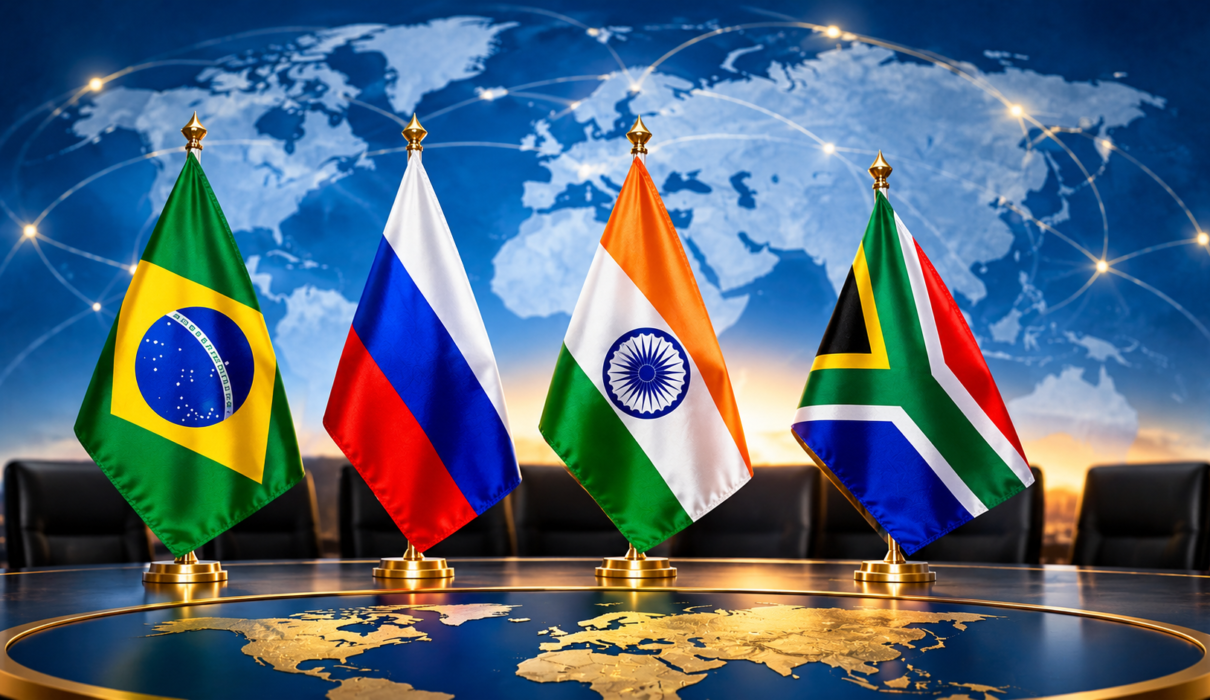
BRICS is an intergovernmental grouping of large emerging economies, now celebrating its 20th anniversary. Official BRICS and Indian government sources list eleven full members: Brazil, Russia, India, China, South Africa, Egypt, Ethiopia, Indonesia, Iran, Saudi Arabia and the UAE. Press reports describe Riyadh’s status less consistently, which tells you something about how loosely the club is stitched together.
India took over the rotating chair from Brazil on 1 January 2026, its fourth turn after 2012, 2016 and 2021. Its theme was resilience, innovation, cooperation and sustainability. The 18th BRICS summit followed at Bharat Mandapam in New Delhi on 12 and 13 September.
The headline numbers are impressive. According to data cited from the IMF’s April 2026 World Economic Outlook, the BRICS members hold about 49.5% of the world’s population, roughly 41% of global GDP and about 26% of global trade. The G7 sits near 28% of GDP. The exact share shifts depending on whether you measure at market exchange rates or purchasing power, but the direction is not in dispute: BRICS passed the G7 in global GDP share around 2020.
Also Read – The UN Was Built for 1945. Is It Still Fit for 2026?
Now comes the footnote that changes the whole story.
The Arithmetic: What Is Left When China Walks Out
Remove China and BRICS falls from about 41% of world GDP to about 21%, which puts it roughly seven points behind the G7. China alone accounts for 48.5% of the bloc’s GDP, according to the figures Business Today drew from IMF data.
| Member | Share of BRICS GDP (%) | Implied share of world GDP (%) |
|---|---|---|
| China | 48.5 | 19.9 |
| India | 20.7 | 8.5 |
| Russia | 8.2 | 3.4 |
| Indonesia | 6.0 | 2.5 |
| Brazil | 5.7 | 2.3 |
| Saudi Arabia | 3.2 | 1.3 |
| Other five members combined | 7.7 | 3.2 |
The third column is my own estimate, multiplying each share by the bloc’s roughly 41% of world GDP. Treat it as a guide to scale, not an official statistic.
Subtracting China from BRICS is like removing the engine from a car and then asking whether the cupholders can still get the family to Goa. India is the largest remaining economy, and it is less than half the size of the Chinese slice. Russia, hit by sanctions and war, contributes a little over 3% of world GDP. Brazil and Indonesia, for all their promise, sit near 2% each.
Population tells a gentler story. China holds roughly 1.4 billion of the bloc’s 3.9 billion people, so the remainder is still about 2.5 billion, or nearly a third of humanity. That is a lot of people. It is not a lot of purchasing power.
The institutions tell the harshest story. The New Development Bank, the flagship BRICS lender, is headquartered in Shanghai. The Contingent Reserve Arrangement, a $100 billion emergency fund, leans heavily on Chinese money. Take away the Chinese seat and you are not trimming the bloc, you are rebuilding it.
The Case For The Shell: BRICS Cannot Even Agree On A Sentence
The sceptics’ strongest argument is not about China at all. It is about glue. A bloc that cannot agree on a paragraph is not yet a bloc.
In April, a BRICS meeting on West Asia in New Delhi ended without a joint communique, and the chair issued a summary instead. In May, the foreign ministers’ meeting ended without a common declaration, because the UAE wanted Iran condemned and Iran wanted the United States and Israel named. India’s foreign minister, S. Jaishankar, pointedly reminded newer members that they must subscribe to BRICS’s existing consensus positions.
The September fix was clever and revealing. The New Delhi Declaration urged restraint in the Middle East but, according to one report, condemned neither the US-Israeli attack nor Iran’s targeting of Gulf states. Another account counted leaders of only eight of the eleven members at the proceedings. Business Standard’s editorial verdict was that the pomp beat the modest expectations, but hopes for the medium term should stay restrained.
Now add the money. The New Development Bank, the pride of the bloc, has aimed to lend about 30% in local currencies between 2022 and 2026, yet scholars such as David Collins of City St George’s, University of London argue that its size limits its power to dent dollar dominance when set against the World Bank. There is still no BRICS currency, only a long and polite conversation about one.
So the shell argument runs like this. BRICS is held together by two things: a shared irritation with a Western-run order, and Chinese scale. Irritation is a feeling, not an institution. Scale is a fact, and it has one passport. Strip it away and the remaining members have to explain why Brazil, India, Indonesia, Iran and the UAE should coordinate at all.
That is a serious argument. It is also incomplete.
The Rebuttal: A Club Of Hedgers Does Not Need A Hegemon
Here is what the shell argument misses. Most BRICS members did not join to become Chinese satellites. They joined to avoid becoming anyone’s satellite.
Think about what India, Brazil, Indonesia and the Gulf states actually want: freedom to trade with Washington, Beijing, Brussels and each other without being forced to pick a camp. BRICS is one more table at which they can sit. That logic, multi-alignment, survives without China because it never depended on China.
India proved the point in September. It chaired a bloc full of rivals, kept the language short of anti-Western, and, as Outlook India reported, resisted an openly anti-Western stance while still landing a consensus text. Narendra Modi’s line to Xi Jinping on the summit’s sidelines, that differences should not become disputes, could serve as the bloc’s unofficial motto.
There is also trade momentum that no single member owns. Intra-BRICS merchandise trade grew from $84 billion in 2003 to $1.17 trillion in 2024, according to the figures Business Today cited. A good share of that runs through Beijing, but the habit of trading across the Global South is now broader than any one capital.
And consider the awkward flip side. A BRICS without China would be far less alarming to Washington. Donald Trump has reportedly threatened punitive tariffs on countries that align with the bloc. An India-led, Indonesia-heavy, Gulf-funded group that talks about local currencies and UN reform sounds less like a rival order and more like a lobbying coalition for fairer rules.
That is the paradox at the centre of this debate. China gives BRICS its weight, but China also gives BRICS its menace. Remove the first and you lose power. Remove the second and you might gain legitimacy. Neither outcome is the “empty shell” the sceptics describe, and neither is the giant the enthusiasts promise.
My Verdict: A Good Address With A Thin Vault
BRICS without China is not a geopolitical giant. It is a well-located building with a thin vault. The address is excellent: nearly a third of humanity, the Gulf, South Asia, Southeast Asia, Africa and Latin America under one roof. The money, the bank and the industrial muscle are the part that moves out with the Chinese seat.
But the opposite error is just as lazy. BRICS with China and without India’s credibility is not a giant either. It is a Chinese-led platform with decorative guests, and the Global South has enough of those already. The bloc’s real power comes from the tension between its two Asian heavyweights, because that tension forces everyone to speak in language that a Brazilian farmer, a Gulf sovereign fund and a Delhi civil servant can all sign.
So judge the bloc by three tests, not by its GDP share:
- Can it agree on hard issues? New Delhi managed a text, barely, at 4 a.m. That is a pass with a warning.
- Can it move real money? The New Development Bank and local-currency settlement are real but small. That is an incomplete.
- Can its two giants share a room? Xi Jinping’s first India visit in nearly seven years, and a bilateral with Modi, suggest the answer is yes for now.
That third test is the one to watch. If India-China relations curdle, BRICS becomes a stage where two actors refuse to share the spotlight. If they hold, the bloc has something no Western club has: a standing negotiation between rival powers that decide to keep talking.
That is my argument, and I will defend it to anyone who thinks BRICS is either the end of the dollar or a talking shop with catering. It is neither. It is a hedge, and hedges are only as strong as the assets they protect.
What This Means For Ordinary People And Investors
BRICS is not a stock, a currency or a country, so no one can “buy BRICS”. What people actually feel is quieter: an exporter who can settle a contract in local currency instead of dollars, a student whose country gets a seat in a reformed IMF, a fuel importer who gains a second supplier.
For anyone investing or planning around the bloc, three signals matter more than any summit photo:
- India-China relations. They decide whether the bloc coordinates or merely convenes.
- Local-currency settlement and New Development Bank lending. Slow, boring progress here is the real de-dollarization story, not headlines about a common currency.
- Gulf-Iran tensions. They are the fault line most likely to break consensus again.
The practical lesson is to treat BRICS as a diplomatic multiplier, not an economic unit. Its members have different growth rates, debts, politics and wars. This is analysis, not financial advice, and anyone allocating capital should look at each country separately.
Also Read – BRICS is not a bloc of rising powers. China is hauling it alone
FAQs…
What does BRICS stand for?
Which countries are in BRICS in 2026?
How much of the BRICS economy is China?
Could BRICS survive without China?
Is BRICS trying to replace the US dollar?
The Bottom Line
BRICS without China would not be a geopolitical giant. It would lose about half its economic weight, its bank’s headquarters and much of its leverage. It would not be an empty shell either, because its real asset is a standing negotiation among rivals, India and China, Iran and the UAE, Russia and everyone’s nerves, that still produces a text at 4 a.m. Giants are measured in GDP. Shells are measured in purpose. BRICS has plenty of purpose and borrows most of its GDP from one member.
