

 By
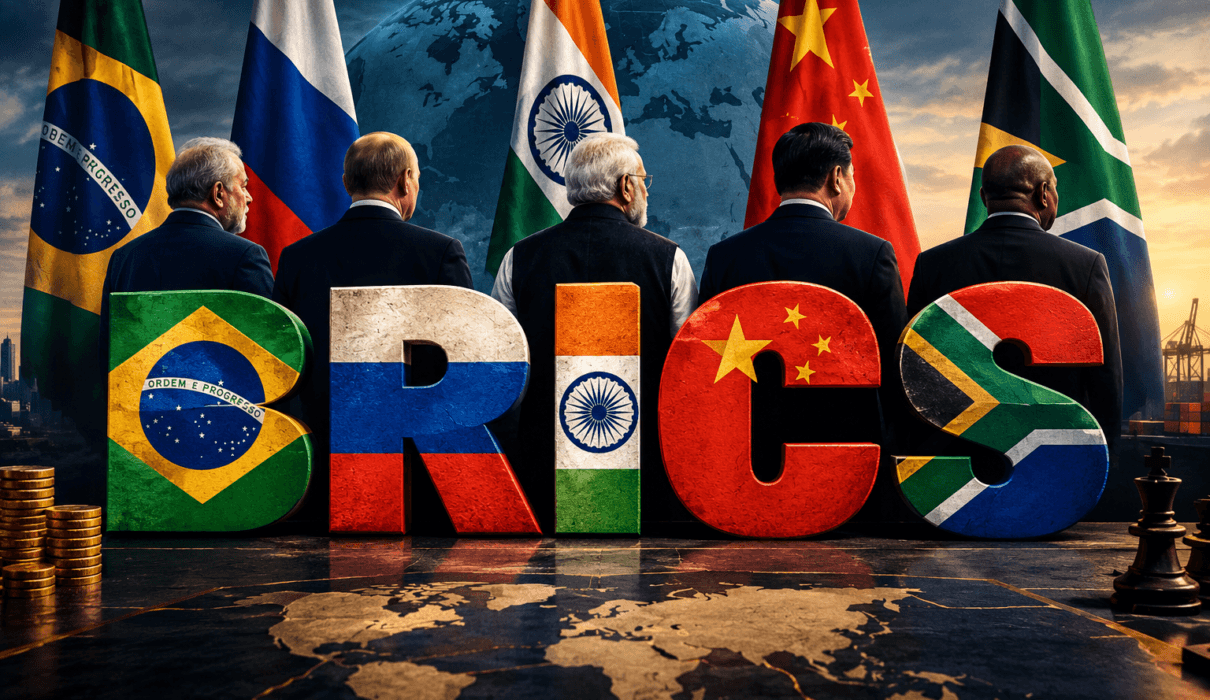
By For twenty years, Western commentators have treated BRICS as a punchline — a talking shop for autocrats and developing economies that meets once a year, issues a vague statement, and changes nothing. That story is getting harder to tell. In September 2026, eleven heads of state walked into Bharat Mandapam in New Delhi representing roughly half the planet’s population and, by purchasing-power terms, a larger slice of global output than the G7. They walked out with a 140-paragraph declaration that quietly rewires how a huge share of humanity plans to trade, borrow, and settle payments for the next decade.
None of this means the dollar is dying tomorrow, or that BRICS has become a unified geopolitical bloc with one voice. It hasn’t. But the gap between “BRICS is irrelevant” and “BRICS is inevitable” has narrowed enough that pretending nothing has changed is now the less defensible position. This is a BRICS 2026 summary and an argument, not a press release: what actually happened in New Delhi, what it means, and where the multipolar-world narrative is honest — and where it’s hype.
1. BRICS 2026 in 60 Seconds
- What happened: The 18th BRICS Summit was held September 12–13, 2026, at Bharat Mandapam in New Delhi, chaired by India under Prime Minister Narendra Modi.
- Who showed up: Leaders and senior officials from all eleven member states — Brazil, Russia, India, China, South Africa, Egypt, Ethiopia, Indonesia, Iran, Saudi Arabia, and the UAE — plus partner countries and invited guests.
- What they signed: The New Delhi Declaration, a 140-paragraph consensus document covering trade, payment systems, institutional reform, climate, health, AI governance, and conflict diplomacy.
- The headline move: A push toward local-currency trade settlement and interoperable payment rails (built around the BRICS Payment Task Force and BRICS Pay), explicitly framed as de-risking from the dollar rather than replacing it.
- What didn’t happen: No common BRICS currency. No direct naming or condemnation of the United States, despite the bloc’s members being squeezed by 2026 tariff policy and the Iran conflict.
- What’s next: China takes the chairship in 2027 and hosts the 19th summit — the real test of whether New Delhi’s promises turn into operating infrastructure.
2. What BRICS Actually Is Now (It’s Not What You Remember)
If your mental model of BRICS is still “Brazil, Russia, India, China, and South Africa,” it’s about six years out of date. The bloc added Egypt, Ethiopia, Iran, Saudi Arabia, and the UAE in 2024, and Indonesia joined in 2025 — expanding the core membership to eleven. On top of that, ten additional partner countries signed on in 2025, including Belarus, Kazakhstan, Nigeria, Thailand, Uzbekistan, and Vietnam, creating a looser outer ring of aligned states.
The practical effect is that “BRICS” no longer describes five large emerging economies with shared grievances about Western financial dominance. It describes a sprawling coalition that includes the world’s largest oil exporters, its most populous nations, several of its fastest-growing economies, and at least two nuclear powers with an openly adversarial relationship with Washington. That’s a very different animal, and it’s one reason the group’s internal contradictions have become as newsworthy as its unity.
Key Takeaways
- BRICS now spans eleven member states and ten partner countries, representing roughly half the world’s population and about 40% of global GDP in PPP terms.
- The 2026 New Delhi Declaration prioritizes local-currency trade settlement and payment infrastructure over any shared currency — this is de-risking, not de-dollarization.
- The bloc’s internal rivalries (Iran-Saudi Arabia, Russia-China, India’s balancing act) remain its biggest structural weakness.
- Institutional reform — IMF quotas, WTO dispute resolution — is the slower, less-covered but potentially more durable part of the multipolar story.
- China’s 2027 chairship will determine whether New Delhi’s commitments become operating infrastructure or another unfulfilled declaration.
Also Read – The Rise of a Multipolar World: Global Power Shift Explained
3. BRICS : Inside the 18th Summit
India held the BRICS chairship for the fourth time in 2026, under the theme “Building for Resilience, Innovation, Cooperation and Sustainability.” The summit itself ran two days, and the substance landed almost entirely on day one, when member states unanimously adopted the New Delhi Declaration — a text that took months of technical negotiation to draft and, notably, avoided the kind of last-minute walkouts that have plagued past BRICS gatherings.
A few things stand out about what the declaration actually contains:
Trade and payments. The document endorses interoperable local-currency payment systems, backs the mandate of the BRICS Payment Task Force, and supports expanded local-currency financing through the New Development Bank. It also references commodity settlement platforms — a direct response to years of complaints from Russia, Iran, and others about sanctions-driven exclusion from dollar-clearing systems.
Institutional reform. The declaration explicitly calls for IMF quota reform under the 17th General Review of Quotas and for restoring a functioning WTO dispute-settlement mechanism — both long-standing Global South demands that Western-led institutions have slow-walked for years.
Conflict diplomacy. On the Middle East, the bloc called for restraint and expressed firm opposition to the forced displacement of Palestinians, but stopped short of condemning the US-Israeli strikes that shaped much of 2026. On Ukraine, the language was even softer — a generic call for dialogue, consultation, and diplomacy that names no party and assigns no blame.
What’s conspicuously missing. Despite BRICS economies absorbing the brunt of the second Trump administration’s tariff escalation and the fallout from the 2026 Iran war, the declaration never names the United States. It criticizes “unilateral sanctions” and “the global trade war” in the abstract — a diplomatic choice that lets every member read the text through their own lens without anyone having to sign their name to direct confrontation.
That last point matters more than it looks. A bloc that can’t agree to name the country whose policies triggered half the summit’s agenda is a bloc that still runs on consensus-by-vagueness. That’s a real constraint on how far “multipolarity” can go in practice — and it’s worth sitting with before we get too excited about the rest of the declaration.
Read – BRICS INDIA 2026 : Building for Resilience, Innovation, Cooperation and Sustainability
4. De-Dollarization or De-Risking? The Argument Nobody’s Actually Having
This is where most coverage of BRICS gets lazy. Headlines love the phrase “de-dollarization,” because it implies a currency war with a winner and a loser. The New Delhi Declaration doesn’t say that, and Indian officials went out of their way to clarify it: this is not an attempt to kill the dollar. It’s an attempt to build alternatives so that dollar dependence stops being a single point of failure.
The distinction is not semantic — it’s strategic. A shared BRICS currency was never seriously on the table in New Delhi, and the declaration says as much. What is on the table is narrower and more achievable: bilateral currency swap lines, rupee-ruble and yuan-based settlement for specific trade corridors, and payment rails that don’t route through SWIFT or require a dollar intermediary at all.
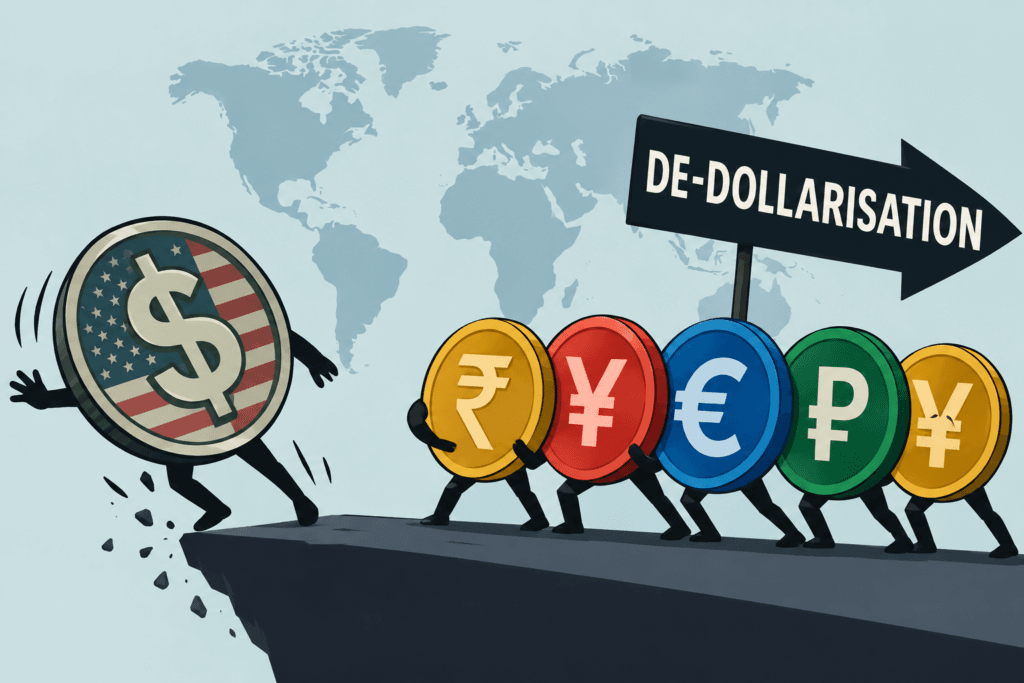
Iran is the clearest case study, and also the most revealing one. Tehran didn’t arrive in New Delhi asking for a dollar bypass — it arrived having already built one: a rial-ruble arrangement with Russia, a long-term strategic cooperation framework with China, and oil sales settled overwhelmingly in yuan, all operating before the ink on the declaration dried. That’s the honest version of the de-dollarization story — not a coordinated bloc-wide revolt against the dollar, but individual sanctioned states quietly building workarounds, with BRICS providing institutional cover and shared plumbing to scale them.
India complicates the triumphalist narrative further. New Delhi has been explicit that it’s chasing de-risking, not de-dollarization as ideology — a conservative goal focused on reducing sanctions exposure without provoking a confrontation with Washington that India, with deep trade and tech ties to the US, has no interest in inviting. Even India’s own local-currency success story is thin: rupee-based settlement remains largely confined to Russia and the UAE, hampered by the mechanical problem of what Russia does with rupees it struggles to spend.
So here’s the argument: BRICS in 2026 isn’t building a rival to the dollar system. It’s building redundancy into the existing one — optional off-ramps for countries that get burned by sanctions, tariffs, or geopolitical whiplash. That’s a meaningfully different, and more durable, kind of multipolarity than the “new global currency” fantasy that dominates social media. Redundant infrastructure doesn’t need consensus to work. It just needs enough countries willing to use the exits that already exist.
5. The Numbers Behind the Noise
Strip away the diplomatic language and the economic weight behind BRICS is not in dispute — only what to do with it is.
| Metric | BRICS (11 members) | G7 |
|---|---|---|
| Share of world population | ~50% | ~10% |
| Share of global GDP (PPP terms) | ~40–42% | ~30% |
| 2026 GDP growth (bloc average) | Roughly 3x the G7 average | ~1% |
| India 2026 growth forecast | 6.2% | — |
| China 2026 growth forecast | Slowing, but still outpacing most G7 members | — |
The PPP-versus-market-exchange-rate distinction is where most bad-faith arguments on both sides live. In market dollar terms, the G7 still commands a larger absolute share of global output — the US alone remains the single largest national economy on earth, and Wall Street still prices most of the world’s commodities and debt. But PPP is the more honest measure of domestic purchasing power and material capacity — how much a Chinese or Indian consumer, factory, or government can actually buy and build with their income at home — and on that measure, the BRICS-vs-G7 crossover happened years ago and has only widened since.
The population gap is arguably more consequential long-term than either GDP measure. A bloc with half the world’s people and structurally younger demographics than the G7’s aging economies isn’t just an economic story — it’s a story about where global demand, labor supply, and political weight are headed over the next thirty years, regardless of what any single summit declaration says.
6. The Cracks Inside the Bloc
Here’s where the multipolar-world narrative has to get honest with itself. BRICS is not a coalition of like-minded partners — it’s a coalition of convenience between countries that often actively distrust each other.
Iran and Saudi Arabia are both full members, and their regional rivalry hasn’t gone anywhere just because they now sign the same declarations. Russia’s economic weight inside the bloc is dwarfed by China’s, to the point that some analysts question whether Moscow is a genuine partner or an increasingly dependent client state reliant on Chinese demand for its energy exports. India, meanwhile, is playing a genuinely difficult balancing act — deepening BRICS ties while maintaining its Quad relationship with the US, Japan, and Australia, and keeping enough distance from China, with whom it shares an unresolved border dispute, to avoid looking like Beijing’s junior partner.
The declaration’s studied silence on the United States, and its near-content-free language on Ukraine, isn’t diplomatic elegance — it’s the visible seam where consensus breaks down. A genuinely unified bloc wouldn’t need to avoid naming its primary antagonist; it does so because naming names would blow up the unanimity the whole summit depends on. Every BRICS declaration since the bloc’s expansion has walked this same tightrope, and it gets a little more crowded each year.
This is the part critics get right, and boosters tend to skip past: BRICS is not becoming a bloc in the NATO or EU sense — an alliance with shared values and mutual defense commitments. It’s becoming something closer to a shared toolbox that structurally opposed countries can each reach into for their own separate reasons. That’s still meaningful. It’s just not the coherent anti-Western axis that either side of the debate often pretends it is.
7. Institutional Reform: The Longer Game
Underneath the payments story is a slower, arguably more consequential push: reforming the institutions the current global order was built on. The declaration’s call for IMF quota realignment under the 17th General Review isn’t new — the Global South has made this demand for over a decade — but having eleven states with roughly 40% of world GDP formally endorse it in one document adds pressure a G77 statement alone never could.
The same goes for restoring the WTO’s dispute-settlement mechanism, effectively paralyzed since the US blocked new appellate body appointments years ago. BRICS can’t fix that unilaterally — the WTO requires consensus among all members, including the US — but a unified bloc voice raises the diplomatic cost of continued obstruction.
None of this trends on social media the way “BRICS ditches the dollar” headlines do. But institutional reform, however slow, is usually where multipolar shifts actually get locked in — not in summit photo-ops, but in the unglamorous business of who gets a bigger vote at the IMF and whose trade disputes get adjudicated.
8. What This Means for the Rest of Us
If you run a business that trades with India, Brazil, the Gulf states, or Southeast Asia, the takeaway isn’t “the dollar is dead” — it’s that alternative settlement rails are becoming real enough to plan around, not just theorize about. Watch the BRICS Payment Task Force’s technical output over the next 12–18 months, not the summit declarations; infrastructure that lowers transaction costs and sanctions exposure gets adopted by exporters long before it gets political fanfare, simply because it’s cheaper and safer.
For the Global South more broadly, the practical stakes are institutional, not rhetorical. IMF quota reform and NDB financing expansion matter more to a mid-sized economy in Africa or Southeast Asia than any de-dollarization headline — those are the levers that actually determine borrowing costs and infrastructure access.
And for anyone trying to read the geopolitical chessboard: the real signal from New Delhi isn’t that a new bloc has formed to challenge the West. It’s that a critical mass of the world’s population and productive capacity now has enough shared interest in not being dependent on any single country’s financial infrastructure that they’re willing to build redundant systems together, even while disagreeing on almost everything else. That’s a quieter, more durable kind of power shift than the currency-war headlines suggest — and arguably a more dangerous one for anyone who assumed the old order was permanent.
9. The Skeptic’s Case (And Why It’s Worth Taking Seriously)
It would be dishonest to end without the obvious caveat: BRICS has a long history of ambitious declarations that never became operational reality. The bloc has talked about alternative payment systems for close to a decade. The New Development Bank was supposed to rival the World Bank and has, so far, been a modest lender operating at a fraction of that scale. Local-currency trade between India and Russia — arguably BRICS’s most-cited success story — remains a small, situational trickle rather than a structural shift, hampered by the unglamorous problem that Russia struggles to find enough to buy with the rupees it earns.
The gap between “endorsed in a declaration” and “operating at scale” is where BRICS ambitions have died before, and the 2026 declaration itself concedes as much — most of its payment mechanisms need further technical negotiation before they’re operational. China’s 2027 chairship is the real test: does the bloc’s largest economy push the New Delhi framework into working infrastructure, or does it become another slide in next year’s summit deck?
10. Frequently Asked Questions…
What is BRICS in 2026?
Did BRICS create a new currency in 2026?
Where and when was the 2026 BRICS summit held?
Is BRICS bigger than the G7 economically?
What did the New Delhi Declaration actually agree to?
Who hosts the next BRICS summit?
11. My Take: Is This Actually a New World Order?
No — and yes, depending on the timeframe you’re using. In 2026, BRICS is not replacing the dollar, not forming a unified geopolitical alliance, and not speaking with one voice on the conflicts that matter most to its own members. Anyone selling you the “BRICS just ended American hegemony” narrative is selling you something.
But the slower story is real and probably more important: a coalition representing half of humanity has now formally, repeatedly, and institutionally committed itself to building financial redundancy outside Western-controlled infrastructure — not out of ideology, but out of accumulated experience with sanctions, tariffs, and payment freezes that made single-point dependency look like a strategic liability rather than a convenience. Multipolarity isn’t arriving as a dramatic currency collapse. It’s arriving as slow, boring, technical infrastructure-building that most people will only notice once it’s already normal — and by the New Delhi Declaration’s own admission, that infrastructure is still mostly blueprint, not rails.
The honest conclusion is that BRICS in 2026 has built the scaffolding for a multipolar financial order without yet building the order itself. Whether that scaffolding becomes a building or gets abandoned half-finished depends less on New Delhi’s declaration than on what Beijing does with the chairship in 2027 — and on whether member states with irreconcilable regional rivalries can keep signing the same documents once the easy consensus language runs out.
