

 By
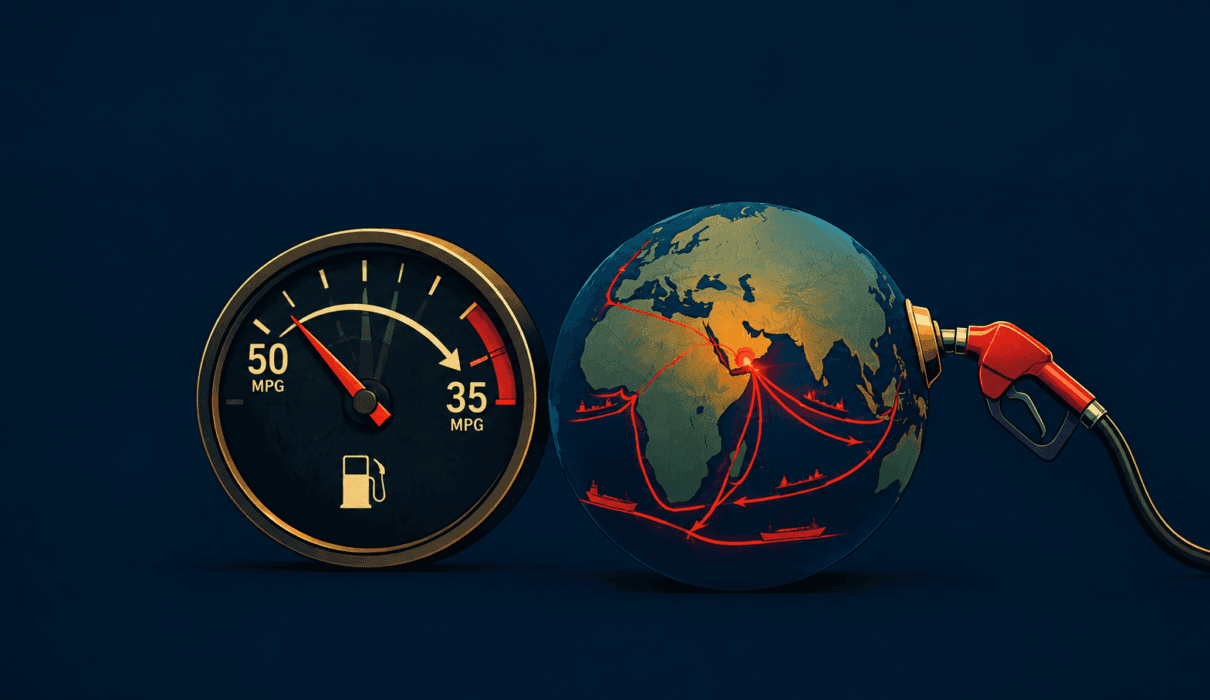
By Washington just told Detroit it can make thirstier cars, and told the world it’s betting on oil.
The new rule cuts the 2031 fleet fuel economy requirement from 50.4 mpg to 34.9 mpg. The Trump Administration calls it common sense and cheaper cars. Look past the sticker price, though, and this is a geopolitical wager: that abundant American oil is a stronger shield than efficiency, and that the world will stay hooked on combustion long enough for the bet to pay off.
Key takeaways:
- The rule is partly symbolic. Penalties for missing the targets were already zeroed out, so this locks in a political direction more than it changes compliance.
- The logic is inverted. CAFE was born to reduce exposure to foreign oil shocks, and this move deliberately keeps that exposure.
- The real risk is strategic. Higher demand supports rival producers’ revenues, and a lax home market can leave US automakers behind China in the technology race.
Below, we break down who wins, who loses, and why this may be the costliest “affordability” policy in years.
1. What the Trump Administration Changed in US Fuel Rules
The finalized rule resets CAFE standards for model years 2022 through 2031 and ends credit trading from the 2028 model year. The official case is affordability. NHTSA projects a $1,300 cut in the average new-vehicle price and $138 billion in consumer savings over five years.
The rule is also partly symbolic. The 2025 budget law had already zeroed out penalties for missing the targets, and the retroactive reset gives automakers credits they can bank against a future tightening. The rule locks in a political preference more than it changes day-to-day compliance.
Also Read – Freefall: Trump’s State-by-State Approval Numbers Reveal a Presidency Losing Its Grip
2. Why the Trump Administration’s Oil Bet Inverts CAFE’s Original Logic
CAFE was created in 1975 in response to the Arab oil embargo. Its purpose was strategic: burn less oil, and foreign suppliers hold less leverage over you.
Today’s policy runs the other way. America is now a giant producer, and the Trump Administration’s “energy dominance” thinking treats domestic demand as an asset. The argument is that if the country pumps more than almost anyone, it need not fear the pump.
That argument has a flaw. Crude trades on a global price. A disruption in the Strait of Hormuz lifts prices in Ohio even when the oil comes from Texas. Efficiency was a demand-side hedge that worked whoever supplied the barrels. Removing it makes American households more exposed to price shocks, not less.
3. The Hidden Geopolitical Winners
Weaker standards keep global oil demand higher than it would otherwise be. That marginally supports prices, and higher prices help every producer, including OPEC+ members and Russia. Washington is subsidizing its rivals’ revenue by keeping its own fleet thirsty. One caveat: the effect is modest and depends on how fast other markets electrify.
4. The China Factor: Who Owns the Next Fleet?
This is the deeper risk. Beijing has spent a decade building dominance in batteries, EV supply chains and low-cost manufacturing. Europe and much of Asia are still pushing electrification. If US automakers build for a lax home market, they risk falling behind in the export markets that are tightening.
The gap could be self-reinforcing. Less domestic pressure means less investment in US battery capacity, which means more reliance on Chinese supply chains if demand later shifts. The policy protects short-term margins while risking long-term industrial leverage.
5. Policy Whiplash and the Investor Lens
Automakers now face a reversible regime. The administration has also ended the $7,500 EV tax credit and repealed federal vehicle greenhouse gas standards. The next administration, or the courts, could swing the pendulum back. For long-lived capital projects like battery plants, that uncertainty raises the cost of capital more than any single rule does.
6. FAQ
What did the Trump Administration change about fuel economy standards?
Will this make cars cheaper?
Federal projections say yes, by roughly $1,300 per vehicle. Critics note that lower efficiency raises fuel costs over a vehicle’s life.
How does this affect oil geopolitics?
7. Bottom Line
The cheap-cars argument is plausible in the near term, but it hides the trade-off. Lower efficiency means higher lifetime fuel spend. It also means a bigger stake in oil markets Washington cannot control, and a weaker starting position in the technology race that will define the next automotive era. The bet pays off only if oil stays cheap, supply stays safe and the world stays reliant on combustion. Those are three big ifs.
Disagree? Comment your opinion…
Sources:
