

 By
By Picture a mid-sized auto parts supplier outside Cleveland. Forty employees, three decades in business, a factory floor that hums with the quiet rhythm of a company that has weathered recessions, oil shocks, and two prior rounds of tariffs. In the spring of 2025, the owner gets a call from her customs broker: the steel she imports from a longtime supplier just got more expensive — again. She doesn’t get to negotiate. She doesn’t get to wait it out. She either eats the cost, passes it to her customers, or cuts a shift.
Picture a mid-sized auto parts supplier outside Cleveland. Forty employees, three decades in business, a factory floor that hums with the quiet rhythm of a company that has weathered recessions, oil shocks, and two prior rounds of tariffs. In the spring of 2025, the owner gets a call from her customs broker: the steel she imports from a longtime supplier just got more expensive — again. She doesn’t get to negotiate. She doesn’t get to wait it out. She either eats the cost, passes it to her customers, or cuts a shift.
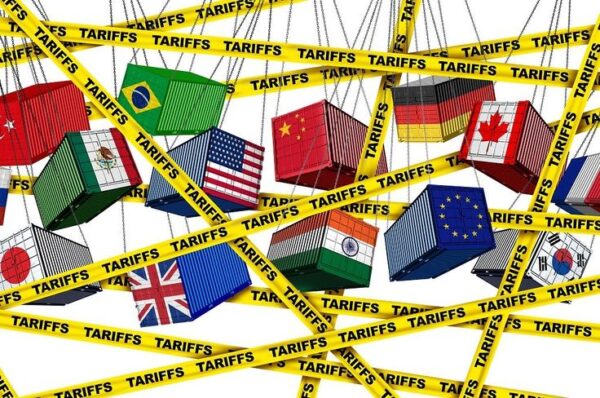
Multiply that phone call by tens of thousands, on every continent, and you have the story of the global economy in 2025 and 2026. Not a chess match between presidents and premiers — a slow-motion transfer of cost from boardrooms and trade ministries onto factory floors, grocery aisles, and farm co-ops. That’s the part the headlines about “Trade wars” and “trade retaliation” often skip. Trade wars aren’t fought between countries in some abstract sense. They’re fought, and paid for, by people who never wanted a seat at the table.
That’s the story worth telling. Not just who’s winning the negotiation — but who’s actually footing the bill.
Key takeaways:
- Tariffs are a tax paid by importers and, ultimately, consumers — not by the exporting country, whatever the political framing suggests.
- The US Supreme Court struck down Trump’s sweeping IEEPA tariffs in February 2026, but the administration simply rerouted through Section 122, 301 and 232 — trade wars didn’t stop, they changed legal costumes.
- The US and China are negotiating tariff cuts ahead of a Xi–Trump summit in late September 2026, while a parallel trade war with Canada and regional disputes (like Colombia–Ecuador) show tariffs have gone global, not just bilateral.
- The real fight isn’t about fairness — it’s about who controls the choke points of the 21st-century economy: chips, rare earths, and supply chains.
1. What Are Trade Wars , Really?
A trade war is what happens when countries use tariffs, quotas, export controls, or other trade barriers as weapons — not to protect a narrow domestic industry, but to pressure, punish, or coerce a trading partner into changing its behavior. It’s economics repurposed as statecraft. The tool looks technical — a customs duty, a percentage on an import form — but the intent is political: leverage, deterrence, or retaliation.
Trade wars are not new. The Smoot-Hawley Tariff Act of 1930 raised US duties on thousands of imports and is widely blamed for deepening the Great Depression by triggering a wave of foreign retaliation that gutted global trade volumes. The lesson from that era has echoed through nearly a century of trade policy: tariffs are simple to impose and brutally hard to walk back once other countries start hitting back.
Also Read – Trade Wars Made Simple: A Beginner’s Guide..
2. How We Got Here: The Anatomy of the 2025–2026 Trade War
If you’ve felt like trade war headlines have been nonstop for two years, you’re not imagining it. Here’s the shape of it.
The opening shot. In April 2025, the US declared a national economic emergency and imposed a sweeping set of “reciprocal” tariffs on imports from nearly every country, alongside separate levies on Canada, Mexico, and China tied to fentanyl trafficking concerns. The legal basis was the International Emergency Economic Powers Act (IEEPA) — a 1977 law built for freezing the assets of hostile regimes, not for rewriting global trade flows.

The China front. The US-China relationship became the main battlefield, as it was during the first Trump-era trade war of 2018–2019. Washington escalated tariffs on Chinese electronics, semiconductors, EV components, and industrial goods through 2025 and into 2026, layering on Section 301 investigations — the same legal tool used to justify the original 2018 tariffs — against a widening circle of trading partners, including the EU, Vietnam, Japan, and India, targeting steel, EVs, semiconductors, solar, and robotics.
Beijing answered not just with retaliatory tariffs on US agricultural exports, but with something more strategically potent: export restrictions on rare earth elements, the minerals that sit inside everything from smartphones to fighter jets. That single move exposed how much of the “trade war” was really a resource war in disguise.
The courts step in. Then came the plot twist few saw coming. In February 2026, the US Supreme Court ruled 6-3 in Learning Resources v. Trump that IEEPA does not authorize the president to impose tariffs at all — not the global “reciprocal” tariffs, and not the fentanyl-linked duties on Canada, Mexico, and China. The majority opinion was blunt: reading IEEPA as tariff authority was, in the Court’s words, an “extravagant” stretch of a law meant for genuine national emergencies. It was a rare moment where the judiciary drew a hard line around unilateral executive power over trade.
But a legal setback isn’t the same as a policy retreat. Within days, the administration pivoted to other statutory tools — Section 122 of the Trade Act (a temporary surcharge power capped at 150 days), alongside existing Section 301 and Section 232 authorities on steel, aluminum, and autos — to keep tariffs largely in place under different legal justification. The ruling reshuffled the paperwork. It didn’t end the trade war.
Europe cuts a deal. Not every front escalated. The EU and US struck a framework in mid-2025 capping US tariffs on most EU goods at 15%, in exchange for the EU eliminating tariffs on US industrial goods and opening access for American agricultural and seafood products. It took until mid-2026 for the European Parliament and member states to finish the legislative work to implement it — a reminder that even “resolved” trade disputes take painfully long to actually close.
Canada gets caught in the crossfire. The US-Canada relationship, anchored by decades of integrated supply chains under NAFTA and then USMCA, took a harder hit. By August 2026, the US had imposed 50% tariffs on roughly $20 billion of Canadian goods, with Ottawa threatening retaliation, and negotiations snagged on politically explosive issues like Canada’s dairy supply management system and digital services taxes. Analysts increasingly describe the USMCA review process as an early, forced renegotiation rather than a routine check-in.

And it’s not just a US story. Trade wars have gone regional and self-replicating. Colombia and Ecuador spent much of 2026 locked in an escalating tariff dispute of their own — reaching triple-digit tariff rates on each other’s goods — a reminder that once tariffs become a normalized tool of statecraft, smaller economies start reaching for them too.
Where it stands right now. As of this month, Washington and Beijing are negotiating tariff reductions on agricultural and energy goods — reportedly around $30 billion in trade on each side — ahead of a summit between Presidents Trump and Xi. It’s being read as a possible extension of the fragile one-year trade truce the two sides have leaned on to avoid full-blown economic rupture. Nobody is calling it peace. They’re calling it a pause.
3. The Case for Tariffs — Steelmanned
It would be intellectually lazy to treat tariffs as pure self-harm with no rational basis. There’s a real argument underneath the political theater, and it deserves a fair hearing.
Proponents argue tariffs can rebuild domestic manufacturing capacity that decades of offshoring hollowed out, protect industries deemed critical to national security (semiconductors, steel, rare earth processing), and force trading partners to the table on long-standing grievances like intellectual property theft and forced technology transfer. China’s use of rare earth export controls as leverage is itself proof that economic dependency is a genuine vulnerability, not a hypothetical one. In that light, tariffs aren’t just protectionism — they’re a blunt tool for de-risking a country’s exposure to a strategic rival. Reasonable people, including some economists who otherwise favor free trade, argue that in a handful of sectors — semiconductors, critical minerals, pharmaceuticals — the security case for tariffs and reshoring outweighs the efficiency cost.
4. The Bill Nobody Wants to Pay
But the weight of the economic evidence, from Smoot-Hawley to the 2018 trade war to the current escalation, points to the same conclusion: tariffs function as a tax, and the exporting country rarely absorbs the cost the way the political rhetoric suggests. Import duties are paid by the domestic company bringing goods across the border, and that cost typically flows downstream to consumers and businesses that rely on imported inputs — the steel bought by that Cleveland auto parts supplier, the electronics components bought by a phone assembler, the fertilizer bought by a farmer.
The costs compound in ways that are easy to underestimate:
- Higher prices for ordinary goods. Tariffs on consumer electronics, steel, and industrial machinery ripple into retail prices, hitting households already sensitive to inflation.
- Investment paralysis. Businesses hate uncertainty more than they hate bad news. A tariff regime that can change with an executive order — and then get struck down by a court, then reappear under a different statute — makes long-term capital planning close to impossible.
- Retaliation hits the wrong targets. When trading partners retaliate, they often target politically sensitive exports — agriculture being the classic example — hurting farmers who had nothing to do with the original dispute.
- Legal whiplash. The IEEPA ruling shows how fragile unilateral tariff policy can be. Companies that restructured supply chains around one legal authority now have to watch whether the replacement authority survives its own court challenges.
- Strained alliances. Tariff fights with Canada and the EU — traditionally among the closest US trading partners — show that trade wars don’t stay neatly confined to adversaries. They spill onto allies, complicating cooperation on everything from defense to climate.
5. Who Actually Wins?
In the short run, a narrow slice of protected domestic industries and their workers can genuinely benefit — that’s not nothing, especially in regions that lost manufacturing jobs to globalization decades ago. Steelmakers, for instance, have periodically seen real relief from Section 232 tariffs.
But the broader ledger tends to run negative: consumers pay more, downstream manufacturers that rely on imported inputs lose competitiveness, export-dependent industries absorb retaliation, and the diplomatic capital spent fighting allies over dairy quotas and digital taxes is capital not spent on larger strategic priorities. The uncomfortable truth of most trade wars is that they redistribute pain more efficiently than they redistribute prosperity.
Also Read – Why Do a Handful of Narrow Straits Hold the Entire World Economy Hostage?
6. The Real Story: Trade as a Weapon, Not Just a Policy
Strip away the tariff schedules and legal citations, and what’s happening in 2025 and 2026 is something bigger than a dispute over trade deficits. It’s the normalization of trade policy as a geopolitical weapon. China’s rare earth restrictions, Washington’s Section 301 probes spanning sixteen economies, the EU’s own safeguard mechanisms built into its US deal, Canada’s threatened retaliation — all of it reflects a world where economic interdependence is treated less as a source of shared prosperity and more as a set of pressure points to be exploited.

This is the fragmentation economists have started calling “geoeconomic decoupling” — the slow unbundling of a globally integrated economy into competing blocs organized around trust, security, and political alignment rather than pure cost efficiency. It’s slower and messier than a formal decoupling, but the direction of travel is unmistakable: friend-shoring over free trade, resilience over efficiency, leverage over law.
7. Where This Goes Next
Watch three things in the coming months. First, whether the US-China truce survives the Xi-Trump summit or simply buys another few months of uneasy calm. Second, whether the Section 301 investigations launched against sixteen economies in 2026 turn into a new wave of tariffs once their review periods close — that’s a lot of potential flashpoints stacked up at once. Third, whether Section 122’s 150-day cap forces Washington back to Congress for durable tariff authority, which would be the first real test of whether lawmakers want to formally own this fight or keep letting the executive branch carry the legal risk.
None of this points toward a return to the pre-2018 trade order. The genie of tariffs-as-leverage is out of the bottle, and it’s not going back in — not while rare earths, chips, and supply chain chokepoints remain the currency of great-power competition.
8. FAQs…
What caused the 2025–2026 trade war?
Do tariffs get paid by the exporting country?
Did the Supreme Court end Trump’s tariffs?
Are the US and China going to reach a new trade deal?
Is the US-Canada trade relationship also affected?
9. The Bottom Line
Trade wars are sold as a fight one side can win. The evidence — from 1930 to 2019 to 2026 — says otherwise. What actually happens is a redistribution: costs move from trade ministries to supply chains, from headlines to invoices, from geopolitical strategy to the grocery bill of someone who never asked to be part of the negotiation.
The 2025–2026 trade war has already survived a Supreme Court rebuke, spawned a regional copycat dispute between Colombia and Ecuador, and dragged America’s closest allies into fights over dairy and digital taxes. It will likely survive whatever comes out of the Xi-Trump summit too.
Trade wars rarely end with a decisive victory. They end when the political cost of continuing finally exceeds the political cost of stopping — and right now, on both sides of the Pacific and the Atlantic, that threshold hasn’t been reached.
What do you think? Comment below…
