

 By
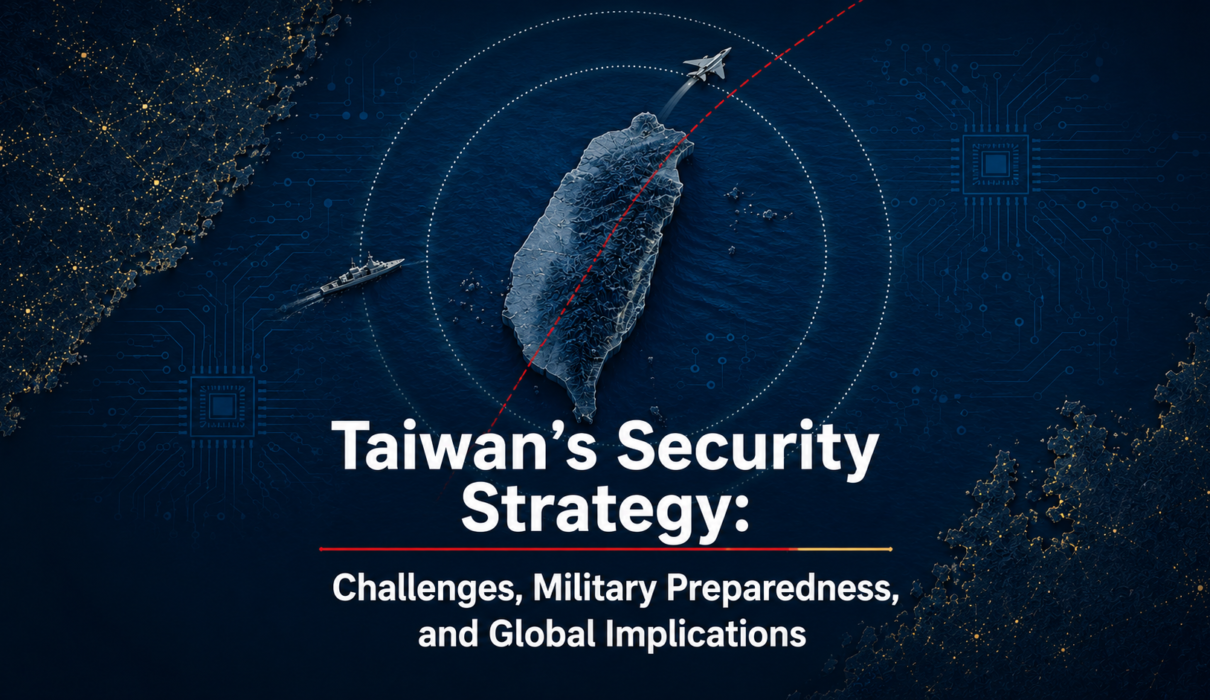
By Taiwan’s security strategy is built on three pillars — an asymmetric “porcupine” defense doctrine designed to make an invasion prohibitively costly for China, deepening reliance on U.S. arms sales and political backing under the Taiwan Relations Act, and the deterrent value of its dominance in advanced semiconductors (the “silicon shield”). In 2026, this strategy is being tested in real time by record levels of Chinese gray-zone pressure, a stalled defense budget in Taiwan’s own legislature, and growing uncertainty over Washington’s commitment amid the Trump administration’s transactional dealings with Beijing.
Key Takeaways
- Taiwan’s 2026 regular defense budget hit a record NT$949.5 billion (roughly US$31 billion), about 3.32% of GDP, with President Lai Ching-te pledging to reach 5% of GDP by 2030.
- A separate multi-year special defense budget, originally proposed at US$40 billion, was pared back by roughly a third to US$25 billion after months of legislative gridlock.
- China conducted a record number of Air Defense Identification Zone (ADIZ) incursions in recent years, part of a broader “gray-zone” coercion campaign that includes drone and balloon overflights and undersea cable sabotage.
- Taiwan’s semiconductor industry, anchored by TSMC, produces roughly 90% of the world’s most advanced chips — a “silicon shield” that raises the economic stakes of any conflict for the entire globe.
- The May 2026 Trump-Xi summit left Taiwan anxious but with U.S. policy officially unchanged, though a $14 billion arms package remained delayed at the time of writing.
1. What Is Taiwan’s Security Strategy?
Taiwan’s security strategy has shifted decisively over the past decade from trying to match China plane-for-plane and ship-for-ship toward what defense planners call “asymmetric” or “porcupine” warfare. The idea, first formalized by former Chief of the General Staff Admiral Lee Hsi-min in the Overall Defense Concept, is that Taiwan cannot win a symmetrical arms race against a military roughly nine times its size. Instead, it aims to survive an initial assault long enough to make occupation unacceptably costly and to buy time for international support — chiefly from the United States — to materialize.
That doctrine now sits alongside two other strategic pillars: sustained U.S. arms sales and diplomatic backing under the 1979 Taiwan Relations Act, and Taiwan’s outsized role in global semiconductor manufacturing, which supporters argue makes the island too economically important to lose. Together, these three pillars form the backbone of what Taipei calls “defense resilience,” a term that now appears throughout its official budget documents.
2. The Core Pillars of Taiwan’s Defense Strategy
A. The Porcupine Doctrine and Asymmetric Warfare
Rather than investing heavily in prestige platforms like fighter jets and large warships, the porcupine approach favors mobile, dispersed, and comparatively cheap systems: shore-based anti-ship missiles, sea mines, drone swarms, and man-portable air defense systems. Taiwan’s coastline and mountainous terrain are seen as natural advantages that favor this kind of dispersed defense over conventional force-on-force engagements.
Analysts at the Center for a New American Security have pushed this further with a “Hellscape” concept — a layered gauntlet of tens of thousands of cheap, autonomous drones across air, sea, and land meant to stop a Chinese landing force before it can establish a beachhead. U.S. Indo-Pacific Command chief Admiral Samuel Paparo popularized the term in 2024, describing an intent to flood the Taiwan Strait with unmanned systems in a crisis.
B. The T-Dome Air Defense System
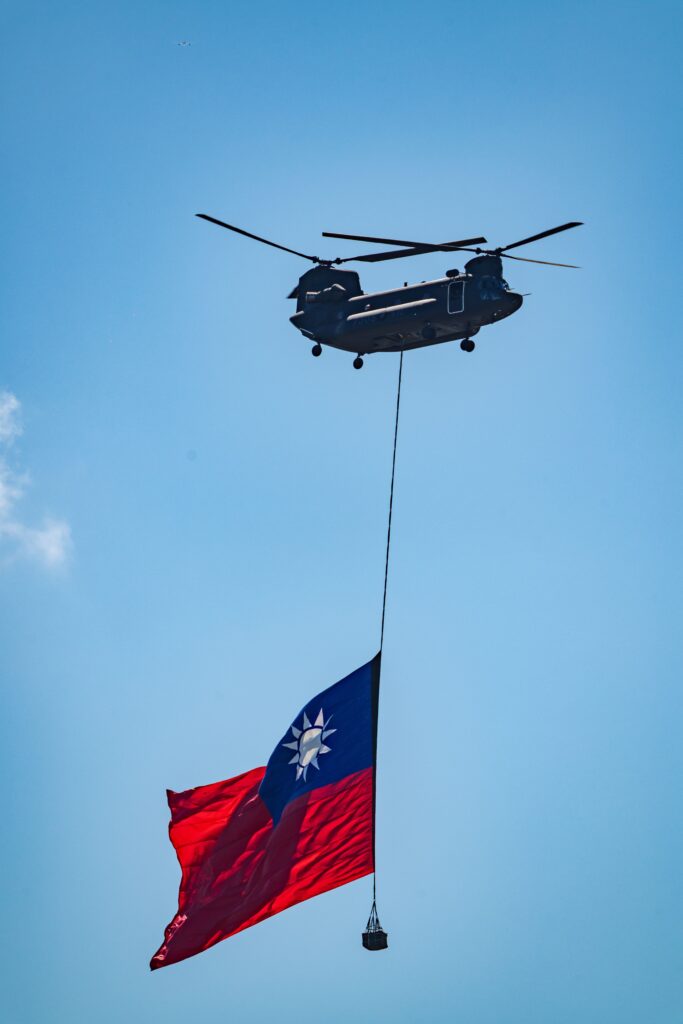
Announced by President Lai during 2025’s National Day celebrations, the T-Dome concept is envisioned as a networked, island-wide air and missile defense system integrating existing Patriot and domestically built Sky Bow batteries with new counter-drone capabilities and AI-enabled command-and-control. It is one of the centerpiece programs inside Taiwan’s special defense budget, though defense commentators note it remains unclear how it will differ operationally from Taiwan’s existing layered air defense network. Some analysts, drawing on Israel’s experience during its 2025 conflict with Iran, warn that expensive interceptor-based systems can be overwhelmed by cheap, mass-produced drones and missiles — meaning Taiwan will need large stockpiles of low-cost counter-drone tools, not just high-end interceptors.
C. Rebuilding the Reserve Force Through Conscription Reform
In 2024, Taiwan extended mandatory military service from four months to one year for men born on or after January 1, 2005, reversing a 2013 decision that had drawn criticism for producing undertrained “summer camp” conscripts. Public support has been strong — roughly 73% of adults and closer to 75% of adults under 29 back the one-year term, according to polling by the Taiwanese Public Opinion Foundation.
Implementation has lagged, however. Taiwan’s Ministry of National Defense has acknowledged falling behind schedule on training, citing shortages of instructors and equipment. Only about 6% of eligible conscripts opted into extended one-year enlistment terms in 2024, with most deferring for university, and Taiwan’s overall military personnel count actually fell from roughly 165,000 in 2022 to about 153,000 in 2024 even as the reform rolled out.
Also Read – Is Military Spending Rising Around The World ?
3. Taiwan’s Defense Budget and Military Modernization
A. Record Spending, Political Gridlock
Taiwan’s defense spending has climbed sharply, but the process has been anything but smooth. President Lai’s government proposed a sweeping NT$1.25 trillion (about US$40 billion) special defense budget in November 2025, meant to run through 2033 alongside the regular annual budget. The opposition-controlled Legislative Yuan — where no single party holds a majority following the 2024 elections — blocked the bill repeatedly, forcing months of negotiation.
On May 8, 2026, lawmakers finally passed a scaled-back version worth roughly US$25 billion, about a third smaller than originally proposed, with funding restricted to U.S. arms purchases and stripped of support for some domestic programs, including an anti-ballistic-missile system meant to anchor the T-Dome. The compromise passed unanimously, with President Lai’s own party abstaining in protest over the reduced size.
B. What the Special Budget Buys
| Category | Amount / Detail | Source |
|---|---|---|
| Regular 2026 defense budget | NT$949.5 billion (~US$31.08B), 3.32% of GDP | Focus Taiwan / CNA, Aug. 2025 |
| Original special budget proposal | NT$1.25 trillion (~US$40B), 8-year plan (2026–2033) | Global Taiwan Institute, Mar. 2026 |
| Special budget as passed | NT$780 billion (~US$25B), May 8, 2026 | FDD / Breaking Defense, May 2026 |
| Target defense spending | 5% of GDP by 2030 | Office of the President (CNA), Aug. 2025 |
| Key purchases funded | HIMARS, Javelin missiles, M109A7 howitzers, loitering munitions | FDD, May 2026 |
| Pending future package | Patriot interceptors, counter-drone systems, Hellfire missiles | Breaking Defense, May 2026 |
Roughly $11 billion of the passed budget covers a U.S. arms package — including HIMARS rocket systems, Javelin anti-tank missiles, howitzers, and loitering munitions — first notified to Congress in December 2025. A further NT$480 billion is earmarked for a future package expected to include Patriot interceptors and counter-drone systems, though its formal approval remained pending as of mid-2026.
4. The Military Balance: Taiwan vs. China
The raw numbers illustrate why Taiwan’s strategy leans on asymmetry rather than parity.
| Metric | Taiwan | China |
|---|---|---|
| Active-duty personnel | ~230,000 | ~2,035,000 |
| Reserve personnel | ~1,657,000 | ~510,000 |
| Paramilitary forces | ~55,000 | ~625,000 |
| Global power ranking (of 145) | 22nd | 3rd |
| Population reaching military age annually | ~306,700 | ~19,810,600 |
| Nuclear warheads | None | ~600 (2025), projected ~1,500 by 2035 |
(Source – Global Fire Power 2026)
China’s active force alone outnumbers Taiwan’s entire population of military-age citizens available annually by a factor of more than 60. This disparity is precisely why Taiwanese and U.S. planners have concluded that matching China conventionally is not a viable path, reinforcing the logic of dispersed, asymmetric defense over large-platform parity.
5. Key Security Challenges Facing Taiwan
A. China’s Gray-Zone Coercion Campaign
Short of outright invasion, Beijing has steadily intensified pressure that stays below the threshold of open war. Taiwan recorded a record number of ADIZ incursions in 2024 — more than 3,000 for the year — and more than 4,000 between January and September 2025 alone, according to Taiwan’s Ministry of National Defense. Since President Lai took office in May 2024, average monthly PLA sorties into Taiwan’s ADIZ have more than doubled compared with the prior two years.
| Gray-zone indicator | Data point | Source |
|---|---|---|
| ADIZ incursions, full year 2024 | 3,000+ (record) | The Soufan Center, Jul. 2025 |
| ADIZ incursions, Jan–Sep 2025 | 4,000+ | TaiwanPlus, Oct. 2025 |
| Average monthly PLA sorties since May 2024 | 300+ (2x prior average) | AEI, Jan. 2026 |
| First PLA drone incursion into Taiwan’s territorial airspace | January 2026 | Brookings / Financial Times, 2026 |
| Snapshot: single-day activity, July 1, 2026 | 13 PLA aircraft sorties, 10 PLAN vessels, 3 official ships | Taiwan MND, Jul. 2026 |
Beyond air and sea incursions, Beijing’s toolkit has expanded to include high-altitude balloon overflights, suspected sabotage of undersea communications cables, disinformation campaigns targeting Taiwanese social media, and export controls against firms with defense ties to Taipei. Multiday PLA exercises simulating a full blockade — such as the 2025 “Justice Mission” drills involving more than 130 aircraft and 14 vessels — have become a recurring feature rather than a rare event.
B. Political Gridlock at Home
Taiwan’s fractured legislature has become a strategic vulnerability in its own right. With the opposition Kuomintang and Taiwan People’s Party controlling the Legislative Yuan, defense spending bills have faced repeated delays, cuts to domestic weapons programs, and public disputes over transparency. U.S. officials, including a bipartisan Senate delegation that visited Taipei in March 2026, have publicly urged lawmakers to break the deadlock, warning that delays raise doubts in Washington about Taiwan’s own resolve.
C. Manpower, Training, and Morale Gaps
Beyond the conscription shortfalls noted above, Taiwan’s military faces a documented shortage of instructors, equipment for realistic training, and — more troublingly — a strained mental health system. Reporting has documented 134 suicides among Taiwan’s military personnel between 2016 and 2024, with legislators pointing to severe understaffing of psychological counselors. A Center for a New American Security report bluntly concluded that Taiwan’s military “suffers from serious deficiencies in manpower, training, and planning” that go beyond any equipment shortfall.
D. Dependence on U.S. Arms Deliveries
Taiwan’s asymmetric strategy depends heavily on the timely delivery of American weapons systems, and that pipeline has proven unreliable. Ahead of the May 2026 Trump-Xi summit in Beijing, the White House reportedly paused progress on an $11 billion arms package and left a separate $14 billion package pending, with President Trump himself calling the sale a “negotiating chip” in talks with Beijing. Following the summit, U.S. officials briefed Taipei that policy toward the island remained unchanged and that further sales would proceed under the Taiwan Relations Act — but the episode underscored how arms deliveries can become entangled in broader U.S.-China dealmaking, a dynamic that did not exist to the same degree in prior administrations.
Also Read – US Apache Crash Near Hormuz Sparks Concern
6. The Global Implications of Taiwan’s Security
A. The “Silicon Shield” and the World Economy
Taiwan’s strategic weight extends well beyond its own defense budget. Taiwan Semiconductor Manufacturing Company (TSMC) produces around 90% of the world’s most advanced logic chips and commands the majority of global foundry capacity, making the island central to everything from smartphones to AI data centers.
| Metric | Figure | Source |
|---|---|---|
| Share of world’s most advanced chips made by TSMC | ~90% | Rest of World / CNBC, 2026 |
| TSMC global foundry market share | ~70–78% | Global Taiwan Institute / Stimson Center |
| Semiconductor sector’s share of Taiwan’s GDP | ~15–18% | Stimson Center, Nov. 2025 |
| Semiconductor share of Taiwan’s exports | ~60% | Stimson Center, Nov. 2025 |
| TSMC 2026 planned capital expenditure | US$52–56 billion | CNBC, 2026 |
| TSMC total Arizona investment commitment | US$165 billion | CNBC / Stimson Center, 2026 |
| Taiwan’s pledged investment in U.S. semiconductor sector (Jan. 2026 deal) | US$250 billion in credit support | CNBC, Jan. 2026 |
Analysts describe this concentration as a double-edged “silicon shield”: it raises the economic cost of any Chinese move against Taiwan so high that even a blockade — not just an invasion — could knock multiple percentage points off global GDP, according to Hoover Institution fellow Eyck Freymann. At the same time, U.S. efforts to onshore chip production in Arizona have stoked Taiwanese anxiety that Washington’s incentive to defend the island could erode over time as American dependence on Taiwanese chips gradually declines, even though most experts agree the most advanced production will remain concentrated in Taiwan through at least the end of the decade.
B. The U.S.-China Balancing Act
Washington’s position remains one of long-standing “strategic ambiguity,” selling Taiwan defensive weapons under the Taiwan Relations Act while avoiding a formal commitment to intervene militarily. That balancing act was visibly strained around the May 2026 Trump-Xi summit, where Taiwan’s status and pending arms sales became explicit bargaining chips in a way that alarmed Taiwanese officials and outside observers alike. Taiwan’s deputy foreign minister said openly that Taipei’s greatest fear was becoming “on the menu” of great-power talks it had no seat at.
C. Ripple Effects for the Indo-Pacific and Beyond
A crisis in the Taiwan Strait would not stay contained to the strait itself. Taiwan sits at the center of the First Island Chain between Japan and the Philippines, a geography the U.S. Department of Defense’s own 2026 National Defense Strategy identifies as central to its Indo-Pacific denial posture. A serious disruption — even one well short of war — would strain global supply chains, test alliance commitments from Japan to Australia, and could trigger the kind of energy and shipping disruptions Taiwan itself is vulnerable to, given that it imports roughly 97% of its energy needs.
7. Future Outlook: Can Taiwan’s Strategy Keep Pace With the Threat?
Taiwan’s defense strategy is, on paper, sound: deny China a quick, low-cost victory, buy time, and lean on economic and alliance leverage to deter escalation in the first place. The gap lies in execution. Budget increases have been real but repeatedly delayed and diluted by domestic political fights. Conscription reform is popular but under-resourced. Arms deliveries from Taiwan’s principal partner have become entangled in broader diplomacy. And the semiconductor industry that underwrites Taiwan’s global relevance is itself becoming a subject of negotiation between Washington and Taipei.
8. My View
Taiwan’s asymmetric pivot makes sense on paper, but it shouldn’t come at the expense of conventional capability. A pure porcupine posture risks leaving Taiwan without the platforms needed to contest its own airspace and waters day to day, not just repel an invasion. The two approaches aren’t mutually exclusive — mass and mobility can coexist with a credible core of jets, ships, and air defense.
Washington’s reliability is the bigger question mark. The Trump-Xi summit made clear that Taiwan can become a bargaining chip alongside trade and tariffs, not a fixed pillar of policy. Arms sales getting paused ahead of a summit, then quietly resuming after, isn’t the behavior of an unconditional guarantee — it’s leverage being managed in real time. Taiwan should plan around that uncertainty rather than assume continuity.
That uncertainty is exactly why the special-budget fight in Taiwan’s legislature matters more than it’s being treated. If U.S. support is genuinely transactional, self-funded resilience becomes more urgent, not less.
On the silicon shield, I lean toward seeing it as double-edged rather than protective. The same concentration that makes Taiwan indispensable also makes it a target for coercion short of invasion — a blockade or quarantine could let China extract leverage over global chip supply without firing a shot, sidestepping the deterrent logic entirely. The slow U.S. onshoring push, however incomplete, also chips away at the very dependency the shield relies on.
There’s a scorched-earth risk here too, one that gets underdiscussed: if Taiwan ever concluded U.S. backing had evaporated, the incentive shifts from preserving TSMC to denying it to Beijing. That’s a strategy resting on a belief system, not a hard guarantee — and beliefs can shift fast.
Put together, Taiwan’s three pillars look less like a stable tripod and more like three moving parts that all depend on assumptions holding — political consensus in Taipei, steady resolve in Washington, and the world continuing to value TSMC’s survival over Beijing’s control. Any one can shift under pressure, which is why domestic execution and hedging deserve more weight than the current strategy gives them.
Frequently Asked Questions…
What is Taiwan’s “porcupine strategy”?
How much does Taiwan spend on defense?
Is the United States obligated to defend Taiwan?
What is the “silicon shield”?
Why does China conduct so many ADIZ incursions?
Conclusion
Taiwan’s security strategy in 2026 is coherent in theory and strained in practice. The shift toward asymmetric warfare, the political commitment to a 5%-of-GDP defense target, and the economic leverage of the semiconductor industry together form a plausible deterrent architecture. But each pillar is carrying more weight than it can comfortably bear on its own.
The porcupine doctrine only works if it’s paired with enough conventional capability to contest the gray zone Taiwan already lives in daily — not just the invasion scenario it was designed for. Legislative gridlock in Taipei keeps turning defense funding into a political football, even as Chinese pressure escalates on a near-daily basis. And Washington’s posture, once treated as a fixed point, now looks increasingly conditional — subject to renegotiation whenever Taiwan intersects with broader U.S.-China dealmaking.
The silicon shield captures this tension best. It was built on the logic that Taiwan’s indispensability guarantees its protection. But indispensability cuts both ways: it invites coercion as much as it deters invasion, and it depends on outside actors continuing to value what Taiwan produces more than they value leverage over it. That’s a bet, not a guarantee.
None of this means Taiwan’s strategy is failing. It means the strategy’s success now hinges less on which doctrine Taipei chooses and more on whether it can execute consistently — funding it fully, training conscripts properly, and building resilience that doesn’t assume any single partner or product will always be there. The next few years will show whether Taiwan closes that gap between strategy and execution, or whether the gap becomes the story Beijing, Washington, and the rest of the world end up reacting to.
I am waiting to watch your thoughts on this topic . Comment below…
