


 By
By Have you ever wondered why the same grocery basket costs more today than it did a year ago? Or why your salary increase sometimes feels smaller than expected? The answer often lies in the Consumer Price Index (CPI), one of the most important economic indicators used around the world.
CPI measures changes in the prices consumers pay for everyday goods and services, making it a key tool for tracking inflation and the cost of living. Governments, businesses, investors, and households all pay close attention to CPI because it influences wages, interest rates, savings, and purchasing power.
Understanding CPI can help you make smarter financial decisions in an increasingly uncertain economy. Here is everything you need to know about CPI.
What Is the Consumer Price Index (CPI)?
The Consumer Price Index (CPI) is one of the most widely used measures of inflation. It tracks the average change in prices paid by consumers for a basket of goods and services over time. These goods and services typically include food, housing, transportation, healthcare, education, and entertainment.
Instead of tracking the price of just one product, CPI tracks the average price movement of many items.
Governments and central banks use CPI to understand how the cost of living is changing. When CPI rises, it generally indicates inflation, meaning consumers need more money to purchase the same goods and services. Conversely, a falling CPI may signal lower inflation or even deflation.
A CPI inflation rate of about 2% (roughly 1%–3%) is generally considered healthy. It indicates that prices are rising slowly enough to preserve purchasing power while supporting economic growth.
The CPI Formula
The Consumer Price Index is calculated using the following formula:
CPI = (Cost of Market Basket in Current Year ÷ Cost of Market Basket in Base Year) × 100
For example, if a basket of goods costs $120 today and the same basket cost $100 in the base year:
CPI = (120 ÷ 100) × 100 = 120
This means prices have increased by 20% since the base year.
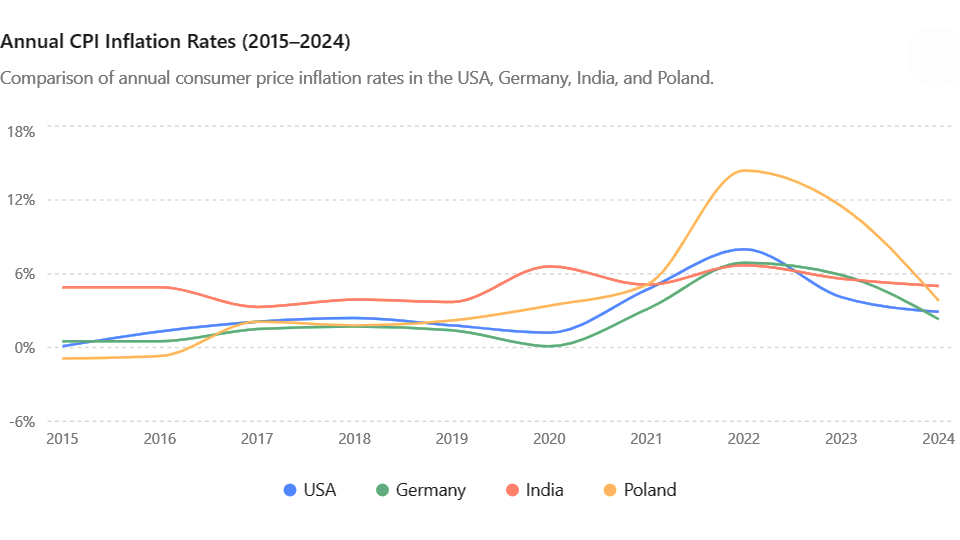
Source: World Bank Consumer Price Inflation Database
Also Read – INFLATION: The hidden parasite in your pocket
How CPI Affects Your Money ?
The Consumer Price Index (CPI) directly affects the value of your money by measuring how the prices of everyday goods and services change over time. When CPI rises, it usually means inflation is increasing, causing the cost of living to go up. As a result, the same amount of money buys fewer goods and services than before, reducing your purchasing power.
For example, if inflation is 5% and your income remains unchanged, you are effectively able to buy 5% less than you could the previous year. This impact is often felt through higher grocery bills, increased transportation costs, rising rent, and more expensive healthcare and education expenses.
CPI also influences wages and salaries. Many employers and governments use CPI data to determine annual pay raises, pensions, and social benefits. If wages grow more slowly than CPI, households may experience a decline in their standard of living.
In addition, central banks monitor CPI closely when setting interest rates. Higher inflation often leads to higher interest rates, which can increase borrowing costs for mortgages, car loans, and credit cards. At the same time, savers may benefit from higher returns on deposits.
Understanding CPI helps individuals make informed financial decisions, plan budgets effectively, and protect their savings and investments from the long-term effects of inflation.
Conclusion
The Consumer Price Index is more than just an economic statistic—it is a reflection of how inflation affects everyday life. From the cost of groceries and housing to savings, salaries, and investment returns, CPI influences the financial decisions we make every day. While moderate inflation is a sign of a healthy economy, sharp increases in CPI can reduce purchasing power and strain household budgets.
By understanding how CPI is calculated and what drives its changes, individuals can better prepare for economic shifts, make smarter financial choices, and protect their long-term wealth. In a world where prices are constantly changing, keeping an eye on CPI is one of the simplest ways to stay informed and financially resilient.
