

 By
By 1. Introduction
Most people assume every country runs on the same basic formula: an elected government, a set of ministries, and a military that answers to the state.
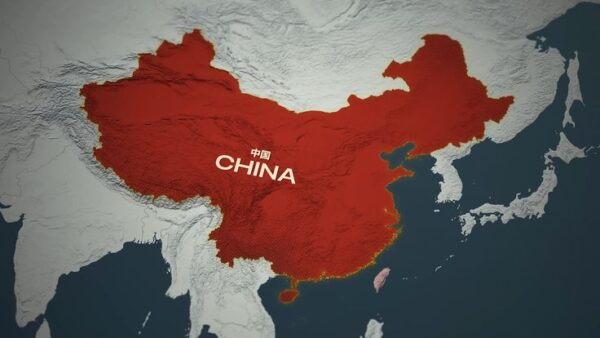
China breaks that formula in a way that surprises even seasoned observers. China’s political system is shaped by the Communist Party, the government, and the military, with the Party holding ultimate authority over both.
In China, the government does not command the military — the Communist Party does. The government does not even run the country independently — it implements what the Party decides. And the military swears loyalty not to the nation as an abstract entity, but to the Party itself.
This single fact — “the Party commands the gun,” a phrase Mao Zedong coined in 1938 — is the key that unlocks how China actually works. Once you understand that the Chinese Communist Party (CPC) sits above and inside the government and the armed forces simultaneously, the entire structure becomes far easier to map.
In this guide, we break down the three pillars of Chinese power — the Party, the State (government), and the Military — how they are structured, how they interact, and why this model has proven both remarkably stable and deeply controversial. We’ll also look at where real decisions get made, who holds them, and what this means for how China governs 1.4 billion people without holding competitive national elections.
2. The Big Picture — One Party, Three Overlapping Pillars
China is a one-party state. The Chinese Communist Party is not one political party competing among several — it is, by constitutional design, the sole permanent ruling authority. Article 1 of the Chinese Constitution explicitly enshrines the leadership of the CPC as a defining feature of the socialist system.
But “one-party state” understates the complexity. Power in China flows through three interlocking institutions:
- The Party (CPC) — sets ideology, policy direction, and personnel appointments.
- The State (government) — the National People’s Congress, the President, the State Council, and ministries that execute policy and manage day-to-day administration.
- The Military (PLA) — the armed forces, which report to the Party’s Central Military Commission, not to the state government.
The same individuals typically hold top posts in all three pillars at once. Xi Jinping, for example, is simultaneously General Secretary of the CPC, President of the People’s Republic of China, and Chairman of the Central Military Commission — a combination known informally as the “three-in-one” leadership arrangement, a pattern followed by top leaders since Jiang Zemin in the 1990s.
Also Read – How China’s Political System Shapes Global Influence
3. Why This Matters for Understanding Chinese Politics
If you only study China’s government ministries or its legislature, you will miss where power actually resides. Formal state bodies like the National People’s Congress often ratify decisions that were already made inside Party institutions. To understand Chinese governance, you have to follow the Party structure first, then see how it’s mirrored in state and military institutions.
Also Read – Xi’s North Korea Visit Raises Regional Concerns
4. Pillar One — The Communist Party Of China (CPC)
The CPC is the nucleus of Chinese political life. With roughly 99 million members, it is the largest political party in the world, and its internal hierarchy determines who leads the country.
A. The National Party Congress
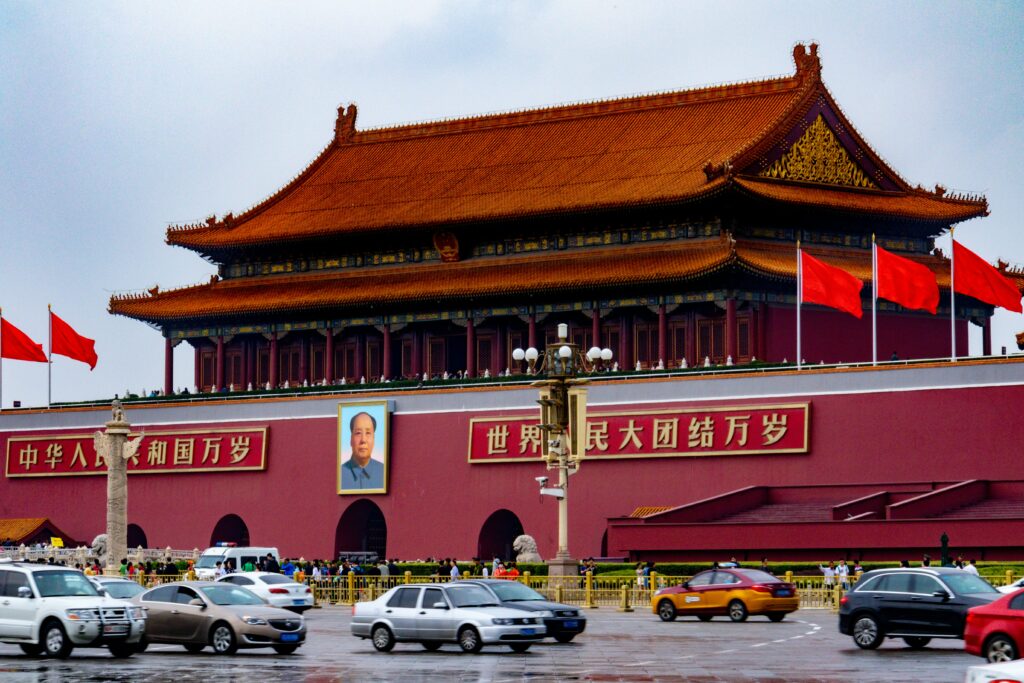
Held once every five years, the National Party Congress is technically the Party’s highest organ. Thousands of delegates gather to approve the Party’s political report, revise the Party constitution if needed, and elect the new Central Committee. In practice, most major decisions are settled beforehand through internal negotiation, and the Congress functions more as a ratification and messaging event than a deliberative one.
B. The Central Committee
Numbering around 200 full members plus roughly 170 alternates, the Central Committee meets in full session (“plenums”) a few times between Congresses. It elects the Politburo and, in turn, is where broader factional and regional interests get some representation, even if the real concentration of power sits above it.
C. The Politburo and Its Standing Committee
The Politburo — around 24 members — functions like an inner cabinet. Within it sits the Politburo Standing Committee (PSC), typically 7 members, which is the actual apex of decision-making in China. As of 2026, the Standing Committee consists of Xi Jinping, Li Qiang, Zhao Leji, Wang Huning, Cai Qi, Ding Xuexiang, and Li Xi, with Han Zheng also among the Party’s most senior figures. Nearly every strategically important decision in China — economic policy, foreign affairs, security — is shaped at this level before it ever reaches a government ministry.
D. The General Secretary
The General Secretary of the CPC Central Committee is the most powerful individual position in China. Since the 2018 removal of presidential term limits, this office no longer has a fixed retirement point, a change that broke with the two-term norm followed from the 1990s through the mid-2010s.
E. The Central Commission for Discipline Inspection
Separate from ordinary courts, the CCDI investigates Party members for “discipline violations,” most notably corruption. It has been one of the primary tools for consolidating internal Party control, especially through anti-corruption campaigns that have simultaneously cleaned up graft and sidelined political rivals.
Read – Chinese Communist Party
5. Pillar Two — The Government (The State Apparatus)
Parallel to the Party sits the formal government structure — the part that most resembles what people from other countries recognize as “government.”
A. The National People’s Congress (NPC)
The NPC is constitutionally China’s highest organ of state power, with nearly 3,000 delegates. It meets in full session annually, passes laws, approves the budget, and elects the President and Premier. Delegates are selected through a multi-tiered indirect process rather than direct nationwide competitive elections, and votes on top leadership positions are, in practice, decided in advance by the Party.
B. The President and the State Council
The President is the head of state, a role that is largely ceremonial when separated from the General Secretary title, though in Xi Jinping’s case, the roles are held by the same person, giving the presidency real weight. The State Council, headed by the Premier — currently Li Qiang — is China’s chief administrative authority, equivalent to a cabinet. It oversees ministries covering finance, foreign affairs, commerce, public security, and dozens of other portfolios.
C. Local Governments and the Dual-Track System
Every level of Chinese government — provincial, municipal, county, township — has a mirrored Party structure running alongside it. A provincial governor manages administration, but the provincial Party secretary usually outranks them politically. This “dual-track” pattern repeats all the way down, ensuring Party oversight reaches every layer of public administration.
Read – National People’s Congress
6. Pillar Three — The Military (People’s Liberation Army)
Unlike most modern militaries, the People’s Liberation Army (PLA) is not a national army in the strict sense — it is the armed wing of the Communist Party.
A. The Central Military Commission (CMC)
The CMC is the top military authority, chaired by the same person who serves as General Secretary — again, since 2012 and 2013, respectively, Xi Jinping. There are technically two CMCs, one under the Party and one under the state, but they share identical membership, making the distinction largely symbolic.
B. Party Control Over the Armed Forces
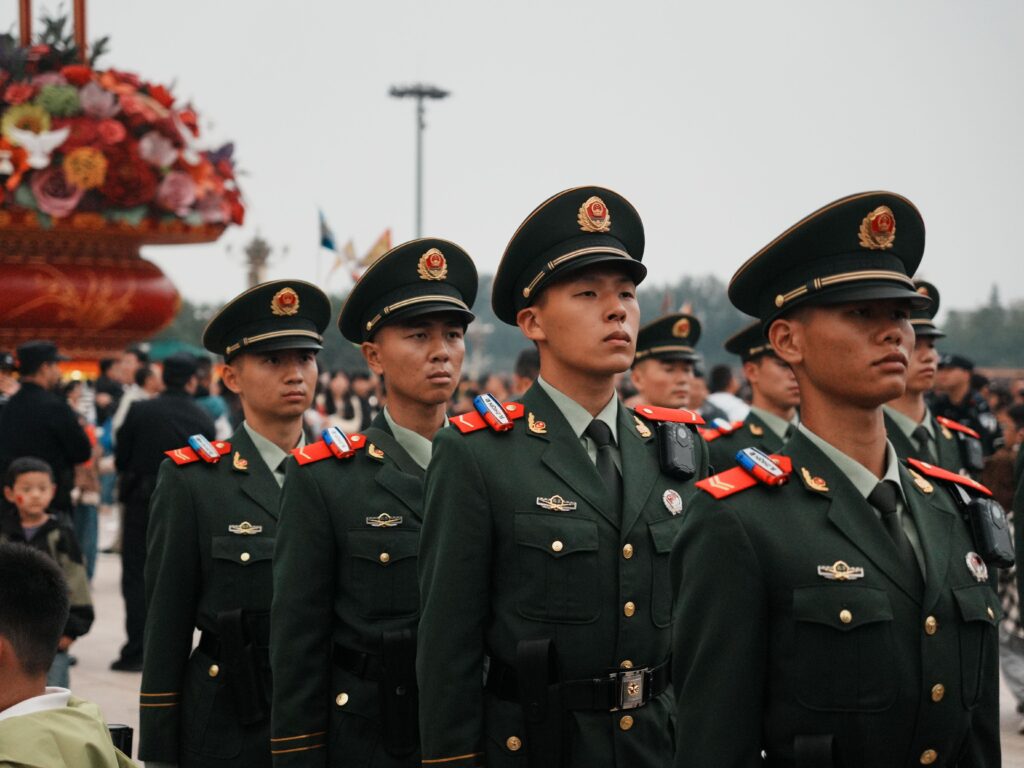
Political commissars are embedded at every level of the PLA, from army-wide down to individual units, ensuring political loyalty runs alongside operational command. Soldiers pledge loyalty to the Party, not to a civilian government or constitution in the way many Western militaries do.
C. Structure and Modernization
The PLA is organized into five service branches — Army, Navy, Air Force, Rocket Force, and Strategic Support Force — coordinated through five regional Theater Commands. Since 2023, the military has undergone a significant anti-corruption purge, removing several senior generals and even former defense ministers, part of a broader effort to tighten political control over the armed forces.
Read – People’s Liberation Army
7. How The Three Pillars Interact: A Comparison Table
| Feature | The Party (CPC) | The Government (State) | The Military (PLA) |
|---|---|---|---|
| Top Body | Politburo Standing Committee | National People’s Congress | Central Military Commission |
| Top Individual Role | General Secretary | President / Premier | CMC Chairman |
| Current Leader(s) | Xi Jinping (General Secretary) | Xi Jinping (President), Li Qiang (Premier) | Xi Jinping (CMC Chairman) |
| Core Function | Sets ideology, policy, and personnel | Administers laws, budget, public services | National defense, internal Party loyalty |
| Selection Method | Internal Party process, Party Congress | Indirect election via NPC delegates | Appointed by Party/CMC leadership |
| Term Length | No fixed limit since 2018 | 5-year terms (state offices) | Tied to Party/CMC tenure |
| Accountability | Accountable internally to the Party | Nominally accountable to the NPC | Accountable to the Party, not civilian government |
8. How Policy Actually Gets Made — Five-Year Plans And Beyond
Understanding the three pillars is only half the picture. It also helps to see how they work together on a practical policy cycle, since this is where the Party’s dominance becomes most visible in everyday governance.
A. The Five-Year Plan Cycle
Every five years, China sets a new Five-Year Plan, a comprehensive economic and social blueprint. China entered its 15th Five-Year Plan period (2026-2030) this year, with Party leadership emphasizing a strong start to the new cycle at a Party School study session for provincial and ministerial officials in January 2026. These plans are drafted through Party bodies first, refined through consultation with think tanks and ministries, and only formally passed into law by the National People’s Congress — a clear example of the Party-sets-direction, state-implements pattern running through the entire system.
B. Central Leading Groups and Commissions
Beyond the formal Politburo structure, Xi Jinping has expanded a network of Party “leading small groups” and commissions covering areas like national security, economic reform, cybersecurity, and foreign affairs. These bodies, chaired directly by top Party leaders, allow the Party to coordinate policy across ministries without going through the ordinary State Council bureaucracy, further reinforcing centralized control over strategic decisions.
C. Provincial Experimentation and Central Approval
A distinctive feature of Chinese governance is policy experimentation at the provincial or municipal level before nationwide rollout. Special economic zones, pilot free-trade areas, and local regulatory sandboxes have historically served as testing grounds. Successful local experiments are studied by central Party bodies and, if effective, scaled nationally — a bottom-up testing process operating inside a fundamentally top-down political structure.
9. Checks, Balances, And Criticism
A. The Meritocracy Argument
Supporters of the Chinese model, including some scholars of comparative governance, argue that this system allows for long-term planning insulated from short election cycles, and that internal Party promotion processes reward administrative experience gained through years of provincial governance before reaching top office.
B. The Democratic Deficit Critique
Critics, including many Western governments, human rights organizations, and China-focused academics, argue that without competitive elections, independent courts, or a free press, there is no meaningful mechanism for citizens to remove leaders they disapprove of, and that internal Party discipline processes can be used to eliminate political rivals rather than purely to fight corruption.
C. Recent Strains — Purges and Succession Uncertainty
Since 2023, a wave of expulsions has hit the Central Committee, the Politburo, and the CMC, including senior military figures. Unlike his predecessors, Xi Jinping has not designated a clear successor, breaking a norm that previously provided some predictability about future leadership transitions. Analysts view this as consolidating Xi’s personal authority, though it also raises open questions about long-term political stability once a transition eventually becomes necessary.
10. My View
Having mapped all three pillars, a few things stand out to me. First, the “three-in-one” arrangement is not a bug — it is the entire point of the system. By fusing Party, state, and military leadership into the same individual, China avoids the coordination problems that can arise when a head of state and a head of government disagree, or when civilian and military leadership pull in different directions.
That fusion is a genuine source of the system’s speed: infrastructure projects, industrial policy, and crisis responses can be executed at a scale and pace that fragmented, multi-veto systems often struggle to match.
The trade-off, though, is equally real. Concentrating ideological, administrative, and military authority in one office removes the built-in correction mechanisms that pluralistic systems rely on — competitive elections, independent judiciaries, and a free press that can surface problems before they compound.
The absence of a named successor to Xi Jinping is, to me, the clearest illustration of this trade-off: a system built for continuity has, at its very center, an unresolved question about what happens next.
Whether that is read as a sign of strength (no rival power center can challenge the center) or fragility (no clear mechanism exists if something changes suddenly) depends heavily on one’s starting assumptions about how political stability is best achieved — through concentrated continuity or through distributed, contestable power.
Reasonable people disagree sharply on which trade-off is worth making, and that disagreement is really a disagreement about first principles of governance, not just about China specifically.
11. FAQs
Is China a one-party state?
Who really controls China — the President or the Communist Party?
Does China’s military report to the government or the Party?
How is China’s top leader chosen?
What is the Politburo Standing Committee?
Are there term limits for China’s president?
What is the difference between the Party’s Central Military Commission and the State’s Central Military Commission?
12. Conclusion
China’s political system cannot be understood by looking at its government alone. The Communist Party is the load-bearing structure — the National People’s Congress, the State Council, and the People’s Liberation Army all operate within a framework the Party designs, staffs, and ultimately controls. The “three-in-one” leadership model, currently embodied entirely in Xi Jinping, ties Party, state, and military authority into a single chain of command, producing a system optimized for coordinated, long-horizon decision-making at the cost of competitive checks on power.
Whether you’re a student of comparative politics, a business leader assessing regulatory risk, or simply a curious reader trying to make sense of headlines about Beijing, the mental model to hold onto is simple: in China, follow the Party first, and the rest of the structure will make sense.
What do you think ? Comment Below …
