

 By
Just after midnight on 26 September 1983, a Soviet officer named Stanislav Petrov sat in a bunker south of Moscow, watching a screen that told him the world was about to end.
The early-warning system had detected a missile launched from the United States. Then another. Then five. Protocol was simple: report it up the chain, and the generals above him would decide whether to strike back. Petrov had minutes.
He hesitated. A real American first strike, he reasoned, would not arrive as five lonely missiles. It would arrive as a flood. He trusted that instinct over the machine, called it a false alarm, and waited. The “missiles” turned out to be sunlight glinting off high-altitude clouds.
Nothing happened. No cities burned. And that is the strange heart of this story: millions of lives may have hinged on a night when the most powerful weapons on Earth did exactly what they were built to do, which was nothing at all.
That is deterrence. It is the only weapon in history whose success is measured by silence. Every day it works, nobody notices. Every day it fails, nobody is left to write about it.
This guide explains how deterrence really works, where it has held, where it has cracked, and why the argument over it matters more in 2026 than it has in a generation.
1. What Is Deterrence?
Deterrence is a strategy that prevents an attack by convincing the opponent that the costs will outweigh any possible gain. It works on the mind of the adversary, not on the battlefield. A country builds the means to retaliate or to defend, signals that it will use them, and hopes nobody ever tests the promise.
A. The one-sentence version
Deterrence is peace through credible consequences. Nuclear weapons are its most famous tool, but the logic is older than the bomb. A walled city, a standing army and a powerful navy all say the same thing: attacking us will hurt you more than it helps you.
B. Why it is “the weapon you never fire”
Most weapons are judged by what they destroy. A deterrent is judged by what never happens. A ballistic missile submarine on silent patrol has one job: to make its own use unthinkable by guaranteeing a devastating reply. The strategist Bernard Brodie saw this as early as 1946, arguing that atomic weapons had shifted the military’s purpose from winning wars to preventing them.
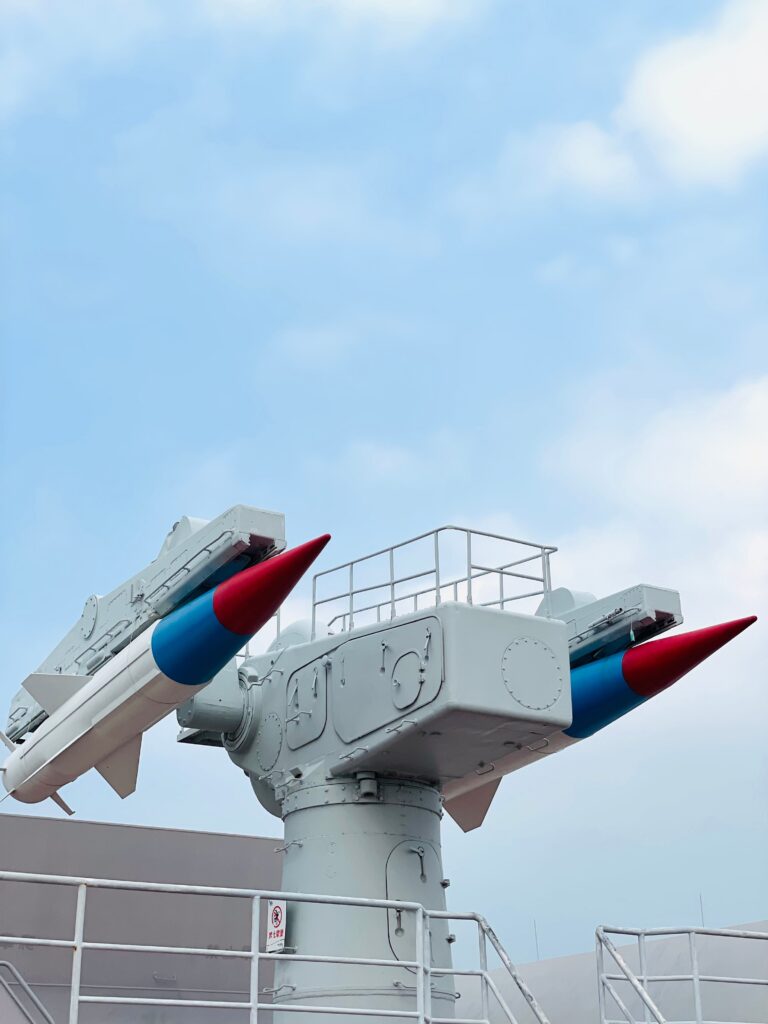
That is the paradox at the core of this subject. The moment a deterrent is fired, it has failed.
Also Read – The Power of Alliances: How Nations Build an Unbeatable Geopolitical Advantage
2. How Deterrence Works: Three Ingredients, Two Strategies
A. Capability, credibility and communication
Every working deterrent needs all three of these. Remove one and the structure collapses.
- Capability. You must actually be able to impose serious costs. A threat without the means behind it deters nobody.
- Credibility. The opponent must believe you will follow through. This is the hardest part. During the Cold War, Europeans kept asking whether Washington would really risk its own cities to save Paris or Bonn. Troops stationed on the front line, who would be caught in any invasion, were the answer: a tripwire that makes the promise believable.
- Communication. Your red lines must be clear. A vague warning invites probing, and probing is how miscalculations start.
B. Punishment versus denial
The scholar Glenn Snyder drew a distinction that still organises the field. Deterrence by punishment threatens retaliation after an attack. Deterrence by denial makes the attack unlikely to succeed in the first place. Real defence postures blend the two.
| Type of deterrence | How it works | Real-world example | Main weakness |
|---|---|---|---|
| Punishment | Threatens unacceptable retaliation after an attack | Nuclear-armed submarines kept on patrol by the US, UK and France | Depends on believing a leader would accept a terrible choice |
| Denial | Makes the attack fail on its own terms | Air and missile defences; Taiwan’s “porcupine” defence concept | Expensive, and a determined attacker can try to overwhelm it |
| Extended | A powerful patron protects an ally with its own forces | The US nuclear umbrella over NATO, Japan and South Korea | Allies must trust a promise made by someone else |
| Conventional | Strong non-nuclear forces raise the cost of invasion | Finland’s large trained reserve | A much bigger neighbour can still outmatch it |
| Cross-domain | Threatens a response in a different arena, such as economic or cyber | Sanctions threats paired with military signals | Hard to calibrate and hard to signal clearly |
3. Deterrence Under Fire: Three Real-World Tests
Theory is tidy. History is not. Three cases show what deterrence can and cannot do.
A. Cuba, 1962: the closest call
In October 1962, the United States discovered Soviet nuclear missiles in Cuba. For thirteen days, two superpowers stood at the edge. President Kennedy ordered a naval quarantine of the island, and Soviet leader Khrushchev eventually pulled the missiles out in return for a public American pledge not to invade Cuba, plus a quiet understanding about American missiles in Turkey.
Both sides held enough weapons to destroy each other, and that shared vulnerability is widely credited with forcing both to back down. But notice the lesson. Deterrence worked, and it still came terrifyingly close to failing.
B. South Asia, 2025: two nuclear neighbours, one step back
After a deadly attack on tourists in Kashmir in April 2025, India and Pakistan exchanged missile, drone and artillery strikes for several days in May before agreeing to a ceasefire. SIPRI’s 2026 yearbook points to heightened escalation risk in South Asia during 2025.
Did nuclear deterrence prevent a bigger war, or did it merely fail to prevent a smaller one? Analysts still argue about it. The fairer reading is both: it did not stop the fighting, but neither side climbed the full ladder.
C. Ukraine: when deterrence is uneven
In 1994, Ukraine handed over the Soviet nuclear weapons on its soil under the Budapest Memorandum and received security assurances, not binding guarantees, from Russia, the United States and the United Kingdom. Russia attacked Ukraine in 2014 and again, at full scale, in 2022.
Meanwhile, Russia’s own arsenal has shaped how far NATO states are willing to go in direct involvement. The uncomfortable pattern is that deterrence protects those under an umbrella and leaves everyone else exposed. Supporters of non-proliferation reply that a world where every threatened state builds a bomb is far more dangerous. Both arguments are serious, and neither is comfortable.
4. The Numbers Behind the Shadow
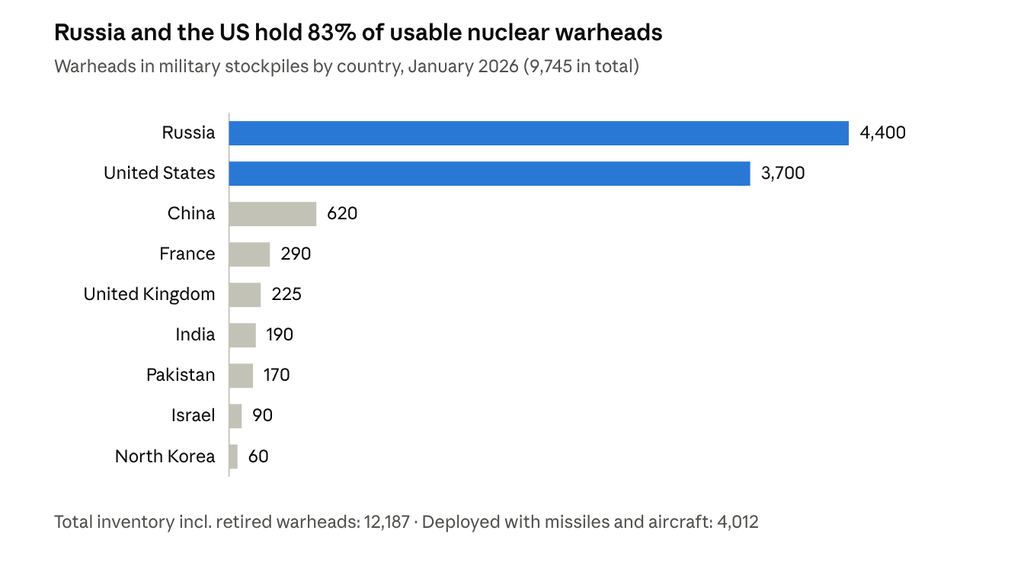
The headline is concentration, not growth. Two countries hold the overwhelming share of usable warheads, which is why the fate of deterrence still runs mostly through Washington and Moscow.
But the direction of travel matters more than the snapshot. SIPRI counts about 130 more warheads in military stockpiles than a year earlier, even as the total inventory slipped from 12,241 to 12,187 because the US and Russia keep dismantling retired weapons. Russia’s deployed count of 1,796 is its highest since 2017. China’s inventory grew from roughly 600 to 620 warheads, and its deployed warheads rose from 24 to 34. The long post-Cold War decline in usable warheads has stalled.
Also Read – Five Things About Deterrence
5. The Case Against Deterrence: Four Cracks in the Logic
Deterrence has a flawless record for one simple reason: we have never seen the alternative result. Serious critics make four arguments, and each deserves a fair hearing.
A. It assumes everyone stays rational
Deterrence needs calm, well-informed leaders making cool calculations. Real crises produce fear, pride and bad information. Petrov’s night was not the only close call. In 1995, Russian radars mistook a Norwegian scientific rocket for a possible American missile, and President Yeltsin reportedly activated his nuclear briefcase before the alarm was resolved. The safeguard each time was human doubt, not design.
B. It feeds the security dilemma
What one side builds to feel safe, its rival reads as a threat. Both build more. Both feel less safe. SIPRI’s 2026 yearbook warns that states are leaning on nuclear weapons as tools of national power again, reversing decades of effort to shrink their role. And the last treaty capping US and Russian strategic forces, New START, expired in February 2026 with no replacement.
C. It cannot stop small, sneaky wars
A nuclear umbrella is built for catastrophic attacks. It does little against cyber intrusions, proxy forces, disinformation or a border nibbled away a slice at a time. Adversaries know this, and they operate in exactly the space deterrence leaves open.
D. It bets everything on never being wrong
This is the moral core of the critique. Imagine, purely as an illustration, that deterrence had just a 1% chance of failing in any given year. Over fifty years that adds up to roughly a 40% chance of at least one failure. A system can look safe for decades and still be a gamble.
6. The Case For Deterrence: The Least Bad Option
Now the other side of the ledger. Supporters make a simple point: the great powers have not fought each other in a direct, all-out war since 1945, arguably the longest such stretch in modern history. Correlation is not proof of cause, and honest defenders admit it. But the world before the nuclear age produced two world wars in thirty years.
Then ask what the alternatives look like.
- Disarmament needs a level of trust and verification that rival states have never achieved.
- Defence without deterrence means hoping an aggressor stays peaceful, which is a plan only until it isn’t.
- Appeasement rewards the very behaviour it is meant to calm.
Deterrence is not a good system. It is the least bad one humanity has found so far. The realistic goal is therefore not to abandon it but to keep it stable: working crisis hotlines, clear red lines, arms control talks that continue even in bad years, and humans, not algorithms, holding the final decision.
7. Deterrence in the Age of Cyber, Space and AI
Cold War deterrence was a two-player game with visible weapons and obvious launches. Today there are nine nuclear-armed states, and the battlefield now includes networks, satellites and algorithms. Three problems follow.
- Attribution. If a power grid fails, who did it? You cannot retaliate against an attacker you cannot name.
- Speed. AI can compress decision time from minutes to seconds. SIPRI’s 2026 yearbook notes that AI and machine learning already play a role in many nuclear command and control systems.
- Entanglement. The same satellites guide conventional forces and warn of nuclear attack. A strike on one could be misread as the opening move of something far worse.
The lesson of Petrov’s night applies with new force: the more we automate, the more we need a human with the authority to say wait.
8. What Deterrence Means for the Rest of Us
This is not only a debate for generals. When deterrence looks credible, investors, businesses and families plan for a stable future. When it wobbles, risk premiums rise, defence budgets swell, energy and shipping routes get nervous, and long-term plans get shorter.
You do not need a security clearance to read the signs. Three signals are worth watching in any news cycle:
- Arms control. Are talks continuing, or have treaties lapsed without replacement?
- Deployments. Are forces and weapons moving closer to the line, or being pulled back?
- Words versus actions. Loud threats cost nothing. What a government spends and positions tells you what it truly intends.
9. FAQs
What is deterrence in simple terms?
What is the difference between deterrence and defence?
What is mutually assured destruction?
Does nuclear deterrence actually work?
How many nuclear weapons exist today?
10. The Silence Worth Protecting
Somewhere tonight, a submarine is gliding through black water, and an officer is watching a screen the way Petrov once did. Nothing will happen. That is the whole point.
Deterrence asks us to live with a paradox: to prepare for the worst so we never meet it, to keep terrible weapons so they are never used, and to treat silence as the measure of success. It is no moral triumph. It is a hard-won pause, held in place by fear, by discipline and, on at least one midnight in 1983, by a single person’s doubt.
The most important thing about the weapon you never fire is not the weapon. It is every quiet morning it buys. Our job, as citizens, is to understand it, to question it, and to insist that the people who hold it never stop working toward a world that needs it less.
What do you think? Comment Below…
